Trump's Own Party Turns on Him: US House Votes to End Iran War as 4 Republicans Break Ranks in Historic Rebellion
The Republican-led US House of Representatives just voted 215-208 to block President Donald Trump from continuing the three-month-old Iran war, with four Republicans defying their own party to side with Democrats. This is the first time a war powers resolution against this conflict has passed either chamber. Here is what happened, who broke ranks, why it matters, and what comes next for Trump, the war, and the world.
Uday Jasani
Gaming Expert · Dhansevan Editorial Team
For the First Time, a Chamber of Congress Has Voted to Stop the Iran War
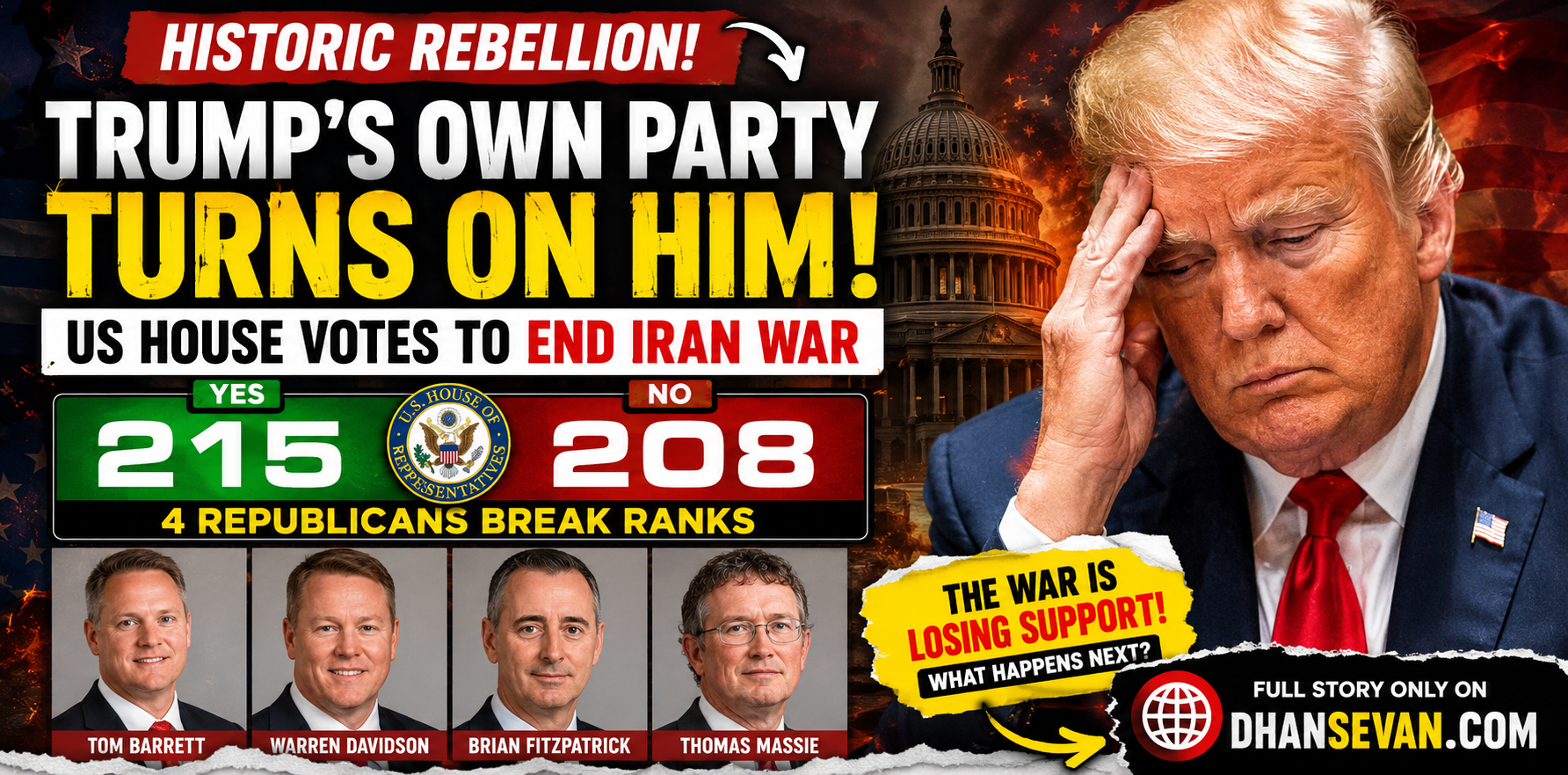
On Wednesday, June 3, 2026, the Republican-led US House of Representatives voted 215 to 208 to approve a war powers resolution aimed at blocking President Donald Trump from continuing military operations against Iran. Four Republicans crossed party lines to vote with Democrats, making this the first time either chamber of Congress has successfully passed a resolution challenging the Iran conflict that began three months ago.
The vote is technically symbolic — the resolution would need to pass the Senate as well and then survive what would almost certainly be a presidential veto, requiring two-thirds majorities in both chambers that do not currently exist. But the symbolism itself is the story. A Republican-controlled House just voted against a Republican president's war. That has not happened in modern American history on a conflict of this scale.
For India and the rest of the world, this vote matters because it signals that the political foundations of the Iran war are weakening inside the United States. And if the war's domestic support continues to erode, the trajectory of the conflict — and its consequences for oil markets, global security, and regional stability — could shift dramatically.
The Four Republicans Who Broke Ranks
The most closely watched element of Wednesday's vote was which Republicans would break ranks. In the end, four did:
- **Tom Barrett of Michigan** — a military veteran and first-term representative who has spoken about the limits of executive war powers
- **Warren Davidson of Ohio** — a member of the conservative Freedom Caucus who has consistently advocated for congressional authority over military action
- **Brian Fitzpatrick of Pennsylvania** — a former FBI agent and one of the most prominent moderate Republicans in the House, known for bipartisan positions
- **Thomas Massie of Kentucky** — a libertarian-leaning Republican who has long opposed unchecked presidential war powers and voted against previous military authorisations
Each of these four represents a different strand of Republican opposition. Barrett brings military credibility that makes it harder to dismiss the vote as anti-patriotic. Davidson represents the constitutional conservative wing that believes Congress, not the president, holds the power to declare war. Fitzpatrick represents the pragmatic moderate wing that worries about electoral consequences in swing districts. And Massie represents the libertarian tradition that has always been sceptical of foreign military entanglements.
Together, they represent a cross-section of Republican dissent that is broader than any single faction. That is what makes this vote significant: the opposition is not coming from one ideological corner. It is coming from multiple directions simultaneously.
No Democrats voted against the resolution. Seven House members did not vote.
Why This Vote Is Different From the Previous Three
This was not the first attempt to pass a war powers resolution against the Iran conflict. Three previous resolutions had failed in the House — but each time by increasingly slim margins. The trajectory tells the story:
- **First attempt** — failed by a comfortable margin, with almost all Republicans voting against
- **Second attempt** — failed by a narrower margin, with one Republican crossing over
- **Third attempt** — failed by an even slimmer margin, with two Republicans breaking ranks
- **Fourth attempt (June 3)** — passed 215-208, with four Republicans voting in favour
This pattern of eroding support is exactly what opponents of the war needed. Each vote that failed by a smaller margin demonstrated growing unease and made it politically safer for the next Republican to cross the line. By the fourth attempt, the dam broke.
The Senate has followed a similar trajectory. A separate war powers resolution in the Senate advanced through a procedural vote last month, after seven previous attempts had failed. The Senate and House are now converging toward the same conclusion: there is no longer a stable congressional majority supporting the Iran war without conditions.
What Is the War Powers Resolution?
A war powers resolution is a congressional tool rooted in the War Powers Act of 1973, which was passed in the aftermath of the Vietnam War. The act was designed to prevent presidents from unilaterally committing US forces to prolonged military conflicts without congressional approval.
Under the War Powers Act, the president can deploy military forces in response to an emergency but must notify Congress within 48 hours and withdraw forces within 60 days unless Congress authorises continued action. A war powers resolution is Congress's mechanism for asserting that the president has exceeded this authority and demanding withdrawal.
In the case of the Iran war, the central argument is that the conflict has continued for three months without a formal congressional authorisation of military force. The administration has relied on existing authorisations and executive authority claims to justify the operations, but critics argue these legal foundations are insufficient for a conflict of this scale and duration.
The resolution itself does not immediately stop the war. It is a statement of congressional will. To become binding, it would need to pass both chambers and survive a presidential veto. Given that Trump would almost certainly veto any such resolution, it would require two-thirds majorities in both the House and Senate to override — a threshold that currently appears out of reach.
But the political damage of a veto should not be underestimated. A president vetoing a bipartisan vote to end a war — a war started without explicit congressional authorisation — creates a powerful campaign narrative that opponents will exploit relentlessly.
The Iran War: Three Months and Counting
The US-Iran conflict began approximately three months ago and has escalated through multiple phases. What started as targeted strikes expanded into sustained military operations across multiple theatres. The war has drawn in regional actors, disrupted global energy markets, and created a humanitarian crisis that has drawn international criticism.
For India, the Iran war has been particularly consequential. India has historically been one of Iran's largest oil customers, and the conflict has disrupted supply routes and driven crude oil prices sharply higher. With India importing approximately 85% of its crude oil needs, every sustained price increase directly impacts inflation, the trade deficit, and the rupee's value.
The war has also complicated India's diplomatic position. India has maintained a careful balance in its relationships with both the US and Iran, and the conflict forces difficult choices about alignment, energy security, and regional stability. A vote by the US House to end the war — even a symbolic one — offers India a potential diplomatic opening if the conflict moves toward negotiation.
The Broader Republican Rebellion Against Trump
The Iran war vote did not happen in isolation. It is part of a pattern of growing Republican pushback against Trump that has accelerated in recent weeks:
Ukraine Aid Vote
On the same day as the Iran war vote, the House also voted to advance a measure providing security aid to Ukraine and imposing new sanctions on Russia. This vote succeeded after a petition reached the 218-signature threshold needed to force a floor vote — a procedural mechanism that bypasses House leadership, which had been blocking the measure.
Six Republicans and one independent who normally votes with Republicans supported the advancement. The Ukraine aid vote is significant because it directly contradicts Trump's stated preference for reducing US involvement in the Ukraine conflict and his resistance to additional sanctions on Russia.
The Political Allies Fund Collapse
On Tuesday, Acting Attorney General Todd Blanche told lawmakers that the administration was abandoning a controversial fund designed to pay political allies who claimed they had been subjects of government abuse. The fund had drawn criticism from Republicans who saw it as a misuse of government resources, and the administration's decision to scrap it came only after Republican opposition made it politically untenable.
The Bill Pulte Intelligence Controversy
Republican lawmakers on Wednesday also publicly criticised Trump's appointment of Bill Pulte — a mortgage regulator with no national security experience — to serve as acting Director of National Intelligence. The criticism is notable because intelligence appointments are typically supported by the president's party. Open Republican opposition to a national security appointment signals a level of dissatisfaction that goes beyond policy disagreements.
What the Pattern Means
Taken together, these events suggest that Trump's grip on congressional Republicans is loosening. For the first two years of his current term, Republican lawmakers almost uniformly supported his agenda, and the few dissenters paid political prices. But the Iran war — with its mounting costs, unclear objectives, and growing public opposition — appears to have created a permission structure for broader dissent.
When Republicans feel safe enough to vote against the president on war, Ukraine, spending, and intelligence appointments all in the same week, the political dynamics have shifted meaningfully. This does not mean Trump has lost control of his party. It means the unconditional support he once enjoyed is now conditional — and the conditions are tightening.
What Does This Mean for the War?
The immediate practical impact of the House vote is limited. The resolution faces significant hurdles in the Senate, and a presidential veto is virtually certain. The two-thirds majority needed to override a veto is not currently achievable in either chamber.
However, the vote creates several longer-term consequences:
- **Political pressure** — Every additional day the war continues, the administration will face questions about why it is persisting with a conflict that even members of the president's own party voted to end
- **Electoral implications** — The four Republicans who voted for the resolution represent districts where the war's popularity is declining. Other Republicans in competitive districts may face similar pressure as the 2026 midterm elections approach
- **Negotiation leverage** — The vote gives diplomatic actors — including potential mediators like India, Turkey, or the EU — evidence that domestic American support for the war is fragile, which could strengthen negotiation positions
- **Military funding** — While the war powers resolution does not cut funding, it creates a political environment where future military appropriations for the conflict face tougher scrutiny
- **Precedent** — The successful passage of a war powers resolution, even if ultimately vetoed, establishes a congressional record that can be cited in legal challenges to the war's authorisation
The Senate's Next Move
Attention now shifts to the Senate, where a separate war powers resolution advanced through a procedural vote last month. The Senate version faces its own political dynamics. Several Republican senators have expressed private concerns about the war but have been reluctant to vote publicly against the president.
The House vote changes the calculus. When the Republican-controlled House passes a war powers resolution, it becomes politically easier for Republican senators to follow. The argument is no longer "I'm the only one opposing the president" — it is "I'm joining a bipartisan consensus that includes members of the president's own party in the House."
Key senators to watch include those from states with significant military populations, those facing re-election in 2028, and those with strong libertarian or constitutionalist leanings. If the Senate also passes a war powers resolution, the combined political pressure — even without overriding a veto — could become a defining issue of the 2026 midterm campaigns.
What This Means for India
For India, the US House vote carries several important implications:
Oil Markets
Any sign that the Iran war may be moving toward negotiation or de-escalation is positive for oil markets. India's crude oil import bill has surged since the conflict began, contributing to inflation and fiscal pressure. If the political dynamics in Washington create space for diplomatic engagement with Iran, even indirectly, oil prices could stabilise.
Diplomatic Positioning
India has maintained a balancing act between its strategic partnership with the US and its historical relationship with Iran. A weakening of domestic American support for the war gives India more room to advocate for diplomatic solutions without appearing to oppose its most important strategic partner.
Regional Security
The Iran war has destabilised the broader Middle East, a region where India has massive economic interests — including the diaspora of over 8 million Indian workers in Gulf countries, energy imports, and trade routes. Any political development that moves the conflict toward resolution reduces risks to Indian interests in the region.
Defence and Strategic Calculations
If the US becomes more constrained in its ability to pursue unilateral military operations — whether through congressional opposition, legal challenges, or public pressure — it may seek greater coalition support from partners like India. This could accelerate defence cooperation discussions but also create pressure on India to take more visible positions on the conflict.
Trump's Response and the Veto Question
President Trump has not yet formally responded to the House vote, but his administration has consistently maintained that the Iran operations are legal under existing authorisations and that the president has constitutional authority as commander-in-chief to conduct military operations necessary for national security.
If the Senate also passes a war powers resolution, Trump will face a choice: veto the resolution and own the political consequences, or allow it to become effective and accept congressional constraints on the conflict. Given his track record, a veto is almost certain. But the act of vetoing a bipartisan resolution to end a war — signed by members of his own party — creates a political vulnerability that did not exist before Wednesday's vote.
The veto question also has legal implications. If Congress passes a war powers resolution and the president vetoes it, the resolution becomes part of the legislative record. Future legal challenges to the war's authorisation can cite the congressional vote as evidence that the conflict does not have legislative support, strengthening arguments that the president is operating beyond his constitutional authority.
The Bigger Question: Is the Iran War Politically Sustainable?
Wednesday's vote forces a fundamental question that will define the second half of 2026: can Donald Trump sustain a war that his own party is voting against?
History suggests that wars without stable domestic support eventually end. The Vietnam War, the Iraq War, and the Afghanistan withdrawal all followed patterns where initial public and congressional support eroded over time until the political cost of continuing exceeded the cost of withdrawal. The Iran war appears to be following a similar trajectory, but at an accelerated pace.
Three months into the conflict, a Republican-controlled chamber has already voted to end it. That is faster than the congressional opposition timelines for Vietnam, Iraq, or Afghanistan. Whether this acceleration reflects the unique characteristics of the Iran conflict, broader war fatigue in American society, or Trump's declining political capital is an open question — but the direction is clear.
For now, the war continues. But Wednesday's vote means it continues under a political shadow that will only deepen with each passing week. The next milestones to watch are the Senate vote, the administration's response, and whether the four Republican dissenters become four, or become fourteen.
Frequently Asked Questions
Did the US House vote to end the Iran war?Yes. On June 3, 2026, the House voted 215-208 to approve a war powers resolution blocking President Trump from continuing the Iran conflict. Four Republicans voted with Democrats in favour of the resolution.Which Republicans voted against Trump on the Iran war?Four Republicans broke ranks: Tom Barrett of Michigan, Warren Davidson of Ohio, Brian Fitzpatrick of Pennsylvania, and Thomas Massie of Kentucky. Each represents a different strand of Republican dissent.Does this vote actually stop the war?Not immediately. The resolution must also pass the Senate and survive a presidential veto, which would require two-thirds majorities in both chambers. The vote is politically significant but not yet legally binding.How many times has Congress voted on the Iran war?This was the fourth attempt in the House. The previous three failed by increasingly slim margins. The Senate advanced a similar resolution through a procedural vote last month after seven failed attempts.What other votes went against Trump on the same day?The House also advanced a measure for Ukraine security aid and Russia sanctions. The administration abandoned a controversial political allies fund after Republican opposition. And Republican lawmakers criticised Trump's pick for acting intelligence director.How does this affect India?The vote is positive for India's interests: it signals potential de-escalation that could stabilise oil prices, gives India more diplomatic room, and reduces risks to Indian workers and interests in the Gulf region.Will Trump veto the resolution?Almost certainly yes. But vetoing a bipartisan resolution from a Republican-controlled chamber to end a war creates a significant political vulnerability, especially heading into the 2026 midterm elections.
About the Author
Uday Jasani
The Dhansevan editorial team consists of passionate gamers and tech enthusiasts who test and review every game before publishing. Our writers bring first-hand gaming experience and follow strict editorial standards to ensure accurate, helpful content for our readers.
Disclaimer: This article is for informational purposes only. Game features, availability, and earning potential may vary. Always download games from official sources and read their terms of service. Dhansevan does not guarantee any specific results from using the apps mentioned above.