
58 of 80 MLAs Revolt: Mamata's Trinamool Implodes in One Day — All Committees Dissolved, Expelled MLA Becomes LoP, Signature Forgery Probe Underway
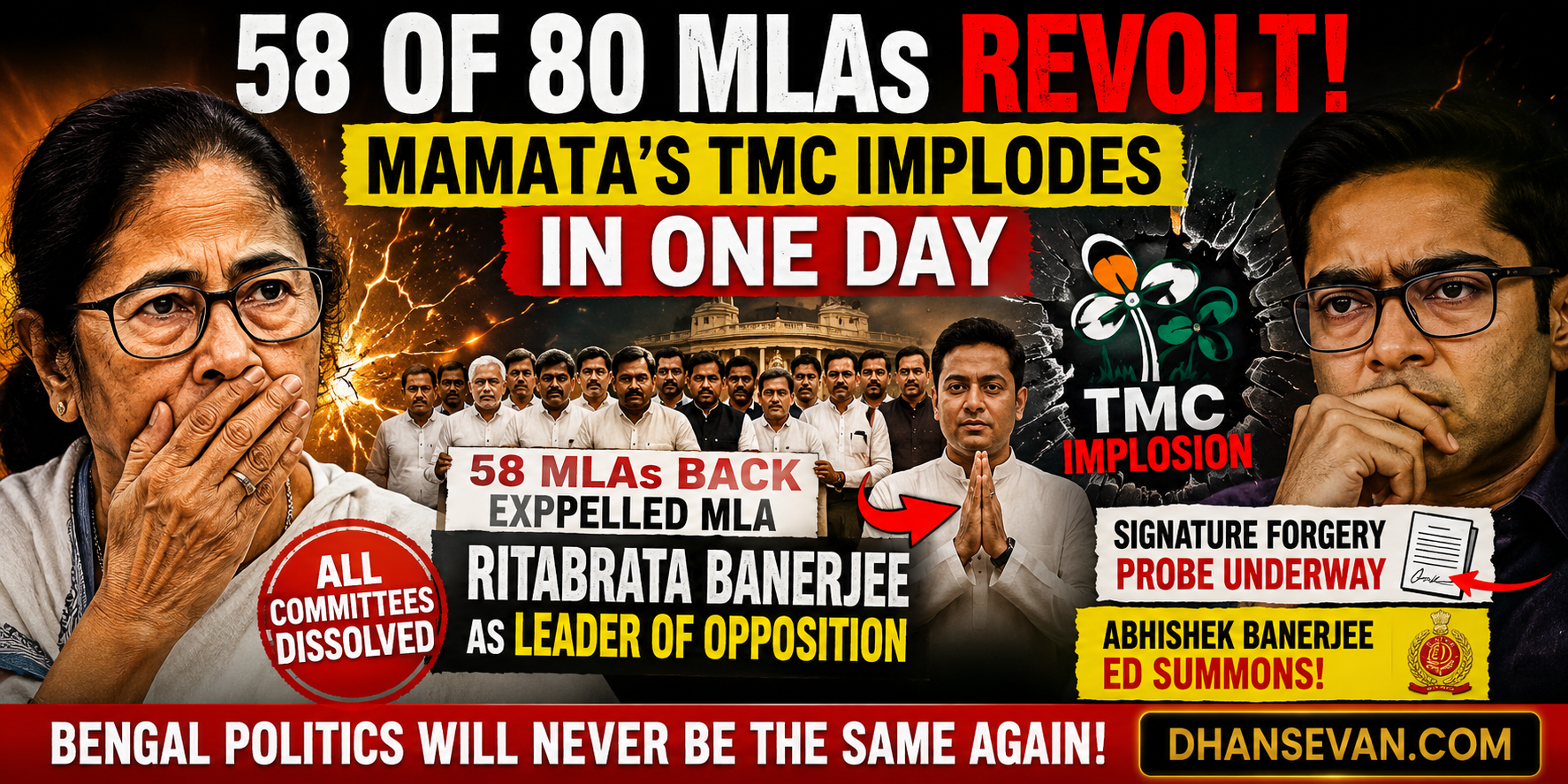
In the most dramatic political implosion in recent Indian history, 58 of Trinamool Congress's 80 MLAs have rebelled against Mamata Banerjee, backing expelled MLA Ritabrata Banerjee as Leader of Opposition. The TMC has dissolved ALL party committees. A signature forgery probe is underway. Abhishek Banerjee faces an ED summons. Here is how a party that ruled Bengal for 15 years disintegrated in a single afternoon.
Uday Jasani
Gaming Expert · Dhansevan Editorial Team
A Party That Ruled Bengal for 15 Years Just Blew Itself Up in One Afternoon
On the afternoon of June 3, 2026, the All India Trinamool Congress — the party that had governed West Bengal unchallenged since 2011, that had survived BJP's most aggressive national campaign to unseat it, that had built a political machine so dominant it was considered unassailable — dissolved all its committees with immediate effect. Every party committee. Every frontal organisation. Gone. In a single post on X.
The dissolution came within an hour of the real bombshell: 58 of the TMC's 80 elected MLAs had walked into the Bengal Assembly Speaker's office and submitted letters backing expelled MLA Ritabrata Banerjee as Leader of Opposition. Not the candidate chosen by Mamata Banerjee. Not the candidate endorsed by her nephew Abhishek Banerjee. An expelled MLA. Backed by nearly three-quarters of the party's legislators.
In Indian political history, parties have split. Factions have rebelled. Leaders have been challenged. But what happened to the Trinamool Congress on June 3 is something different in both speed and scale. A party that won 80 seats just one month ago has, in the space of 30 days, lost power, lost its MLAs, dissolved its own organisational structure, and is now fighting a CID probe into alleged signature forgery in its own internal communications. This is not a crisis. This is an implosion.
The Numbers That Tell the Story
The arithmetic of the TMC rebellion is devastating for Mamata Banerjee:
- **Total TMC MLAs:** 80
- **MLAs who backed the rebel LoP candidate:** 58
- **MLAs who remain with the official party leadership:** approximately 22
- **Percentage of party legislators in revolt:** 72.5%
When nearly three out of every four elected legislators of a party reject the leadership's chosen candidate for a legislative post, the leadership's authority is not merely challenged — it is effectively nullified. Mamata Banerjee and Abhishek Banerjee may still hold the party's organisational titles, but they have lost the allegiance of the people the party elected.
This is not a faction breaking away. This is the main body of the party walking out while the leadership stays behind in an empty room.
Who Is Ritabrata Banerjee — And How Did He Go From Expelled to LoP?
Ritabrata Banerjee is a first-time MLA who headed the TMC's trade union wing until his expulsion. On Monday, June 1, the TMC expelled Ritabrata Banerjee and fellow debut MLA Sandipan Saha for what the party called "anti-party activities." Two days later, those same expelled leaders had the backing of 58 of the party's 80 MLAs.
The speed of this reversal is extraordinary. Expulsion from an Indian political party is typically a political death sentence — the expelled leader loses access to party infrastructure, funding, and the goodwill of fellow legislators. For Ritabrata Banerjee, expulsion had the opposite effect. It liberated him from the constraints of party discipline and positioned him as the rallying point for legislators who had been privately chafing under the Banerjee family's control but lacked a focal point for their discontent.
The rebel MLAs did not just endorse Ritabrata as LoP. They also endorsed three deputy leaders of opposition — expelled MLA Sandipan Saha, Siuli Saha, and Javed Khan — and appointed Raghunathganj MLA Akhruzzaman as their chief whip. This is not a spontaneous protest. It is an organised parallel leadership structure that mirrors the official party positions, suggesting weeks or months of behind-the-scenes coordination.
The Official Party's Counter-Move — And Why It May Not Work
The TMC leadership's response came through national general secretary Abhishek Banerjee, who shot off a letter to Assembly Speaker Rathindra Bose reiterating the party's decision to appoint Sobhandeb Chattopadhyay as LoP, with Ashima Patra and Nayana Bandyopadhyay as deputy LoPs and Firhad Hakim as chief whip.
But the delivery of this letter became its own humiliation. Two TMC MLAs — Kunal Ghosh and Ashima Patra — attempted to hand-deliver the letter to the Speaker on Tuesday. They alleged that in the Speaker's absence, his office secretary refused to accept it, stating he was "under verbal instructions not to receive any letters from the TMC."
Ghosh said he left the letter on the Speaker's table and subsequently emailed and registered-posted it. A party that once controlled every lever of state power in Bengal is now reduced to leaving letters on desks and hoping they are read.
The legal argument the loyalists are making is that individual MLAs do not have the authority to nominate an LoP — only the party can do so through its official communication. "Under rules, who submitted this letter on behalf of the AITC, the party? The MLAs have no authority to do so," a senior leader told PTI. But this argument has a fundamental weakness: if 58 of 80 MLAs say they want a different leader, the Speaker may well conclude that the majority of the legislative party has spoken, regardless of what the party's official letterhead says.
The Signature Forgery Probe: The Scandal Within the Scandal
Underlying the LoP battle is an even more explosive allegation. A CID probe is underway into an alleged signature forgery case. On May 27, Ritabrata Banerjee and Sandipan Saha informed the Speaker that no resolution regarding the selection of the LoP had been adopted at the party's May 6 meeting — contradicting the claim made in the party's official communication to the Speaker.
If this allegation is substantiated, it would mean that the TMC leadership fabricated or misrepresented the decisions of its own legislative party meeting to install their preferred LoP candidate. This is not merely an internal party dispute — it is potentially a criminal matter involving forged communications to a constitutional authority.
The CID probe adds a legal dimension to what was already a political crisis. If evidence of forgery emerges, it could strengthen the rebel MLAs' position and further undermine the authority of Mamata and Abhishek Banerjee to speak on behalf of the party's legislators.
Why TMC Dissolved All Committees
The TMC's decision to dissolve all party committees and frontal organisations is being presented as a "comprehensive exercise of introspection, performance review and organisational assessment." The party statement said the organisational structure would be "reconstituted and announced in due course."
The real purpose is different. By dissolving all committees, the leadership is attempting to strip rebel leaders of any organisational positions they hold, remove the infrastructure that the rebels might use to further consolidate their faction, and create a blank slate from which Mamata Banerjee can attempt to rebuild the party around loyalists.
It is a scorched-earth tactic. If you cannot control the existing structure, destroy it and start over. The gamble is that Mamata Banerjee's personal brand and political skills are strong enough to attract new cadres and rebuild the party from scratch. Given that she built the TMC from nothing once before — breaking away from the Congress in 1998 and building it into Bengal's dominant party — this is not an impossible bet. But she did it over 13 years, not overnight. And she did it as a rising challenger, not as a leader whose party just lost power and whose legislators are in open revolt.
The Mamata vs Abhishek Question
The TMC implosion cannot be understood without examining the role of Abhishek Banerjee, Mamata's nephew and the party's national general secretary. Multiple reports and rebel MLA statements suggest that resentment towards Abhishek is a primary driver of the revolt.
The accusations against Abhishek, as articulated by various rebel leaders and former MLAs, include:
- **Autocratic decision-making** — Rebel MLAs allege that Abhishek concentrated power around himself and a small coterie, sidelining senior leaders and local elected representatives
- **Electoral interference** — Former TMC MLA Gias Uddin Molla has lodged a case against Abhishek, blaming him for the election debacle and alleging that police officers loyal to Abhishek took "unwarranted punitive action" against party workers who resisted his control
- **ED summons** — Abhishek Banerjee has been summoned by the Enforcement Directorate in a primary school recruitment case on June 15, adding legal pressure to political turmoil
The Mamata-Abhishek dynamic presents a classic succession crisis. Mamata built the party and remains its most recognisable face. Abhishek was positioned as her eventual successor and given increasing operational control. But the transition appears to have alienated the party's grassroots leaders and elected representatives, who felt that they were being managed by someone who had not earned their loyalty through years of political struggle.
Whether Mamata can save the party by distancing herself from Abhishek's decisions, or whether the two are now politically inseparable and must rise or fall together, is the central strategic question facing the TMC.
The Electoral Backdrop: How TMC Lost Bengal
The implosion becomes comprehensible when placed in its electoral context. Just one month ago, the TMC was voted out of power in West Bengal after 15 years of uninterrupted rule. The party that won a commanding majority in 2021 was reduced to 80 seats — still a significant number, but not enough to prevent the BJP from forming the government.
The election loss shattered the party's aura of invincibility. For 15 years, the TMC operated on the assumption that Bengal was its permanent fortress. Leaders, workers, and allied interests all operated within that assumption. When the fortress fell, the incentive structure that held the party together collapsed with it.
In power, the cost of dissent was high — rebel leaders lost access to government patronage, contracts, and protection. Out of power, the cost of loyalty is high — loyal leaders are now associated with a losing brand, face potential legal action from a new government, and have no patronage to distribute. The calculus has flipped, and the results are visible in the 58-to-22 split.
The Domino Effect: Resignations, Arrests, and Defections
The LoP revolt is not the only front on which the TMC is haemorrhaging. Multiple simultaneous crises are accelerating the collapse:
- **Mass resignations** — Elected representatives in zilla parishads, municipal corporations, and municipalities have been resigning en masse
- **Arrests** — Several TMC leaders and representatives have been arrested in pending criminal cases that were dormant during the party's time in power but are now being activated by the new government
- **Absence from meetings** — A number of party leaders have stayed away from key internal meetings, signalling disengagement
- **Firhad Hakim's mayoral exit** — Firhad Hakim, the Kolkata Municipal Corporation Mayor and a powerful TMC leader, has resigned from the position, further fragmenting the party's institutional presence
- **Ganguly security downgrade** — Even tangentially associated figures are feeling the effects: Sourav Ganguly's security cover has been downgraded from Z to Y category
Each of these events individually would be manageable for a functional party organisation. Together, they create a cascading failure where each departure encourages the next, each arrest intimidates fence-sitters into switching sides, and each absence from meetings signals that the party is no longer worth attending.
Can Mamata Rise Like a Phoenix?
Mamata Banerjee has defied political obituaries before. She survived decades in the wilderness before toppling the Left Front in 2011. She survived the BJP's most aggressive campaign in 2021. She survived internal challenges, corruption allegations, and the Saradha and Narada scandals.
Her political instincts, her connection with Bengal's rural and urban poor, and her personal brand as a fighter against the powerful are genuine assets. The TMC's announcement that it will "introspect and build the organisation afresh" echoes previous moments when Mamata has used a crisis to purge dissenters and emerge stronger.
But this time is different in several critical ways:
- **She is out of power** — Previous crises were managed from the Chief Minister's office, with access to government resources, police cooperation, and institutional levers. None of those are available now.
- **The scale of revolt is unprecedented** — Previous challenges involved individual leaders or small factions. Seventy-two percent of the legislative party is not a faction. It is the party.
- **Legal pressures are mounting** — The ED summons to Abhishek, the CID signature forgery probe, and the activation of dormant criminal cases create legal constraints that did not exist during previous crises.
- **The BJP controls the state machinery** — The new government has every incentive to encourage TMC defections, facilitate arrests, and create conditions that accelerate the party's collapse.
Mamata and Abhishek Banerjee will travel to Delhi next week for an INDIA bloc meeting to discuss the monsoon session of Parliament and a potential nationwide movement against the BJP. The irony of discussing a national Opposition strategy while your own party disintegrates at home will not be lost on political observers.
What Happens Next
The immediate question is whether the Speaker recognises Ritabrata Banerjee or Sobhandeb Chattopadhyay as LoP. This decision will have enormous consequences:
- If the Speaker recognises Ritabrata, it effectively legitimises the rebel faction as the "real TMC" in the legislature, marginalising Mamata and Abhishek's authority
- If the Speaker recognises Sobhandeb, the rebels may form a separate legislative group or even a new party, formalising the split
- Either outcome accelerates the TMC's fragmentation
Beyond the LoP question, the broader trajectory is clear. The TMC is in a death spiral that can only be arrested by either Mamata Banerjee making dramatic concessions to the rebel faction — which would mean accepting a diminished role for Abhishek — or by the rebels overplaying their hand and giving Mamata a rallying cause.
For now, the party that dominated Bengal for a decade and a half is reduced to posting dissolution notices on social media, leaving letters on desks that no one will accept, and watching its own MLAs walk away. The speed of the collapse is breathtaking. The consequences will reshape Bengal's politics for years.
Frequently Asked Questions
How many TMC MLAs have revolted against Mamata Banerjee?Fifty-eight of the TMC's 80 MLAs have backed expelled MLA Ritabrata Banerjee as Leader of Opposition, going against the official party line. This represents 72.5% of the party's elected legislators.Who is Ritabrata Banerjee?Ritabrata Banerjee is a first-time MLA who headed the TMC's trade union wing. He was expelled from the party on June 1, 2026, for anti-party activities. Two days later, 58 MLAs endorsed him as LoP.Why did TMC dissolve all its committees?The TMC dissolved all party committees and frontal organisations to strip rebels of organisational positions and attempt to rebuild the party around loyalists. The party said it would undertake introspection and reconstitute the structure later.What is the signature forgery probe about?A CID investigation is examining allegations that the TMC's official communication to the Assembly Speaker about LoP selection misrepresented the decisions of the party's May 6 legislative meeting, potentially involving forged or fabricated resolutions.Has Abhishek Banerjee been summoned by the ED?Yes, the Enforcement Directorate has summoned Abhishek Banerjee in a primary school recruitment case, with the appearance date set for June 15, 2026.When did TMC lose power in Bengal?The TMC was voted out of power approximately one month before the current crisis, in the 2026 West Bengal Assembly elections. The party won 80 seats but was unable to prevent the BJP from forming the government.Can Mamata Banerjee save the TMC?Mamata has survived political crises before, but this time she lacks access to government resources, faces an unprecedented 72.5% legislative revolt, mounting legal pressures, and a new BJP-controlled state machinery that has every incentive to accelerate the TMC's collapse.
About the Author
Uday Jasani
The Dhansevan editorial team consists of passionate gamers and tech enthusiasts who test and review every game before publishing. Our writers bring first-hand gaming experience and follow strict editorial standards to ensure accurate, helpful content for our readers.
Disclaimer: This article is for informational purposes only. Game features, availability, and earning potential may vary. Always download games from official sources and read their terms of service. Dhansevan does not guarantee any specific results from using the apps mentioned above.