
4 Dead as Fire Rips Through Bihar Hospital ICU at 4 AM — One Day After Delhi Fire Killed 21: India's Fire Safety Nightmare Continues
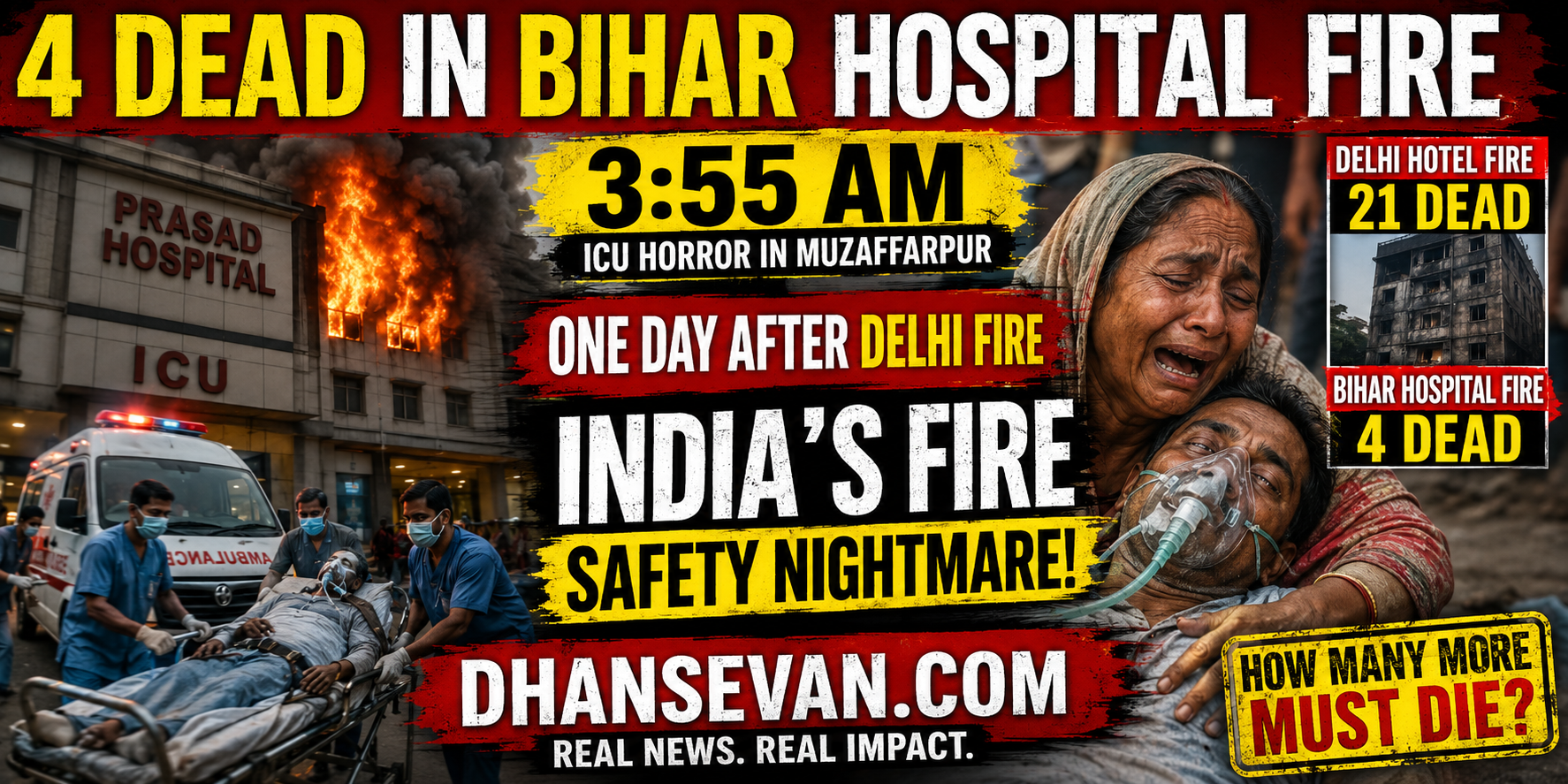
Just 24 hours after the Malviya Nagar hotel fire killed 21 people in Delhi, another devastating blaze erupted in the ICU of Prasad Hospital in Muzaffarpur, Bihar, at 3:55 AM — killing at least 4 patients who were on ventilators and life support. Preliminary reports point to a short circuit. Here is the full story, the horrifying pattern of hospital fires in India, and why the country's fire safety infrastructure is fundamentally broken.
Uday Jasani
Gaming Expert · Dhansevan Editorial Team
While India Was Still Counting Bodies From Delhi, Another Fire Killed Patients in Their Hospital Beds
At 3:55 AM on June 4, 2026 — barely 19 hours after rescue operations concluded at the Malviya Nagar hotel fire that killed 21 people in Delhi — a fire erupted in the Intensive Care Unit on the fifth floor of Prasad Hospital in Muzaffarpur, Bihar. At least four patients were killed. Around 20 others were evacuated from the ICU. The remaining patients have been transferred to nearby hospitals. The death toll is expected to rise.
The patients who died were among the most vulnerable people imaginable. They were ICU patients — critically ill, connected to ventilators, monitors, and IV lines, incapable of evacuating themselves. When fire engulfed the unit where they lay, they could not get up, could not run, could not even call for help in many cases. They were entirely dependent on the hospital's fire safety systems, its staff's emergency response, and the structural integrity of the building. All of these appear to have failed.
Two patients died on the spot. Two more died during or after evacuation. Preliminary reports suggest a short circuit caused the fire — the same mundane, preventable cause that has been behind countless fire tragedies across India. An electrical failure. In a hospital ICU. Where oxygen lines, volatile medical equipment, and immobile patients create the most dangerous possible combination.
What Happened at Prasad Hospital
Prasad Hospital is a private healthcare facility in Muzaffarpur district, Bihar. The fire broke out on the fifth floor, specifically in the ICU ward. At the time of the fire, approximately 13 patients were in the ICU and a few others were admitted in the CCU (Cardiac Care Unit).
The fire department received an emergency call at 3:55 AM and dispatched a team immediately. Ram Niwas Pandey, a fire department official in Muzaffarpur, provided the initial account: "We rescued 15-20 patients from the ICU of which two died on the spot. The other patients have been moved to nearby hospitals. We don't have an update on their health condition."
District Magistrate Subrat Kumar Sen confirmed the patient numbers and said: "Around 13 patients were there in ICU and few others were admitted to the CCU. Appropriate action will be taken based on the investigation."
The phrase "appropriate action will be taken based on the investigation" has become the standard bureaucratic response to fire tragedies in India. It is uttered after every incident, promises accountability that rarely materialises, and is forgotten by the time the next fire kills the next group of people who should have been protected by the systems that repeatedly fail them.
Why Hospital ICU Fires Are Especially Deadly
A fire in a hospital ICU is qualitatively different from a fire in a hotel, factory, or commercial building. The reasons are both medical and structural:
Immobile Patients
ICU patients are, by definition, critically ill. Many are sedated. Many are on mechanical ventilators that breathe for them. Many are connected to multiple monitoring devices, IV drips, and drainage systems. Evacuating an ICU patient is not like evacuating a hotel guest — you cannot simply tell them to walk out. Each patient requires disconnection from equipment, manual transport on a stretcher or bed, and continued medical support during and after evacuation. In a fire emergency, with smoke filling the ward and minutes deciding the difference between life and death, this process is agonisingly slow.
Oxygen-Rich Environment
ICUs use significant amounts of medical oxygen — for ventilators, oxygen concentrators, and supplemental oxygen delivery. Oxygen is not flammable itself, but it dramatically accelerates combustion. A fire in an oxygen-rich environment burns faster, hotter, and more intensely than the same fire in a normal atmosphere. This means that a small electrical fire that might be containable in an office or hotel room can become an inferno within seconds in an ICU.
Electrical Load
ICUs have among the highest electrical loads of any hospital ward. Ventilators, monitors, infusion pumps, defibrillators, suction machines, bed controls, and lighting all draw power continuously. This concentrated electrical demand increases the risk of short circuits, overloaded wiring, and equipment malfunction — all potential fire ignition sources.
Flammable Materials
Hospital environments contain numerous flammable materials: bedding, curtains, disposable medical supplies, alcohol-based sanitisers, and certain medications. In an ICU, these materials are concentrated in a small space around patients who cannot move away from them.
Smoke Inhalation Risk
For patients already on respiratory support, smoke inhalation is immediately life-threatening. Their compromised respiratory systems have no reserve capacity to handle toxic fumes. Even patients who survive the fire itself may die from smoke inhalation injuries within hours or days.
The Pattern: Delhi on Tuesday, Bihar on Wednesday
The Muzaffarpur hospital fire occurred less than 24 hours after the Malviya Nagar hotel fire in Delhi. The juxtaposition is devastating:
FactorDelhi (June 3)Bihar (June 4)LocationFlourish Stay B&B, Malviya NagarPrasad Hospital ICU, MuzaffarpurDeaths214 (expected to rise)VictimsHotel guests, including 11 foreignersICU patients on life supportSuspected causeUnder investigationShort circuit (preliminary)Safety violationsNo fire NOC, sealed windows, single exitUnder investigationTime of fire~8:30 AM~3:55 AM
Two fires in two days. Twenty-five dead and counting. Both in buildings where vulnerable people — sleeping tourists and critically ill patients — were entirely dependent on safety systems that did not exist or did not work.
This is not coincidence. This is a systemic failure playing out in real time across different states, different building types, and different regulatory frameworks. The common thread is not the specific cause of each fire. It is the universal absence of functioning fire safety infrastructure in buildings across India.
India's Hospital Fire History: A Catalogue of Preventable Deaths
The Muzaffarpur fire is the latest in a long and shameful history of hospital fires in India:
- **AMRI Hospital, Kolkata (2011)** — 93 patients died in one of India's worst hospital fire tragedies. The fire broke out in the basement and smoke spread through the building. Staff abandoned patients. The hospital's fire safety systems were found to be grossly inadequate.
- **Bhandara District Hospital, Maharashtra (2021)** — 10 newborn babies died in a fire in the Special Newborn Care Unit. A short circuit in a radiant warmer was identified as the cause.
- **Welfare Hospital, Bharuch, Gujarat (2021)** — 18 COVID patients died in a fire in the ICU. The hospital was treating critical coronavirus patients when the fire broke out.
- **COVID hospital fires (2020-2021)** — Multiple fires at COVID treatment facilities across India killed dozens of patients during the pandemic, exposing the dangerous conditions in hastily converted hospitals.
Each of these tragedies prompted investigations, arrests, policy announcements, and public outrage. None of them produced lasting systemic change. The same fire safety gaps that killed 93 patients in Kolkata in 2011 are killing patients in Muzaffarpur in 2026.
Why Private Hospitals Are Especially Vulnerable
Prasad Hospital is a private facility, and India's private healthcare sector has specific fire safety vulnerabilities that deserve scrutiny:
- **Building conversions** — Many private hospitals operate in buildings that were originally designed as residential or commercial properties and converted into medical facilities. These conversions often do not include the structural modifications needed for fire safety compliance in a healthcare setting.
- **Cost pressures** — Private hospitals, especially smaller ones in district towns like Muzaffarpur, operate on tight margins. Fire safety infrastructure — sprinklers, alarms, fire-rated doors, emergency generators, dedicated fire exits — represents a significant capital investment that some operators defer or skip entirely.
- **Regulatory gaps** — While government hospitals are subject to public audit and legislative scrutiny, private hospitals often operate with less oversight. Fire safety inspections, where they occur, may be superficial or subject to the same enforcement failures that plague other sectors.
- **Electrical infrastructure** — Older buildings converted into hospitals often have electrical wiring that was not designed for the load that modern medical equipment demands. Upgrading wiring throughout a building is expensive and disruptive, leading some operators to add circuits incrementally without comprehensive rewiring — a recipe for overloading and short circuits.
What the Investigation Must Examine
The investigation into the Prasad Hospital fire must go beyond identifying the immediate cause — the suspected short circuit — and examine the systemic factors:
- **Fire NOC status** — Did the hospital have a valid No Objection Certificate from the fire department? When was it last inspected?
- **Electrical audit history** — When was the hospital's electrical infrastructure last audited? Were there previous reports of wiring issues or overloading?
- **Fire safety equipment** — Were functional fire extinguishers, sprinklers, smoke detectors, and fire alarms present in the ICU? Were staff trained to use them?
- **Evacuation protocol** — Did the hospital have a documented evacuation plan for ICU patients? Was it practised? Were adequate staff present at 3:55 AM to execute it?
- **Building approval** — Was the fifth-floor ICU operating in a space approved for that purpose? Was the building structurally assessed for the load and infrastructure requirements of an ICU?
- **Oxygen safety** — Were oxygen storage and delivery systems compliant with safety standards? Were proper precautions in place to prevent fire in oxygen-rich zones?
The LG's Audit Order — But Only for Delhi
In the aftermath of the Delhi fire on June 3, Lieutenant-Governor Taranjit Singh Sandhu ordered a month-long fire safety compliance drive covering all hotels, nursing homes, coaching institutes, and restaurants in Delhi. The order was significant in scope and intent.
But it applies only to Delhi. The Muzaffarpur fire — occurring in a completely different state, under a completely different administrative framework — demonstrates that the problem is national, not local. A fire safety audit in Delhi does nothing for hospitals in Bihar, hotels in Gujarat, or factories in Tamil Nadu.
What India needs is not a city-specific response to city-specific tragedies. It needs a national fire safety enforcement framework that mandates regular inspections, enforces compliance, and holds both building operators and regulatory officials accountable when violations are found. Until that exists, the country will continue to cycle through the same pattern: fire, deaths, outrage, investigation, inaction, and then the next fire.
The Human Cost
The four patients who died at Prasad Hospital in the early hours of June 4 were people who had gone to the hospital to get better. They were sick enough to need ICU care — the highest level of medical attention a hospital provides. They trusted that the hospital would protect them while they were at their most vulnerable. Instead, the hospital became the thing that killed them.
Their families brought them to Prasad Hospital because they believed it would save their lives. Their families will now take them home to be cremated, carrying the knowledge that their loved ones died not from their illness but from a fire that should never have happened in a facility that should never have been allowed to operate an ICU without comprehensive fire safety measures.
Twenty-five people are dead in 24 hours from fires in India — 21 in Delhi and 4 in Bihar. Each one of them was someone's parent, child, sibling, or friend. Each one of them died because the systems that were supposed to protect them did not exist, did not work, or were never enforced. And until those systems are built and maintained, the dying will continue.
Frequently Asked Questions
How many people died in the Bihar hospital fire?At least four patients died after a fire broke out in the ICU on the fifth floor of Prasad Hospital in Muzaffarpur, Bihar, at 3:55 AM on June 4, 2026. The death toll is expected to rise.What caused the Bihar hospital fire?Preliminary reports suggest a short circuit caused the fire. A detailed investigation is underway. District Magistrate Subrat Kumar Sen has said appropriate action will be taken based on the findings.How many patients were rescued?Around 15-20 patients were rescued from the ICU, according to fire department official Ram Niwas Pandey. Two died on the spot and the remaining patients have been transferred to nearby hospitals.Is this connected to the Delhi hotel fire?The two fires are not directly connected, but they occurred within 24 hours of each other, highlighting a systemic failure in fire safety enforcement across India. The Delhi fire killed 21 and the Bihar fire killed at least 4.Why are hospital ICU fires so deadly?ICU patients are critically ill and cannot evacuate themselves. The oxygen-rich environment accelerates combustion. High electrical loads increase short circuit risks. And compromised respiratory systems make smoke inhalation immediately fatal.What action has been taken?An investigation has been ordered by the District Magistrate. In Delhi, the LG ordered a month-long fire safety audit after the Malviya Nagar fire, but no national fire safety enforcement framework exists.Has India had hospital fires before?Yes, India has a long history of hospital fire tragedies, including AMRI Hospital Kolkata (2011, 93 dead), Bhandara District Hospital (2021, 10 newborns dead), and multiple COVID hospital fires that killed dozens of patients.
About the Author
Uday Jasani
The Dhansevan editorial team consists of passionate gamers and tech enthusiasts who test and review every game before publishing. Our writers bring first-hand gaming experience and follow strict editorial standards to ensure accurate, helpful content for our readers.
Disclaimer: This article is for informational purposes only. Game features, availability, and earning potential may vary. Always download games from official sources and read their terms of service. Dhansevan does not guarantee any specific results from using the apps mentioned above.