CBSE Caught Red-Handed: Board Gave Scripts to School Principals to Defend Faulty OSM Marking System While Students Got Wrong Answer Sheets
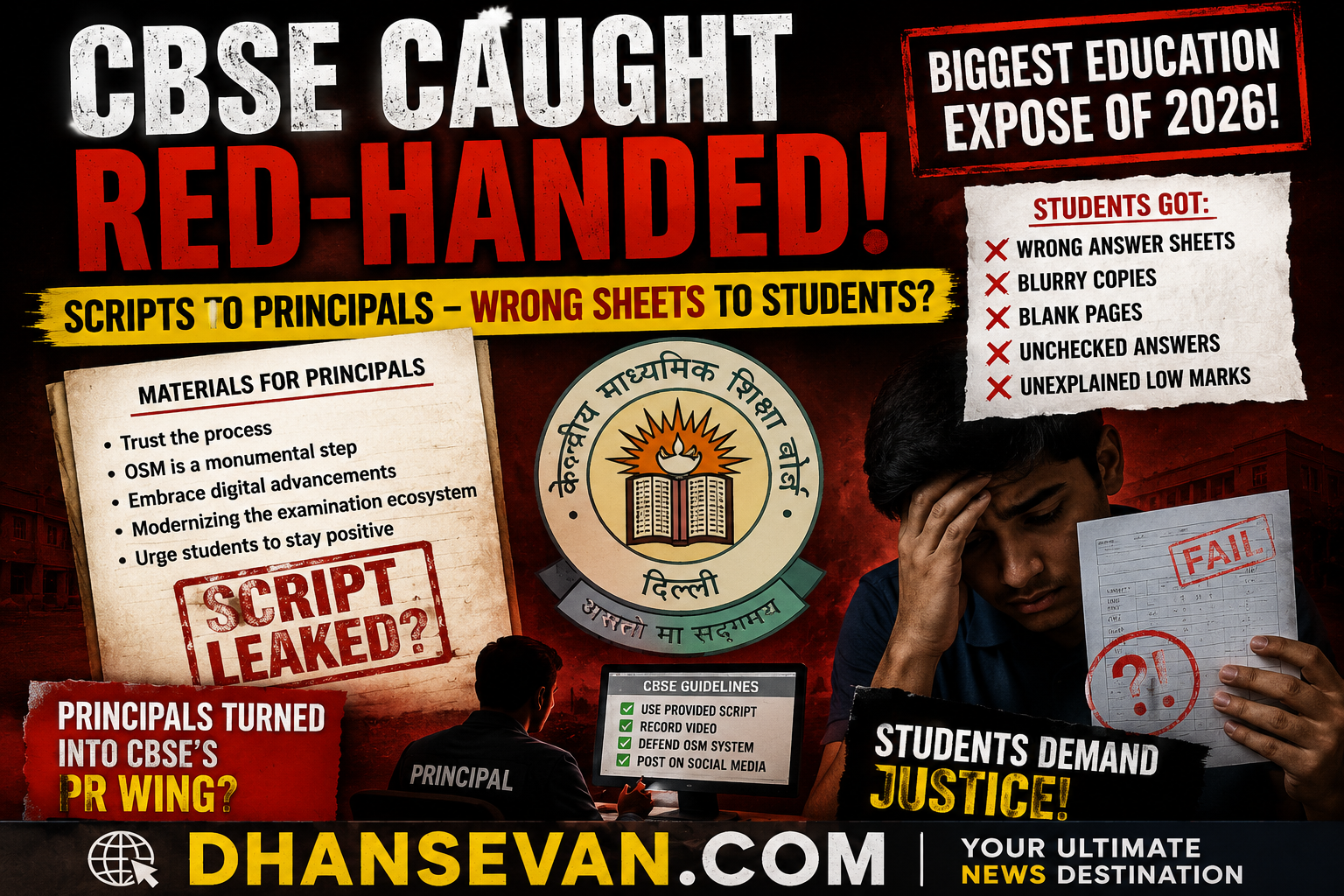
An explosive investigation reveals how CBSE allegedly circulated prepared scripts to school principals across India, turning them into social media defenders of the controversial On-Screen Marking system — while thousands of Class XII students complained of receiving wrong answer sheets, blank pages, unchecked answers and unexplained low marks.
Uday Jasani
Gaming Expert · Dhansevan Editorial Team
CBSE's On-Screen Marking System Under Fire — And the Board's Response Has Made It Worse
For millions of Indian families, CBSE Class XII board results represent one of the most consequential moments in a student's life. College admissions, scholarship opportunities, career trajectories and family aspirations all hinge on a number printed on a mark sheet. So when students across India began reporting serious irregularities in the CBSE's newly introduced On-Screen Marking (OSM) system in 2026, the impact was not merely academic — it was deeply personal.
But instead of transparently addressing mounting student complaints about wrong answer sheets, blank pages, unchecked responses and inexplicable marks drops, CBSE appears to have chosen a different strategy: turning school principals into its social media PR wing.
An investigation by Alt News has revealed a disturbing pattern. Dozens of principals from CBSE-affiliated schools across India uploaded strikingly similar videos — many reading from what appears to be the same script — defending the OSM system and urging students to 'trust the process.' The language, structure and tone were near-identical across schools in different cities. Videos were posted through official school social media accounts. And according to Hindustan Times, a document titled 'Materials for Principals' containing prepared talking points was allegedly circulated to school heads.
This article breaks down what happened, which schools were involved, what students have alleged, and what parents and students should do now.
What Is the CBSE On-Screen Marking (OSM) System?
For the first time in 2026, the Central Board of Secondary Education introduced On-Screen Marking for Class XII board examinations. Under this system, physical answer sheets are no longer sent to examiners' homes or marking centres in bundles. Instead, answer scripts are scanned, uploaded to a centralised digital portal, and evaluated on screen by examiners logging into the CBSE platform.
Marks are entered directly into the system, and the final scores are calculated digitally. CBSE promoted the system as a modernisation effort designed to eliminate manual tabulation errors, reduce the time required for result declaration, and standardise the evaluation process across the country.
On paper, the transition from manual to digital evaluation sounds logical. Many examination boards worldwide have successfully adopted similar systems. However, the scale of CBSE's rollout — approximately 98 lakh (9.8 million) answer sheets digitised in a single examination cycle — made this the largest digital evaluation exercise in Indian education history. And the execution, based on student complaints, appears to have been deeply flawed.
What Are Students Complaining About?
Shortly after the declaration of Class XII results, social media platforms — particularly X (formerly Twitter) — were inundated with complaints from students alleging serious irregularities in the evaluation process. The complaints fell into several categories:
1. Wrong Answer Sheets
Multiple students alleged that when they applied for photocopies of their answer scripts through CBSE's re-evaluation process, the answer sheets they received did not appear to be their own. The handwriting, content and responses did not match what they had written during the examination.
One of the most prominent cases was that of Vedant Srivastava, a Class XII student from Delhi. Srivastava claimed that after receiving unexpectedly low marks in Physics, he applied for photocopies. To his shock, the Physics answer sheet uploaded by CBSE did not appear to be his own handwriting or his answers.
2. Blurry and Partially Missing Scanned Copies
Dozens of students reported that the scanned copies of their answer scripts were blurry, partially missing or displayed entirely blank pages. In a system where examiners evaluate answers on screen, blurry or incomplete scans could directly result in answers being missed or partially marked — with devastating consequences for students' final scores.
3. Correct Answers Marked Incorrectly
Several students claimed that correct MCQ (Multiple Choice Question) responses were awarded only partial marks. In objective-type questions where the answer is definitively right or wrong, partial marking makes no logical sense — suggesting either a system error or examiner confusion caused by the digital interface.
4. Step Marking Ignored
Students in subjects like Physics, Mathematics and Chemistry reported that step marking — the established practice of awarding partial credit for correct working even if the final answer is wrong — appeared to have been ignored in their evaluated scripts. Entire solutions appeared unchecked, with marks awarded only for final answers.
5. Unexplained Low Scores
Beyond specific errors, a large number of students reported overall scores that were significantly lower than what they expected based on their preparation level and the answers they recalled writing. While subjective perception always plays a role in such assessments, the volume and consistency of these complaints — across multiple subjects and multiple examination centres — pointed to a systemic issue rather than individual student overconfidence.
The Doordarshan Anchor Incident
The student complaints took a particularly ugly turn when Vedant Srivastava's social media post about his wrong answer sheet attracted the attention of Doordarshan news anchor Ashok Shrivastav. Instead of acknowledging a legitimate student grievance, Shrivastav sarcastically wrote in Hindi: 'Did Pakistanis also appear for CBSE exams?!'
The comment was widely condemned across social media. A state-employed journalist mocking a teenager for raising a genuine academic concern — and weaponising nationalism to dismiss it — highlighted the toxic environment in which students were attempting to seek accountability from the education board.
The incident also illustrated a broader pattern: instead of the establishment addressing student grievances on merit, the default response from some quarters was to attack the students raising concerns.
How CBSE Turned Principals Into Its PR Wing
As student complaints gained traction online, a curious counter-narrative began to emerge. A coordinated wave of videos featuring principals, faculty members and administrators from CBSE-affiliated schools suddenly appeared across social media platforms. Many were uploaded through official school accounts.
The pattern was unmistakable. Across these videos, school administrators repeatedly described the transition from traditional paper-checking to digital evaluation as a 'monumental step' towards 'modernising the examination ecosystem.' They urged students to 'trust the process' and 'embrace digital advancements with patience.'
The language, tone and structure of these statements bore uncanny similarities — in many cases appearing to be near-identical scripts read aloud by different principals in different cities.
Schools Identified in the Coordinated Campaign
The following schools were identified as having posted similar or near-identical videos defending the CBSE OSM system:
- **Delhi Public School (DPS), Nerul, Navi Mumbai** — posted a detailed statement on its official Facebook page describing OSM as a 'massive step towards modernizing the examination ecosystem' and a 'monumental reform.' The statement was notably attributed not to the school principal but to the 'City Coordinator CBSE.' The post has since been deleted.
- **New Era School, Baroda**
- **K R Mangalam World School, GK-II, Delhi**
- **Sir Padampat Singhania Education Centre, Kanpur**
- **Cygnus World School**
- **DPS Gandhinagar**
- **CHIREC International School, Kondapur**
- **Lakshmipat Singhania Academy, Kolkata**
- **DPS Siliguri**
- **Bhagirath Rati Maheshwari Vidyapeeth**
- **Vikash Residential School, Bargarh**
- **Remal Public School, Delhi**
- **Miles Broson Residential School, Guwahati**
- **CM Shri School, Rohini**
Most of the videos have since been taken down from these schools' social media pages — a telling detail that suggests the schools themselves recognised the problematic optics of the campaign once it was exposed.
The 'Materials for Principals' Document
According to a report published by Hindustan Times, the publication reviewed a document titled 'Materials for Principals' that allegedly contained prepared talking points and a suggested script for school heads to read aloud on camera. The contents of this document, per the report, closely mirrored the messaging seen across the videos uploaded by various schools.
If this document was indeed circulated by CBSE to affiliated schools — effectively instructing principals to create social media content defending a system that students were actively complaining about — it represents one of the most brazen examples of institutional PR manipulation in Indian education history.
Students and Faculty Allegedly Coerced
The campaign reportedly extended beyond principals. There were allegations on social media that faculty members and even students at certain schools were ordered to create similar videos and upload them on social media platforms defending the OSM system.
Pressuring students — many of whom may themselves have been affected by marking irregularities — to publicly endorse the system responsible for those irregularities raises serious ethical questions about the power dynamic between educational institutions and the families they serve.
A Pattern of Coordinated PR Campaigns
The CBSE principal video campaign is not an isolated incident. Alt News has previously documented similar patterns in which social media content creators appeared to amplify government policy narratives using scripts reportedly circulated by PR agencies.
Following the rollout of ethanol-blended petrol, several creators published videos in collaboration with the Ministry of Petroleum and Natural Gas promoting its benefits. A similar pattern emerged in early 2026 after the Supreme Court accepted the Union government's 100-metre elevation formula for a uniform definition of the Aravalli Hills: multiple influencers came forward reporting they had been approached by agencies for paid collaborations to produce content favouring the ruling.
The CBSE campaign follows a recognisable template: identify a network of trusted voices (in this case, school principals whom parents inherently trust), provide them with unified messaging, and deploy them across social media to counter negative narratives — even when those narratives are based on legitimate student grievances.
What Should Parents and Students Do Now?
If your child has received CBSE Class XII results that appear inconsistent with their preparation and expected performance, here are the practical steps to consider:
Step 1: Apply for Re-evaluation Immediately
CBSE provides a formal process for obtaining photocopies of evaluated answer scripts and requesting re-evaluation. Do not delay — there are strict deadlines for these applications. Apply through the official CBSE website at cbse.gov.in.
Step 2: Document Everything
If the answer sheet you receive appears to belong to someone else, is blurry, contains blank pages, or shows unchecked answers, document everything with screenshots and photographs. This evidence will be critical if you need to escalate your complaint.
Step 3: File a Formal Complaint
Beyond the re-evaluation process, file a formal written complaint with CBSE describing the specific irregularities you have identified. Keep copies of all correspondence.
Step 4: Connect With Other Affected Students
Many students facing similar issues have organised on social media platforms. Connecting with these groups can provide both practical guidance on the re-evaluation process and collective strength in pressuring CBSE for accountability.
Step 5: Consider Legal Options
If CBSE fails to address legitimate grievances through its internal processes, affected students and parents may consider approaching the courts. Indian courts have previously intervened in examination-related controversies, and the scale of complaints in the OSM rollout may warrant judicial scrutiny.
Step 6: Do Not Be Intimidated
The Doordarshan anchor incident demonstrated how students raising legitimate concerns can face public ridicule or institutional pushback. Do not let this discourage you. Every student has the right to a fair and transparent evaluation process.
The Bigger Question: Can We Trust CBSE's Digital Infrastructure?
The controversy surrounding the OSM system raises fundamental questions about India's readiness for large-scale digital examination infrastructure.
Digital evaluation has clear theoretical advantages: faster processing, reduced manual errors, standardised scoring, and better audit trails. Countries like the United Kingdom, Australia and Singapore have successfully implemented digital marking systems across various examination boards.
However, the success of such systems depends entirely on execution — the quality of scanning hardware, the reliability of the digital platform, the training of examiners, and robust quality assurance processes to catch errors before results are declared.
When approximately 98 lakh answer sheets are digitised in a single cycle, even a small error rate of 0.1 percent would affect nearly 10,000 students. If the error rate is higher — and student complaints suggest it may be significantly higher — the number of affected students could run into the hundreds of thousands.
CBSE's response to this crisis will determine whether the OSM system survives beyond its first year or becomes a cautionary tale in Indian education policy. Transparency, accountability, and a genuine willingness to correct errors — rather than coordinated PR campaigns — will be the test of the board's institutional integrity.
Frequently Asked Questions
What is CBSE's On-Screen Marking (OSM) system?OSM is a digital evaluation system introduced by CBSE in 2026 for Class XII board exams. Answer sheets are scanned, uploaded to a centralised portal, and evaluated on screen by examiners. Marks are entered directly into the system.What problems have students reported with the OSM system?Students have reported receiving wrong answer sheets (not their own), blurry or partially missing scanned copies, blank pages, correct MCQ answers given partial marks, step marking being ignored, unchecked answers, and unexplained low scores.Who is Vedant Srivastava?Vedant Srivastava is a Class XII student from Delhi who posted on social media alleging that the Physics answer sheet uploaded by CBSE during the re-evaluation process did not appear to be his own.What did the Doordarshan anchor say?Doordarshan news anchor Ashok Shrivastav sarcastically wrote 'Did Pakistanis also appear for CBSE exams?' in response to Srivastava's complaint, drawing widespread condemnation.Did CBSE really give scripts to school principals?According to an Alt News investigation, multiple principals posted near-identical videos defending the OSM system. Hindustan Times reported reviewing a document titled 'Materials for Principals' containing prepared talking points allegedly circulated by CBSE.Which schools posted scripted videos defending CBSE?Schools identified include DPS Nerul, New Era School Baroda, K R Mangalam World School Delhi, Sir Padampat Singhania Education Centre Kanpur, Cygnus World School, DPS Gandhinagar, CHIREC International Kondapur, Lakshmipat Singhania Academy Kolkata, DPS Siliguri, and several others. Most videos have since been deleted.How can I apply for CBSE re-evaluation?Apply through the official CBSE website at cbse.gov.in. You can request photocopies of evaluated answer scripts and file for re-evaluation within the deadline specified by CBSE.How many answer sheets were digitised under OSM?Approximately 98 lakh (9.8 million) answer sheets were digitised globally under the CBSE OSM system in 2026.
About the Author
Uday Jasani
The Dhansevan editorial team consists of passionate gamers and tech enthusiasts who test and review every game before publishing. Our writers bring first-hand gaming experience and follow strict editorial standards to ensure accurate, helpful content for our readers.
Disclaimer: This article is for informational purposes only. Game features, availability, and earning potential may vary. Always download games from official sources and read their terms of service. Dhansevan does not guarantee any specific results from using the apps mentioned above.