
Trump-Netanyahu Call Explodes: Beirut Strike Stopped, Hezbollah Ceasefire Claim & Iran Talks on the Brink
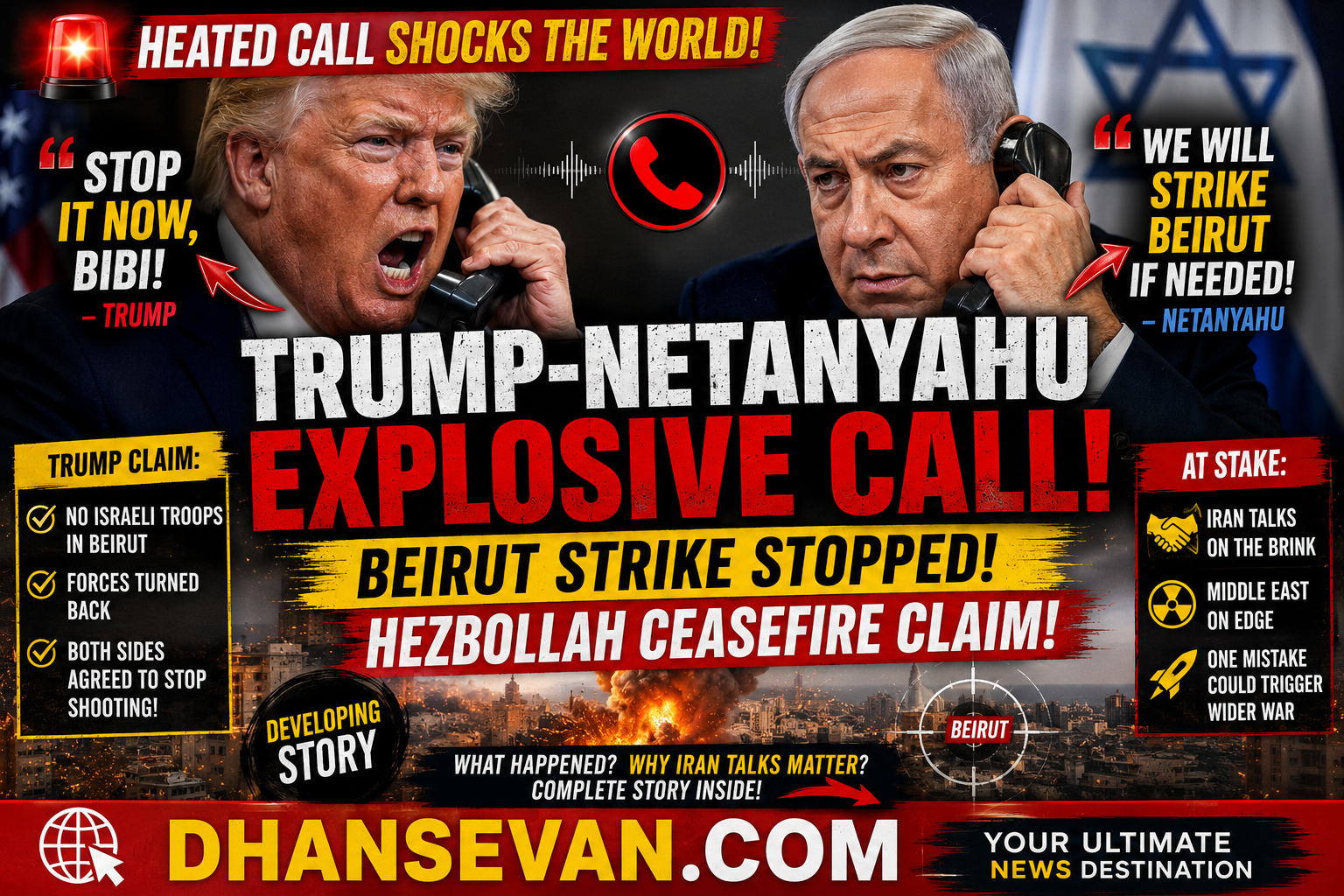
Donald Trump reportedly erupted at Benjamin Netanyahu in a furious call over Israel's Lebanon escalation, pushed back on a planned Beirut strike, and then claimed Israel and Hezbollah had agreed to stop shooting. Here is what happened, why Iran talks suddenly matter, and why this could become the Middle East's most important diplomatic flashpoint of 2026.
Uday Jasani
Gaming Expert · Dhansevan Editorial Team
The Call That Shook Washington, Tel Aviv and Beirut
A furious phone call between US President Donald Trump and Israeli Prime Minister Benjamin Netanyahu has become the biggest diplomatic flashpoint in the Middle East this week. According to reports citing US officials and a person briefed on the conversation, Trump sharply confronted Netanyahu over Israel's escalation in Lebanon and pushed back against a planned strike on Hezbollah targets in Beirut. The call was not just another tense exchange between two powerful leaders. It may have temporarily stopped a major Beirut operation, reopened a fragile path toward an Israel-Hezbollah pause, and exposed how close the wider Iran war talks are to collapse.
The story matters because it sits at the intersection of three explosive issues: Israel's military pressure on Hezbollah, Lebanon's fear of another destructive urban conflict, and Washington's effort to keep negotiations with Iran alive. If any one of those tracks breaks down, the region could move from a controlled escalation to a much wider conflict. That is why this phone call is being watched not only in Washington and Jerusalem, but also in Tehran, Beirut, the Gulf capitals, and global oil markets.
For Indian readers, the stakes are not distant. Middle East instability can affect crude oil prices, shipping routes, inflation, the rupee, and the safety of Indian workers across the region. A headline about Trump and Netanyahu may look like foreign political drama, but its economic consequences can reach petrol pumps, stock markets, remittance corridors, and household budgets in India within days.
What Reportedly Happened on the Trump-Netanyahu Call?
The immediate trigger was Israel's escalation in Lebanon. Hezbollah had resumed firing at Israel, and Israeli officials argued that they needed to respond. But Washington reportedly believed Netanyahu was moving toward a disproportionate response, including threats to hit Beirut, the Lebanese capital. That raised alarm inside the Trump administration because a Beirut strike could have blown up negotiations with Iran, which wanted any broader understanding to include Lebanon.
Axios reported that Trump became intensely angry with Netanyahu during the call, accusing him of escalating in a way that could isolate Israel internationally and damage the diplomatic track. The most viral part of the report was Trump's alleged profane outburst, including a claim that Netanyahu was acting recklessly and had become deeply unpopular internationally. Because the exact language is based on anonymous briefings, the important point is not the profanity itself. The important point is the policy signal: Trump wanted Netanyahu to stop short of a major Beirut attack.
After the call, an Israeli official reportedly said Israel no longer planned to strike Hezbollah targets in Beirut. Trump then publicly presented the conversation as productive, writing that no Israeli troops would go to Beirut and that forces already moving in that direction had been turned back. Netanyahu confirmed the conversation but framed his message differently, saying Israel would still strike Beirut if Hezbollah did not stop its attacks and that operations in southern Lebanon would continue as planned.
Why Beirut Became the Red Line
Beirut is not just another target on a military map. It is Lebanon's capital, a dense urban centre with political, symbolic, and humanitarian weight. Any major Israeli strike there would carry a high risk of civilian casualties, global backlash, and renewed pressure on Lebanon's already fragile state institutions. Washington's concern appears to have been that a strike designed to hit a single Hezbollah commander or target could trigger a chain reaction far bigger than the military objective itself.
For Israel, the argument is that Hezbollah cannot be allowed to fire into northern Israel without consequence. For Lebanon, the fear is that the country could again become the battlefield for a conflict it cannot afford. For the US, the calculation is wider: if Beirut is hit hard, Iran may walk away from talks, Hezbollah may escalate further, and Israel may face even deeper diplomatic isolation.
This is why Trump's intervention is significant. It suggests that the US is still willing to restrain Israel when Washington believes an operation threatens broader American goals. That does not mean the US has broken with Israel. It means that even close allies can clash when tactical military pressure endangers strategic diplomacy.
The Hezbollah Ceasefire Claim
After speaking with Netanyahu, Trump claimed that representatives had also communicated with Hezbollah and that both sides had agreed to stop shooting. That claim immediately became one of the most important and uncertain parts of the story. As of the initial reports, there was no immediate public confirmation from Hezbollah. Netanyahu's statement also sounded more conditional than celebratory, warning that Israel would strike Beirut if Hezbollah attacks continued.
This leaves the situation in a grey zone. Trump is presenting the moment as a de-escalation. Netanyahu is presenting it as deterrence. Hezbollah's silence or delayed response leaves open the question of whether there is a real ceasefire, a temporary tactical pause, or simply a public relations window while back-channel talks continue.
The difference matters. A genuine ceasefire would require both Hezbollah and Israel to stop attacks, avoid provocative troop movements, and agree on enforcement through Lebanese and possibly international intermediaries. A temporary pause could collapse after one rocket, drone, airstrike, or misread battlefield move. In a conflict zone where both sides distrust each other, even a small incident can become the excuse for a much larger operation.
How Iran Talks Became the Hidden Centre of the Crisis
The Lebanon escalation is not happening in isolation. It is tied to the wider attempt to extend or stabilise negotiations connected to the Iran war. Tehran reportedly wants Lebanon included in any agreement, which makes Hezbollah's battlefield posture central to the diplomatic equation. If Israel escalates in Beirut, Iran can argue that talks are meaningless because its allies and regional interests are still under attack. If Hezbollah keeps firing, Israel can argue that diplomacy is only giving its enemy time to regroup.
Trump's anger, therefore, appears to be rooted in timing. The US may accept that Israel has a right to defend itself against Hezbollah attacks, but Washington does not want an Israeli operation to detonate the very negotiations it is trying to close. This is the classic tension of Middle East diplomacy: battlefield advantage can undermine political settlement, while political settlement can feel like restraint to the side under attack.
Iran's role also explains why this story can influence oil markets. Every sign that US-Iran talks are failing raises fears of wider regional instability. Every sign of de-escalation can calm markets temporarily. India, as a major crude importer, is especially sensitive to this cycle. A Lebanon headline can quickly become an oil price headline, and an oil price headline can become an inflation headline.
Trump and Netanyahu: Allies With a Strained Private Relationship
Trump and Netanyahu have often projected strong public alignment, especially on Iran and regional security. But their relationship has never been simple. It has included periods of close cooperation, mutual political benefit, and deep private irritation. The latest call fits that pattern: public coordination, private fury, and a battle over who controls the narrative afterward.
Netanyahu needs to show Israeli voters that he is not being restrained by Washington when Hezbollah is firing at Israel. Trump needs to show that he can control escalation, protect negotiations, and force leaders on all sides to listen. Both leaders have domestic political audiences. Both benefit from appearing strong. And both risk losing credibility if the battlefield moves faster than their statements.
This is why the same call produced two different messages. Trump said he stopped a major Beirut raid. Netanyahu said Israel would still act if Hezbollah continued attacks. Those two versions are not necessarily mutually exclusive, but they reveal the political balancing act. Trump wants credit for restraint. Netanyahu wants room for future military action.
What This Means for Israel
For Israel, the call creates both relief and pressure. The relief is that Washington has not abandoned Israel's core claim that Hezbollah attacks must stop. The pressure is that a major Beirut strike now carries a clearer American warning. If Israel hits Beirut after Trump's intervention, it risks looking like it defied the US president and endangered Iran talks.
Israel's military may continue operations in southern Lebanon, where Netanyahu says the campaign will proceed as planned. That allows Israel to maintain pressure without immediately crossing the Beirut threshold. But the battlefield is unpredictable. If Hezbollah fires deeper into Israel or causes major casualties, Israeli leaders may again face pressure to strike harder.
The strategic question for Israel is whether continued pressure in southern Lebanon can stop Hezbollah attacks without triggering the broader war that Washington fears. That is a narrow path, and it depends heavily on intelligence accuracy, target selection, civilian impact, and political discipline.
What This Means for Lebanon
For Lebanon, even a temporary halt to Beirut strikes is significant. The country has already endured years of political crisis, economic collapse, infrastructure decay, and public frustration. A major attack on the capital could deepen humanitarian distress and push more civilians into displacement. Lebanese officials have been trying to secure an arrangement under which Hezbollah stops attacks on northern Israel and Israel avoids strikes on Beirut's southern suburbs.
The difficulty is that Lebanon's state does not fully control Hezbollah's military decisions. That weakens Beirut's ability to guarantee implementation, even when Lebanese political figures are involved in negotiations. At the same time, Israel often doubts Lebanese assurances because Hezbollah operates with significant autonomy. This creates a diplomacy problem: the people signing or communicating proposals may not have complete control over the people firing rockets or ordering strikes.
Still, Lebanon has every incentive to keep Beirut out of the war zone. If Trump's pressure creates even a short window for a more formal arrangement, Lebanese officials will likely try to use it.
What This Means for Hezbollah
Hezbollah now faces a tactical choice. If it pauses attacks, it may claim that Israeli pressure was checked and that Beirut was protected. If it continues firing, it risks giving Israel a reason to revive the Beirut option. The group also has to consider Iran's diplomatic needs. If Tehran wants talks preserved, Hezbollah may be encouraged to reduce escalation. If Iran believes talks are collapsing anyway, Hezbollah may have less reason to hold back.
Hezbollah's public response will be watched closely. Silence can mean internal deliberation, back-channel negotiation, or simply a refusal to validate Trump's version of events. A clear ceasefire statement would be a major development. A new round of attacks would suggest Trump's claimed pause is already under strain.
Why This Story Is Going Viral
The viral power of this story comes from a rare combination: a profanity-laced leadership clash, a possible stopped military strike, Hezbollah, Iran talks, and the fear of a wider Middle East war. Readers are not only clicking because of the alleged insult. They are clicking because the insult signals something larger: the US president may be openly furious with one of America's closest allies over a war decision.
For search traffic, the strongest hooks are clear: "Trump Netanyahu call," "Beirut strike stopped," "Hezbollah ceasefire," "Iran talks," and "Israel Lebanon conflict." These phrases capture both the drama and the real policy stakes. But a viral article cannot survive on headline energy alone. Readers need the deeper explanation: why Beirut matters, why Iran talks are connected, and what happens next.
What Could Happen Next?
There are four realistic scenarios to watch in the coming days.
**Scenario one: a temporary ceasefire holds.** Israel limits operations, Hezbollah stops firing, and US-led diplomacy creates a more formal mechanism. This would be the best-case outcome for civilians and markets, but it requires discipline from all sides.
**Scenario two: southern Lebanon fighting continues without Beirut strikes.** This may be the most likely near-term outcome. Israel continues limited ground or air operations, Hezbollah fires intermittently, and Washington keeps trying to prevent the conflict from reaching the capital.
**Scenario three: Hezbollah resumes significant attacks and Israel strikes Beirut.** This would be the most dangerous escalation. It could derail Iran talks, increase civilian casualties, and create pressure for a broader Israeli campaign.
**Scenario four: diplomacy collapses over Iran.** If Iran concludes that the Lebanon front is not being restrained, Tehran may walk away from talks. That would turn a Lebanon crisis into a wider regional crisis, with consequences for oil prices, shipping security, and global diplomacy.
India Impact: Oil, Inflation and Worker Safety
India should watch this story closely for three reasons. First, crude oil markets react quickly to Middle East instability. Even if Lebanon itself is not a major oil producer, conflict involving Israel, Hezbollah, Iran, and the US can raise risk premiums across the region. Higher crude prices can pressure India's import bill, widen inflation concerns, and affect petrol and diesel pricing expectations.
Second, the Gulf and wider Middle East are home to millions of Indian workers. Escalation can affect aviation routes, insurance costs, remittance confidence, and embassy advisories. A contained ceasefire is better not only for regional civilians but also for migrant communities across the area.
Third, Indian investors increasingly react to geopolitical shocks in real time. Energy stocks, airline stocks, defence counters, currency expectations, and broader market sentiment can all move when Middle East risk rises. That makes this story relevant beyond foreign affairs enthusiasts.
Bottom Line
The Trump-Netanyahu call is not just a political gossip story. It is a warning flare over the Middle East. A planned or threatened Beirut strike appears to have been paused, at least for now. Trump is claiming a pathway to stopping Israel-Hezbollah fire. Netanyahu is keeping military options open. Hezbollah has not fully clarified its position. Iran talks remain vulnerable.
The next 48 to 72 hours will matter. If the guns stay quieter, this call may be remembered as the moment Washington pulled the region back from a dangerous escalation. If the fighting resumes, it may be remembered as a brief pause before a larger crisis. Either way, the story is now bigger than one angry phone call. It is about whether diplomacy can still outrun the battlefield.
Frequently Asked Questions
What did Trump reportedly say to Netanyahu?Reports citing US officials said Trump sharply criticised Netanyahu in a heated and profane call over Israel's Lebanon escalation. The core issue was Trump's objection to a major Beirut strike that could derail Iran-related negotiations.Did Trump stop Israel from striking Beirut?According to reports, Trump pushed back against Israel's plan or threat to strike Hezbollah targets in Beirut, and an Israeli official later said Israel no longer planned to strike those targets at that time. Netanyahu, however, said Israel could still strike Beirut if Hezbollah attacks did not stop.Did Hezbollah agree to a ceasefire?Trump claimed that Hezbollah agreed to stop shooting through representatives, but early reporting did not include immediate direct confirmation from Hezbollah. That makes the situation fragile and still developing.Why is Iran involved in a Lebanon-Israel crisis?Iran is central because Hezbollah is an Iranian-backed force, and Tehran reportedly wants Lebanon included in any broader agreement. A major Israeli escalation in Beirut could threaten US-Iran negotiations.Why does this matter for India?Middle East escalation can affect crude oil prices, inflation expectations, shipping risk, aviation routes, remittances, and the safety of Indian workers in the region. That makes the story economically relevant for Indian readers.What should readers watch next?Watch for Hezbollah's official response, Israeli military activity in southern Lebanon, any renewed Beirut threats, US statements on Iran talks, and market reaction in crude oil prices.
About the Author
Uday Jasani
The Dhansevan editorial team consists of passionate gamers and tech enthusiasts who test and review every game before publishing. Our writers bring first-hand gaming experience and follow strict editorial standards to ensure accurate, helpful content for our readers.
Disclaimer: This article is for informational purposes only. Game features, availability, and earning potential may vary. Always download games from official sources and read their terms of service. Dhansevan does not guarantee any specific results from using the apps mentioned above.