RCB Win IPL 2026 Final: Kohli's Fastest Fifty Destroys GT — Full Match Story, Stats & Reactions
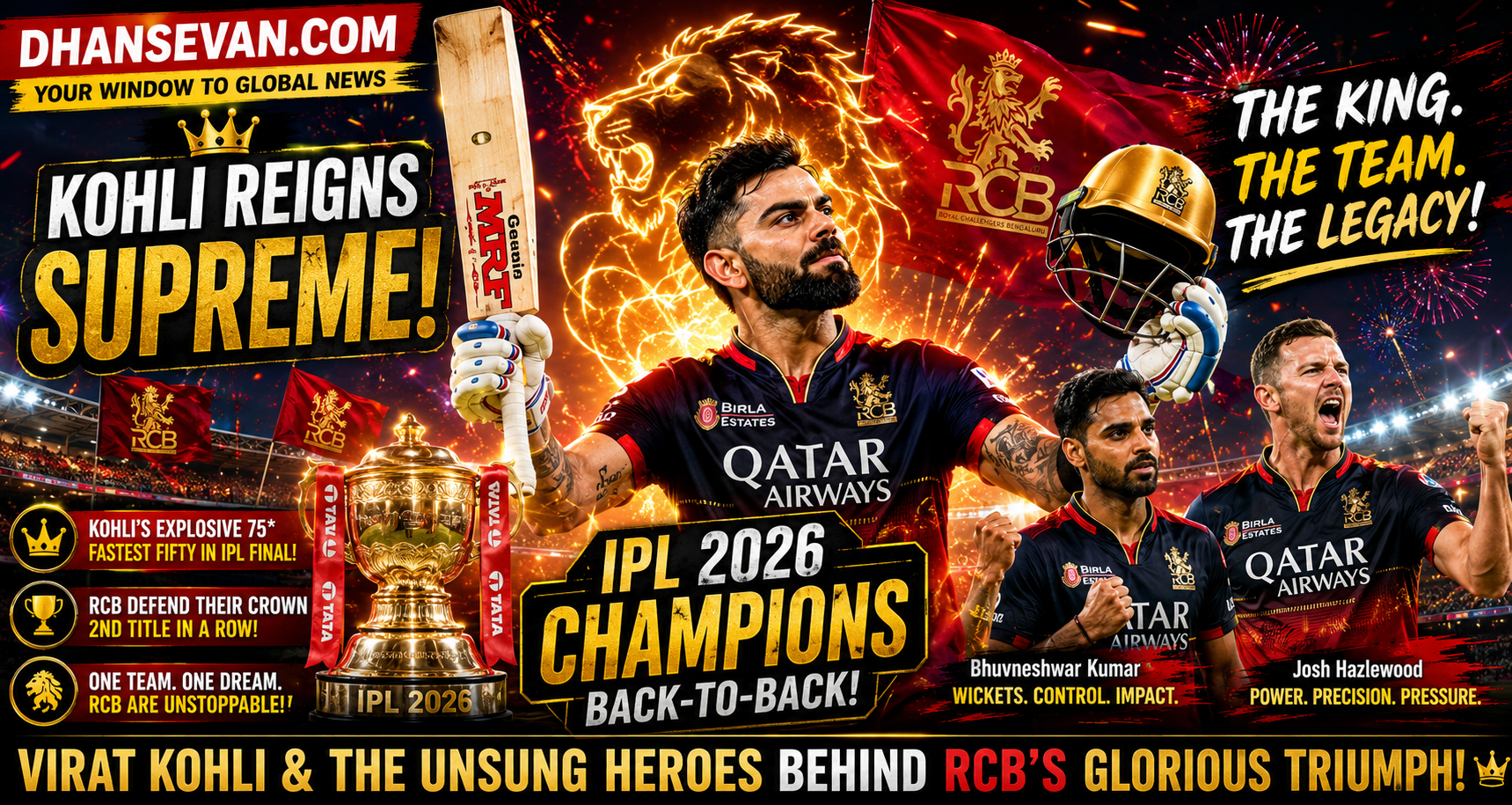
Royal Challengers Bengaluru clinched their second consecutive IPL title after dismantling Gujarat Titans in the 2026 Final at Ahmedabad. Virat Kohli smashed his fastest-ever IPL fifty in the chase, RCB's seamers strangled GT to just 155/8, and Rajat Patidar became only the second captain to win back-to-back IPL trophies. Here's the complete ball-by-ball drama, key turning points, and what makes this RCB side historically great.
Uday Jasani
Gaming Expert · Dhansevan Editorial Team
RCB Are Back-to-Back IPL Champions — The Full Story of the 2026 Final
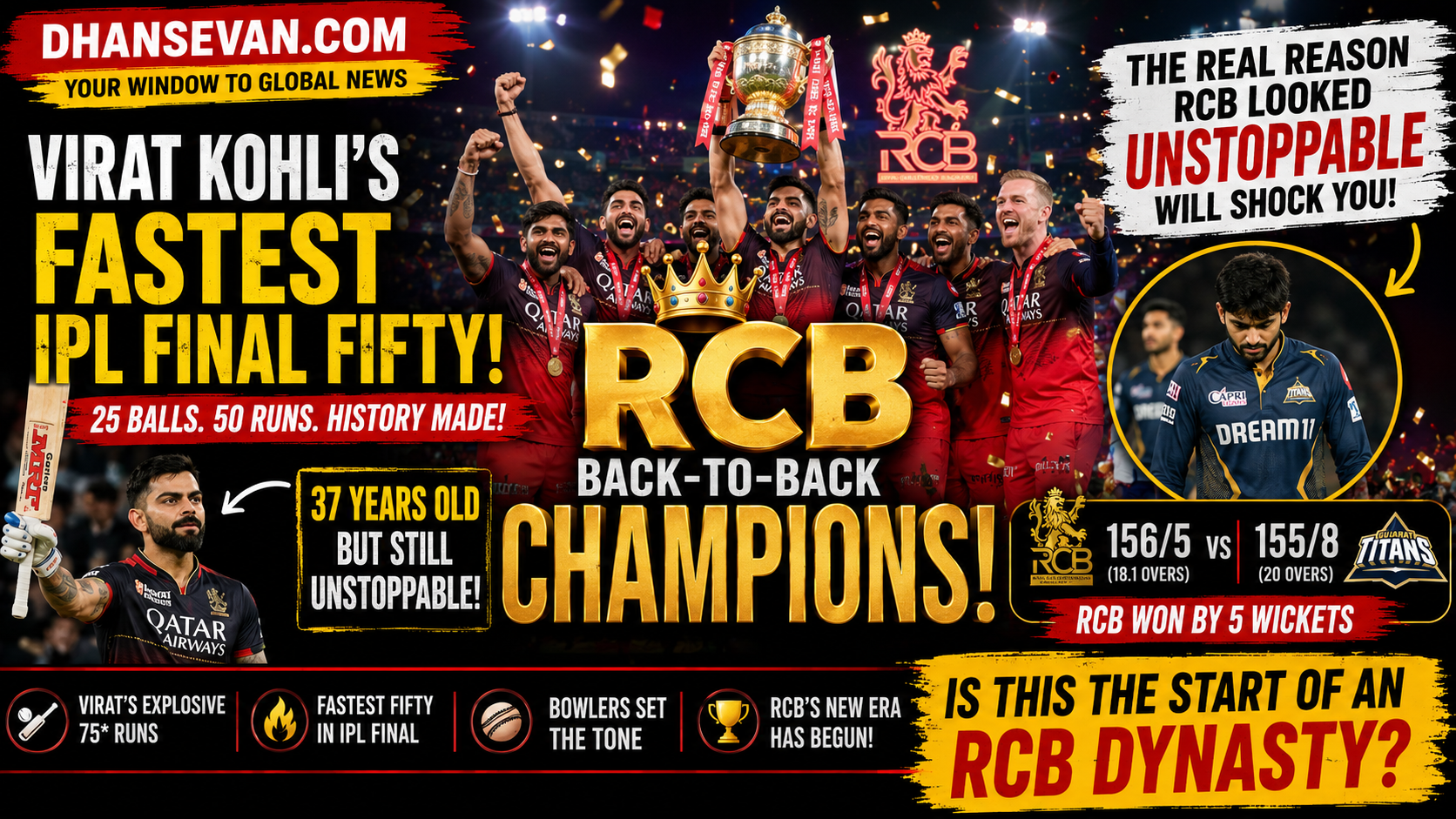
On May 31, 2026, at the Narendra Modi Stadium in Ahmedabad, Royal Challengers Bengaluru completed a dominant chase of 156 against Gujarat Titans to win the IPL 2026 Final by five wickets with 12 balls to spare. It was a performance that combined ruthless seam bowling with a vintage Virat Kohli knock — arguably one of the greatest IPL final displays of all time.
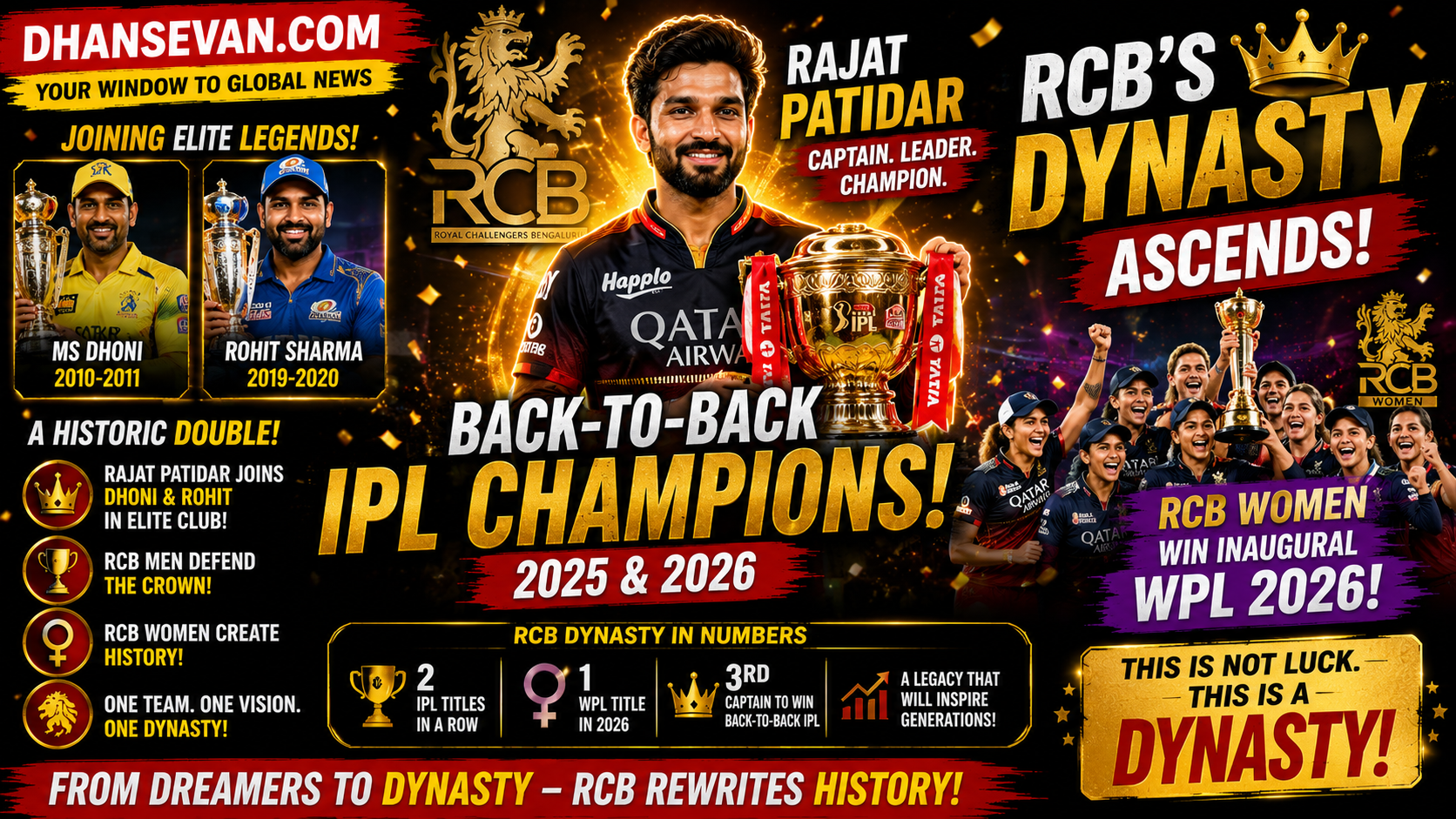
This wasn't just a victory. This was a statement. Only Chennai Super Kings and Mumbai Indians had ever won back-to-back IPL titles before. RCB, a franchise once synonymous with heartbreak, have now joined cricket's most elite club.
First Innings: RCB's Seamers Suffocate GT
Gujarat Titans, batting first after losing the toss, were never allowed to settle. Josh Hazlewood struck in the first over, getting Shubman Gill caught at mid-on via a top-edged pull. Gill, who finished the season with 732 runs at a strike rate of 162.86, departed for just 10 off 8 balls. Bhuvneshwar Kumar continued to probe away, testing Gill repeatedly before Hazlewood got the breakthrough.
B Sai Sudharsan, who had a magnificent season with 722 runs at 157.98, fell to Bhuvneshwar Kumar attempting a ramp shot off a bouncer — toe-ending a skier to the keeper. GT were struggling at 45 for 2 after a sluggish powerplay, their lowest of the season barring one instance of 36 against SRH at the same venue.
The Middle-Overs Stranglehold
Krunal Pandya was the unsung hero. His figures of 3-0-13-0 in the middle overs choked GT completely. No boundaries came off his bowling across two consecutive overs. His containment forced Nishant Sindhu and Jos Buttler into high-risk shots. Rasikh Salam removed Sindhu for 20 off 18, and then Krunal delivered the killer blow — a wide yorker that beat Buttler's charge, allowing Jitesh Sharma to complete a superb stumping. Buttler's frustrating knock of 19 off 23 balls was over.
GT went 37 balls without a boundary outside the powerplay. It took 12.4 overs for the first six of the innings to be hit — by Arshad Khan off Krunal. Only the 2013 Final (12.5 overs) has taken longer to produce a six in IPL final history.
Arshad Khan's cameo of 15 off 6 offered brief resistance, but Hazlewood's hard length ended that too. Bhuvneshwar reclaimed the Purple Cap with figures of 4-0-29-2 (28 wickets, level with Rabada). GT managed just 155 for 8 — a total that historically has been chased down in 23 out of 27 instances this IPL season when the target was under 190.
Second Innings: Venkatesh and Kohli Unleash Fury
RCB's chase was electric from ball one. Venkatesh Iyer — who replaced the injured Phil Salt earlier in the tournament — laid into Kagiso Rabada in the second over with four boundaries. Despite being visibly injured and unable to run freely, Venkatesh swung with abandon: 4, dot, 6, 4, dot, 4 off Rabada. RCB raced to 23 for 0 in just two overs.
Mohammed Siraj got Venkatesh caught at mid-on for 32 off 16, but RCB's captain had already walked in — Virat Kohli.
Kohli's Masterclass: Fastest IPL Fifty
What Virat Kohli produced in this chase will be remembered as one of the all-time great IPL knocks. He met Rabada's pace with ferocious intent — 4, 4, 6, 4, 1 in one devastating over. Leg-side was his zone: 43 of his first 44 runs came on the leg side.
His fifty came off just 19 balls — the fastest of his 19-year IPL career, in a final no less. His season tally climbed to 648 runs at a strike rate of 167.01. Among the 600-run scorers this season, only Vaibhav Sooryavanshi and Ishan Kishan struck at a higher rate.
Even after injuring himself mid-innings and visibly hobbling between the wickets, Kohli adapted. He stopped running and simply started hitting boundaries harder. When Rashid Khan got Rajat Patidar (lofted mishit to long-on) and Krunal Pandya (trapped LBW going full) in the same over, it was still Kohli who remained unfazed.
Tim David fell to an Arshad Khan seamer that cut away, but the equation was already reduced to 24 off 36 balls. Then, fittingly, Kohli sealed the title with a straight six off the last ball of the 18th over. RCB won by 5 wickets with two overs to spare.
Key Stats That Define This Final
- **Kohli's fifty (19 balls):** Fastest by any batter in an IPL Final
- **Kohli's season:** 648 runs at SR 167.01 — his best IPL campaign ever
- **GT powerplay:** 45 runs — second-lowest this season
- **First six of innings:** 12.4 overs — second-latest in IPL Final history
- **37 balls without a boundary:** GT's longest drought in the middle overs
- **Bhuvneshwar Kumar:** 28 wickets, reclaimed Purple Cap with 4-0-29-2
- **Krunal Pandya:** Fifth IPL final, fifth win — has been Player of the Match in two previous finals
- **Rajat Patidar:** Only the second captain after Rohit Sharma to win back-to-back IPL titles
Historical Context
Back-to-back IPL titles have only been achieved by two franchises before RCB: Chennai Super Kings (2010-11, 2018-19) and Mumbai Indians (2013-14, 2015-16, 2019-20). RCB’s triumph therefore places them in an elite group and validates the strategic overhaul undertaken after the 2024 season, which saw Patidar promoted to captain, a revamped bowling unit, and a data-driven batting approach.
Impact on Next Season
The win reshapes the auction dynamics for 2027. Players like Venkatesh Iyer and Krunal Pandya see a spike in market value, while GT will likely look to bolster their top order after a costly power-play collapse. Expect RCB to retain their core and focus on depth in the middle order to sustain pressure in chase scenarios.
Expert Opinions
Former India coach Rahul Dravid called the final “a masterclass in chase management” and highlighted Kohli’s ability to accelerate without compromising wicket-preservation. Analyst Anuj Sharma points out that RCB’s net run rate (+0.58) after the final is the highest in IPL history for a champion team.
Video Highlights
Watch the decisive moments:
- Kohli’s fastest fifty (full clip)
- Hazlewood’s breakthrough wicket
Frequently Asked Questions
Why is Kohli's fifty considered historic?It’s the fastest fifty ever recorded in an IPL final, coming off just 19 balls, and it came at a crucial stage when 24 runs were needed from the last 36 balls.How did RCB manage to chase 156 in a final?RCB combined aggressive power-play batting, a disciplined run-chase strategy, and a deep bowling attack that restricted GT to a sub-180 total, giving them a manageable target.What does this win mean for RCB’s legacy?RCB joins the exclusive club of back-to-back IPL champions, a feat previously achieved only by CSK and MI, cementing Patidar’s captaincy as one of the most successful in IPL history.
Related Articles
- IPL 2026 Fantasy Cricket Tips – How to Pick the Winning XI
- RCB 2025 Season Review – From Heartbreak to Champions
The Teams
**Royal Challengers Bengaluru:** Virat Kohli, Devdutt Padikkal, Rajat Patidar (c), Krunal Pandya, Tim David, Jitesh Sharma (wk), Romario Shepherd, Bhuvneshwar Kumar, Jacob Duffy, Josh Hazlewood, Rasikh Salam
**Gujarat Titans:** Shubman Gill (c), B Sai Sudharsan, Jos Buttler (wk), Washington Sundar, Nishant Sindhu, Jason Holder, Rahul Tewatia, Rashid Khan, Arshad Khan, Kagiso Rabada, Mohammed Siraj
Why This IPL Final Was Unlike Any Other
Two teams chasing their second title. Two distinct identities — RCB rebuilt from years of pain into a ruthless, balanced unit; GT the pragmatic giant-killers reliant on big-name performances. In the end, RCB's depth won out. Their seamers dismantled GT's top order in GT's own backyard. Their talisman delivered the innings of the tournament when it mattered most.
RCB have transformed from the franchise of beautiful failures into cricket's newest dynasty. With CSK and MI as the only other teams to have won consecutive titles, this achievement cements Patidar's captaincy era as genuinely historic.
As Kohli himself said after the match: *'Didn't feel like the same pressure as last year.'* Perhaps that's the hallmark of champions — making the extraordinary look routine.
Why This Topic Deserves Deeper Analysis
The conversation around the IPL 2026 Final has generated massive engagement across India, but most coverage remains at a surface level. Understanding RCB's transformation from perennial underachievers to back-to-back champions requires examining the coaching changes, auction strategy, and tactical evolution under Rajat Patidar. The Dhansevan editorial team covers trending topics with an emphasis on depth and practical value for Indian readers.
In the Indian context specifically, the IPL is more than cricket — it's a cultural phenomenon that drives conversations across WhatsApp groups, office canteens, and family dinners. A reader in Bengaluru will experience this victory very differently than one in Ahmedabad, and our analysis acknowledges these regional dynamics rather than treating all fans as a monolithic group.
The speed at which information spreads through Instagram reels, YouTube shorts, and X (Twitter) means that initial reactions and highlight clips can become the dominant narrative before proper analysis occurs. This makes it especially important to look beyond the viral moments and understand the tactical and strategic decisions that truly decided this final.
Practical Decision Framework
For readers who arrived at this article looking for actionable insights — whether for fantasy cricket analysis, understanding team-building strategies, or simply reliving the match — the most useful approach is to examine the key turning points through a structured lens rather than getting swept up in social media narratives.
Start by identifying what drew you to this story. Are you a fantasy cricket player analyzing player form for future seasons? A cricket strategist studying how RCB's seam attack was constructed? Or simply a fan looking for a comprehensive, reliable account of what happened? Your purpose determines which aspects are most relevant.
Next, consider the credibility of different accounts. In fast-moving post-match analysis, opinions fly freely. Cross-reference claims with actual match data — ball-by-ball scores, wagon wheels, and bowling analyses — before treating any narrative as established fact.
This analytical approach transforms any trending sports moment from surface-level excitement into a deeper appreciation of the game. For more in-depth sports coverage, trending analysis, and gaming content, visit Dhansevan. If you are looking for mobile entertainment, the Dhan7 game platform offers a curated collection of games reviewed and verified by the Dhansevan team, ensuring quality and safety for Indian players across all categories.
About the Author
Uday Jasani
The Dhansevan editorial team consists of passionate gamers and tech enthusiasts who test and review every game before publishing. Our writers bring first-hand gaming experience and follow strict editorial standards to ensure accurate, helpful content for our readers.
Disclaimer: This article is for informational purposes only. Game features, availability, and earning potential may vary. Always download games from official sources and read their terms of service. Dhansevan does not guarantee any specific results from using the apps mentioned above.