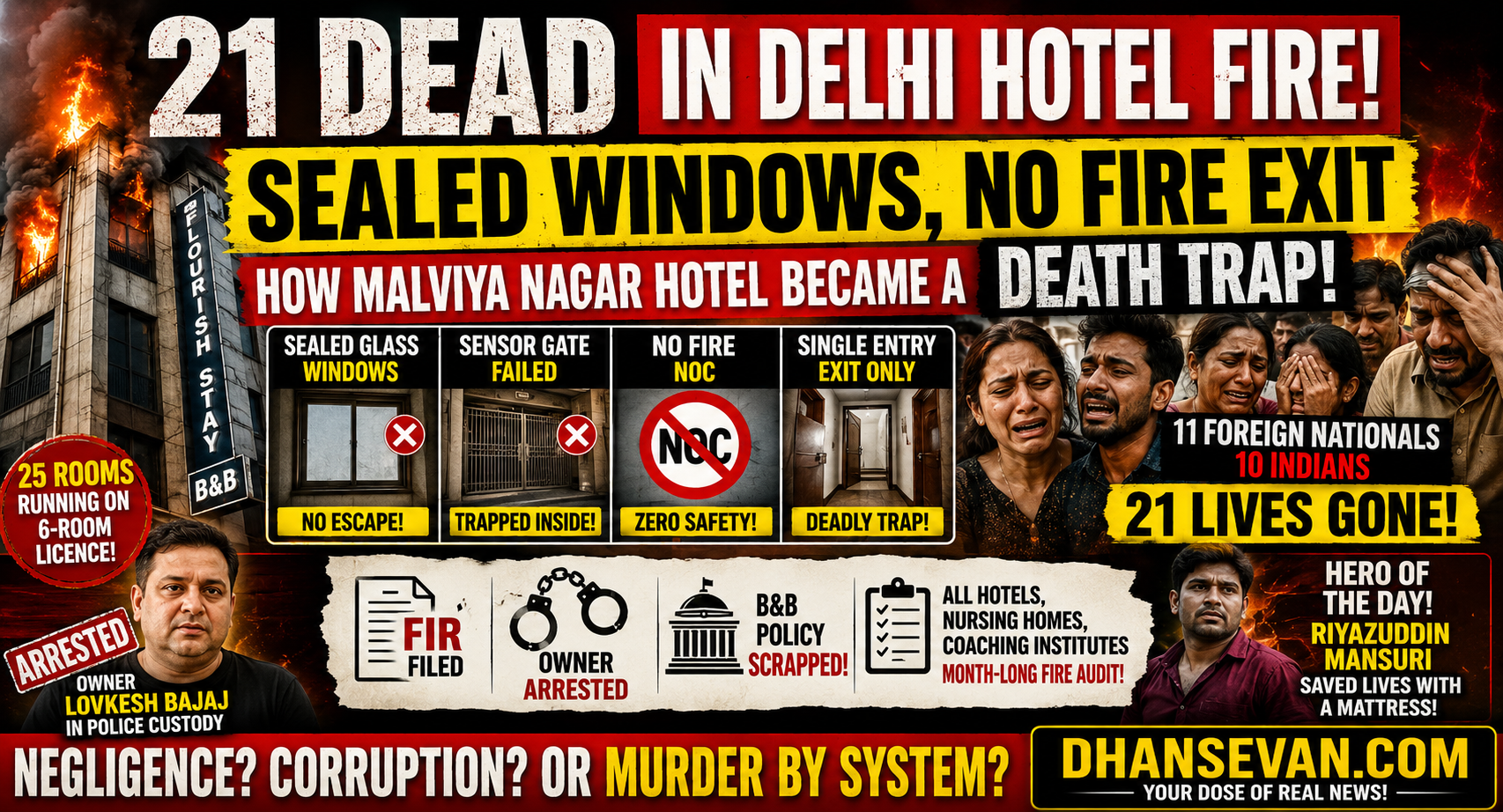
21 Dead, Sealed Windows, No Fire Exit: How Delhi's Malviya Nagar Hotel Became a Death Trap — Owner Arrested, B&B Policy Scrapped, Full Timeline
A devastating fire ripped through the Flourish Stay B&B in Delhi's Malviya Nagar on June 3, killing 21 people including 11 foreign nationals. Sealed glass windows, sensor-operated gates that failed, 25 rooms running on a 6-room licence, no fire NOC, and a single entry-exit point turned the building into a death trap. The owner has been arrested. Delhi has scrapped its entire B&B policy. Here is the full story — from the first spark to the political fallout.
Uday Jasani
Gaming Expert · Dhansevan Editorial Team
A Building Designed to Kill: How 21 People Died in a Hotel That Should Never Have Existed
On the morning of June 3, 2026, at approximately 8:30 AM, a fire broke out at the Flourish Stay bed-and-breakfast in Hauz Rani, a congested bylane in south Delhi's Malviya Nagar. Within minutes, thick black smoke and flames engulfed the five-storey building. People inside — tourists from Africa, Turkmenistan, Bangladesh, and Indian travellers — woke to screams, smoke, and the horrifying realisation that there was almost no way out.
Twenty-one people died. Eleven of them were foreign nationals — nine from Africa and two from Turkmenistan. Ten were Indians. At least 47 others were pulled out and rushed to hospitals. Several remain in critical condition on ventilators. The death toll may still rise.
This was not a freak accident. This was a catastrophe written in advance by every safety violation that was ignored, every inspection that never happened, and every official who looked the other way. The building had sealed glass windows. Sensor-operated gates that stopped functioning during the fire. Twenty-five rooms running on a licence that permitted only six. No fire department clearance. A single entry-exit point. And an owner who, according to police, had been operating this death trap in plain sight for years.
The owner, Lovkesh Bajaj, has been arrested. An FIR has been filed under culpable homicide. Delhi has announced it will scrap its entire bed-and-breakfast policy. The MCD has ordered a sealing drive. The Lieutenant-Governor has ordered a month-long fire safety audit of every hotel, nursing home, and coaching institute in the city.
None of this will bring back the 21 people who burned to death in a building that should never have been allowed to operate.
The Timeline: From First Spark to 21 Bodies
Reconstructing the morning from official statements, eyewitness accounts, and hospital records reveals a sequence of events that is both horrifying and infuriating:
- **~8:00 AM** — Residents of the surrounding area begin noticing a burning smell. Anita Chaudhary, a local resident, later tells reporters she heard "multiple blast-like sounds" followed by screams from inside the building.
- **~8:30 AM** — The fire is now visible. Thick smoke pours from the building. People inside begin screaming for help. Some attempt to jump from windows.
- **8:48 AM** — Delhi Police control room receives the first information about the fire. Local police staff reach the spot and begin rescue operations.
- **~9:00-9:15 AM** — Fire tenders begin arriving. Residents and opposition politicians later allege the fire brigade took approximately 45 minutes to reach the site despite a fire station being just three minutes away. The Delhi Fire Service denies this.
- **Morning hours** — Rescued victims are rushed to AIIMS Trauma Centre, Max Hospital Saket, and Safdarjung Hospital. Bodies begin arriving at hospital morgues.
- **~1:00 PM** — Rescue operations conclude. The building is cordoned off for investigation. The death toll is confirmed at 21.
The gap between when residents first noticed the fire and when professional rescue arrived is the most contested element of the timeline. If the fire brigade truly took 45 minutes to reach a site three minutes from the station, as alleged, the delay almost certainly cost lives. If the fire service's denial is accurate, the question becomes why residents perceived such a long wait — possibly because the narrow lanes of Hauz Rani prevented fire tenders from reaching the building quickly, regardless of when they were dispatched.
Why the Building Was a Death Trap
Fire officials who entered the building after the blaze was controlled described a structure that was, in every meaningful sense, designed to prevent escape. Chief Fire Officer Abhilash Kumar Malik identified multiple factors that turned the fire from a survivable emergency into a mass casualty event:
Sealed Glass Windows
The building's windows were sealed with glass that could not be opened. In a fire, windows are often the difference between life and death — they allow smoke to vent, provide access points for rescue, and give trapped people an escape route when corridors are blocked. Sealed windows eliminated all of these options, trapping smoke inside and making it impossible for occupants to signal for help or escape without breaking the glass — something many may not have had the tools or presence of mind to do while choking on smoke.
Sensor-Operated Gates That Failed
The building used sensor-operated gates — automated entry and exit systems that require electronic activation. When the fire disrupted the building's electrical system, these gates stopped functioning, effectively locking people inside. A manual override, which any properly designed system should have, was either absent or not accessible to panicked occupants.
This is a critical design failure. Automated gates in buildings that house sleeping guests should always fail to the open position in an emergency — meaning that when power is lost, the default state should be open, not closed. A system that locks people in when the electricity fails is not a security feature. It is a death sentence.
Single Entry-Exit Point
MCD officials confirmed that the building had a single entry-exit point. Fire safety regulations universally require multiple exits precisely because a single exit can be blocked by fire, smoke, or structural collapse. In this case, when the fire blocked or made the single exit unusable, everyone above the fire floor was trapped.
25 Rooms on a 6-Room Licence
The building was licensed under Delhi's bed-and-breakfast scheme for only six rooms. It was operating approximately 25 rooms across the basement, ground floor, and five upper floors — including rooms on the terrace. This meant the building was housing four times more people than its licence permitted, in a structure that was never designed for that occupancy level.
More people means more potential victims. It also means more strain on the building's infrastructure — more electrical load, more cooking activity, more flammable materials — all in a structure that lacked even basic fire safety provisions for its permitted capacity, let alone its actual one.
No Fire NOC
The building did not have a No Objection Certificate from the Fire Department. This means it had never been inspected by fire officials, never been required to demonstrate compliance with fire safety standards, and never been mandated to install fire extinguishers, sprinklers, fire alarms, or emergency lighting. It was operating as a commercial accommodation facility — housing paying guests, including foreign tourists — without the most basic safety certification.
The Hero With the Mattresses
In the chaos of the morning, one story stands out as a testament to what ordinary people will do when institutions fail. Riyazuddin Mansuri, a mattress trader whose shop stands opposite the burning building, made a split-second decision that saved at least eight lives.
When smoke began pouring from the building and people appeared at windows screaming for help, Mansuri and his staff rushed out with their entire stock — dozens of quilts and mattresses worth approximately ₹2 lakh — and spread them on the ground below the building, creating a makeshift safety net.
Trapped guests jumped from upper floors onto the cushioned surface. By the time fire tenders arrived, Mansuri and his team had already rescued eight people. Both Mansuri and his son sustained injuries during the rescue.
The contrast is devastating: a mattress trader sacrificed ₹2 lakh of his livelihood and his own physical safety to save strangers, while the building owner had spent years profiting from a structure that endangered everyone inside it. One man lost money saving lives. The other made money risking them.
Who Died: The Victims
Of the 21 confirmed dead, 11 were foreign nationals — nine from Africa and two from Turkmenistan. Ten were Indians. The specific nationalities of the African victims have not been fully detailed in initial reports, but the Hauz Rani area is known to attract travellers from across Africa and Central Asia, who choose budget B&B accommodation for its affordability.
Five Bangladeshi nationals were traced among the injured — three receiving treatment at Max Hospital in Saket and two at Safdarjung Hospital. The Bangladesh High Commission issued a statement offering condolences and confirmed it was monitoring the situation.
At Max Hospital alone, 39 patients were received. Eighteen were brought dead. Fifteen were admitted to ICU, including eight on ventilators in critical condition. Five with minor injuries were treated and discharged. One patient was transferred to Safdarjung Hospital due to excessive burns.
External Affairs Minister S. Jaishankar confirmed the MEA was in touch with the embassies of affected countries. The diplomatic dimension adds international pressure to what is already a domestic crisis — foreign governments will demand answers about how their citizens died in an unlicensed, uninspected building in India's capital.
The B&B Policy: Scrapped After the Tragedy
Within hours of the fire, Delhi Tourism Minister Kapil Mishra announced that the Delhi government would officially withdraw its entire bed-and-breakfast policy and review all establishments operating under the scheme.
"We are going to officially withdraw the Bed and Breakfast scheme, and all establishments licensed under it will be checked," Mishra told PTI. "Action would be taken against operators found violating the terms of the licence. If any establishment registered under the scheme is found running more than six rooms, its licence will be cancelled."
The B&B policy was originally designed to allow homeowners with spare rooms to offer affordable accommodation to tourists. In theory, it was a sensible policy that expanded Delhi's hospitality capacity and gave homeowners supplementary income. In practice, it was exploited by operators who converted entire buildings into commercial hotels while operating under the lighter regulatory framework meant for spare-room homestays.
The gap between the policy's intent and its reality is the central governance failure of this tragedy. A scheme designed for a family renting out two spare bedrooms was used to operate a 25-room commercial hotel in a building with sealed windows and no fire safety certification. The regulatory framework that was supposed to distinguish between a homestay and a hotel failed completely.
The Owner: Lovkesh Bajaj
Delhi Police arrested Lovkesh Bajaj, the owner of the building, hours after the fire. An FIR was registered under Sections 105 (culpable homicide not amounting to murder) and 326 (mischief by fire) of the Bharatiya Nyaya Sanhita.
The culpable homicide charge is significant. It is not merely a negligence charge — it asserts that the building's condition was so dangerous that operating it constituted an act likely to cause death. If the charge is upheld, Bajaj faces a maximum sentence of 10 years in prison.
MCD sources revealed that the building was originally constructed in the 1980s in a Lal Dora village area and was later rebuilt in 2012-13. Lal Dora areas have historically operated under different building regulations than the rest of Delhi, with less stringent oversight — a legacy of colonial-era land classification that has created pockets of regulatory ambiguity exploited by commercial operators.
The Political Fallout
The fire immediately became a political battleground, with every major party and leader weighing in:
The Government Response
Prime Minister Narendra Modi condoled the deaths and announced an ex-gratia of ₹2 lakh each from the PM National Relief Fund for the families of the deceased and ₹50,000 for the injured. Delhi Chief Minister Rekha Gupta said the government was "closely monitoring the situation." Lieutenant-Governor Taranjit Singh Sandhu ordered a month-long fire safety compliance drive covering all hotels, nursing homes, coaching institutes, and restaurants.
The Opposition Attack
Former Chief Minister Arvind Kejriwal called the continuous fire incidents "extremely concerning." AAP Delhi unit president Saurabh Bharadwaj alleged the fire brigade took 45 minutes to reach a site three minutes from the station, calling it an "International Shame." Congress president Mallikarjun Kharge urged the government to provide adequate compensation. Former AAP MLA Somnath Bharti echoed the delay allegations.
Delhi Congress president Devender Yadav pointed to a pattern: "There is an absolute failure of the fire department in this case, and several other incidents have been reported in the past few days. Before this, there were incidents in Palam and Vivek Vihar."
The Condolence Chorus
President Droupadi Murmu called the news "extremely heartbreaking." Vice-President C.P. Radhakrishnan expressed condolences. Rahul Gandhi urged Congress workers to assist in relief. Uttar Pradesh CM Yogi Adityanath called it "soul-wrenching." Jharkhand CM Hemant Soren described it as "heartbreaking." Mamata Banerjee expressed grief. J&K LG Manoj Sinha and CM Omar Abdullah offered condolences.
The volume of political condolences is standard for tragedies of this scale. What matters more is what follows: whether the promised investigations, sealing drives, and policy reviews produce lasting change, or whether they fade once the news cycle moves on.
The MCD Sealing Drive: Too Late?
The MCD announced it would begin sealing unauthorised commercial buildings in the South Zone starting June 4. The drive targets establishments similar to the Flourish Stay — buildings operating commercial hospitality businesses without proper approvals, fire safety compliance, or building plan adherence.
The irony is bitter. The MCD is now sealing buildings that it should have identified and acted upon years ago. The Flourish Stay was not hidden. It operated openly, accepted online bookings, hosted foreign tourists, and ran 25 rooms in a building approved for far less. It existed in plain view of every municipal official, police officer, and fire inspector who ever visited or drove through the area.
The question that the sealing drive raises is not whether it should happen — it obviously should — but why it did not happen before 21 people had to die. The answer, almost certainly, involves a combination of regulatory gaps, enforcement failures, corruption, and the systemic tendency of Indian governance to react to crises rather than prevent them.
The Fire Safety Audit: What the LG Ordered
Lieutenant-Governor Sandhu ordered a comprehensive month-long drive starting June 4 covering:
- All hotels, lodges, and inns
- All nursing homes
- All coaching institutes
- All restaurants
- All other vulnerable commercial establishments
The specific directives include closing all rooms in hotels that exceed their permitted limit, conducting accessibility surveys to identify bottlenecks preventing fire tenders from reaching buildings, and ensuring strict compliance with fire safety norms.
If implemented thoroughly, this audit could identify hundreds — possibly thousands — of buildings across Delhi operating in similar conditions to the Flourish Stay. The political question is whether the government has the capacity and will to act on the findings, or whether the audit becomes another report that sits on a shelf until the next tragedy.
10 Police Personnel Hospitalised: The Rescuers Who Risked Everything
Ten police personnel from the Malviya Nagar police station were hospitalised at AIIMS Trauma Centre after suffering suffocation and hypoxia during rescue operations. They entered the smoke-filled building to evacuate trapped guests, absorbing toxic fumes in the process.
All ten are reported stable and under observation. Their willingness to enter a burning building without fire-rated equipment — because they were the first responders on scene — deserves recognition. But it also underscores a systemic problem: police officers should not be the ones entering burning buildings. That is the fire department's job. The fact that police had to improvise because professional firefighters had not yet arrived reinforces the timeline controversy and raises questions about Delhi's emergency response coordination.
Why This Keeps Happening: India's Fire Safety Crisis
The Malviya Nagar fire is not an isolated incident. It is the latest in a recurring pattern of fire tragedies that have killed hundreds of people across India over the decades. A timeline compiled by The Hindu documents major fire accidents since Independence — a grim catalogue that includes the Uphaar cinema fire of 1997 (59 dead), the Bawana factory fire of 2018 (17 dead), the Mundka building fire of 2022 (27 dead), and the Rajkot game zone fire of 2024 (27 dead).
Each time, the pattern is the same: a fire breaks out in a building with known safety violations. People die because exits are blocked, fire equipment is absent, and rescue is delayed. Politicians express shock. Investigations are ordered. Owners are arrested. Sealing drives are announced. Committees are formed. Reports are written. And then, slowly, attention fades, enforcement relaxes, and the conditions that caused the tragedy are allowed to persist until the next one.
The fundamental problem is not a lack of regulations. India has fire safety codes, building regulations, and licensing requirements. The problem is enforcement — or more precisely, the systematic failure of enforcement at every level of governance. Buildings operate without fire NOCs because inspections do not happen. Inspections do not happen because enforcement agencies are understaffed, underfunded, and, in many cases, compromised by corruption. And the political incentive to fix this problem disappears the moment the news cycle moves on.
What Needs to Change
The Malviya Nagar fire demands more than condolences and ex-gratia payments. It demands structural reform:
- **Mandatory fire safety certification for all commercial accommodation** — No hotel, B&B, lodge, or guesthouse should be allowed to operate without a valid fire NOC, regardless of the regulatory category it falls under
- **Automated exit systems must fail-open** — Any building using electronic gates or sensor-operated doors must ensure they default to the open position when power is lost
- **Regular unannounced inspections** — Fire safety compliance must be checked through unannounced inspections, not scheduled visits that operators can prepare for
- **Digital licensing with real-time monitoring** — B&B and hotel licences should be linked to digital systems that track the number of rooms being operated, with automatic alerts when operators exceed their permitted capacity
- **Criminal accountability for regulators** — If a building operates without a fire NOC and people die, the officials responsible for that jurisdiction should face inquiry alongside the building owner
- **Mandatory insurance for commercial accommodation** — Operators should be required to carry insurance that covers guests, creating a financial incentive for compliance and a mechanism for victim compensation
For the Families
Twenty-one families woke up on June 3 without knowing it was the last morning they would have their loved ones. Some were tourists who had come to Delhi for opportunity or adventure. Some were workers visiting the capital for business. Some were travellers passing through. All of them trusted that a building offering accommodation in the capital of the world's largest democracy met basic safety standards. That trust was betrayed by every person and institution that allowed the Flourish Stay to operate as it did.
The ₹2 lakh ex-gratia from the PM National Relief Fund is a gesture, not compensation. The arrest of the building owner is a start, not justice. The scrapping of the B&B policy is a reaction, not reform. What the families of the dead deserve — and what the millions of people who stay in similar buildings across India deserve — is a system that prevents the next fire from becoming the next tragedy.
Frequently Asked Questions
How many people died in the Delhi Malviya Nagar hotel fire?Twenty-one people were killed, including 11 foreign nationals — nine from Africa and two from Turkmenistan — and 10 Indians. At least 47 others were rescued and hospitalised, with several in critical condition.What caused the Malviya Nagar hotel fire?The exact cause is still under investigation. However, fire officials identified sealed glass windows, sensor-operated gates that failed during the fire, 25 rooms operating on a 6-room licence, no fire NOC, and a single entry-exit point as factors that turned the fire into a mass casualty event.Who is Lovkesh Bajaj?Lovkesh Bajaj is the owner of the building housing the Flourish Stay B&B. He was arrested on June 3 and faces charges under Sections 105 (culpable homicide not amounting to murder) and 326 (mischief by fire) of the BNS.Has the B&B policy been scrapped?Yes. Delhi Tourism Minister Kapil Mishra announced the Delhi government would officially withdraw its bed-and-breakfast policy and review all establishments operating under the scheme.Who saved lives during the fire?Riyazuddin Mansuri, a mattress trader opposite the building, spread quilts and mattresses worth ₹2 lakh on the ground, creating a makeshift safety net that allowed trapped guests to jump to safety. He and his son saved at least 8 lives and were injured during the rescue. Ten police personnel were also hospitalised after entering the building.What compensation has been announced?PM Modi announced ₹2 lakh from the PM National Relief Fund for the families of each deceased and ₹50,000 for those injured.What is the MCD doing after the fire?The MCD has ordered a sealing drive targeting unauthorised commercial buildings in the South Zone starting June 4. The LG has ordered a month-long fire safety compliance audit of all hotels, nursing homes, coaching institutes, and restaurants across Delhi.
About the Author
Uday Jasani
The Dhansevan editorial team consists of passionate gamers and tech enthusiasts who test and review every game before publishing. Our writers bring first-hand gaming experience and follow strict editorial standards to ensure accurate, helpful content for our readers.
Disclaimer: This article is for informational purposes only. Game features, availability, and earning potential may vary. Always download games from official sources and read their terms of service. Dhansevan does not guarantee any specific results from using the apps mentioned above.