US Slaps Extra 12.5% Tariff on India Over 'Forced Labour' Rule: 60 Countries Hit, Exemptions Listed, and What It Means for Indian Exports
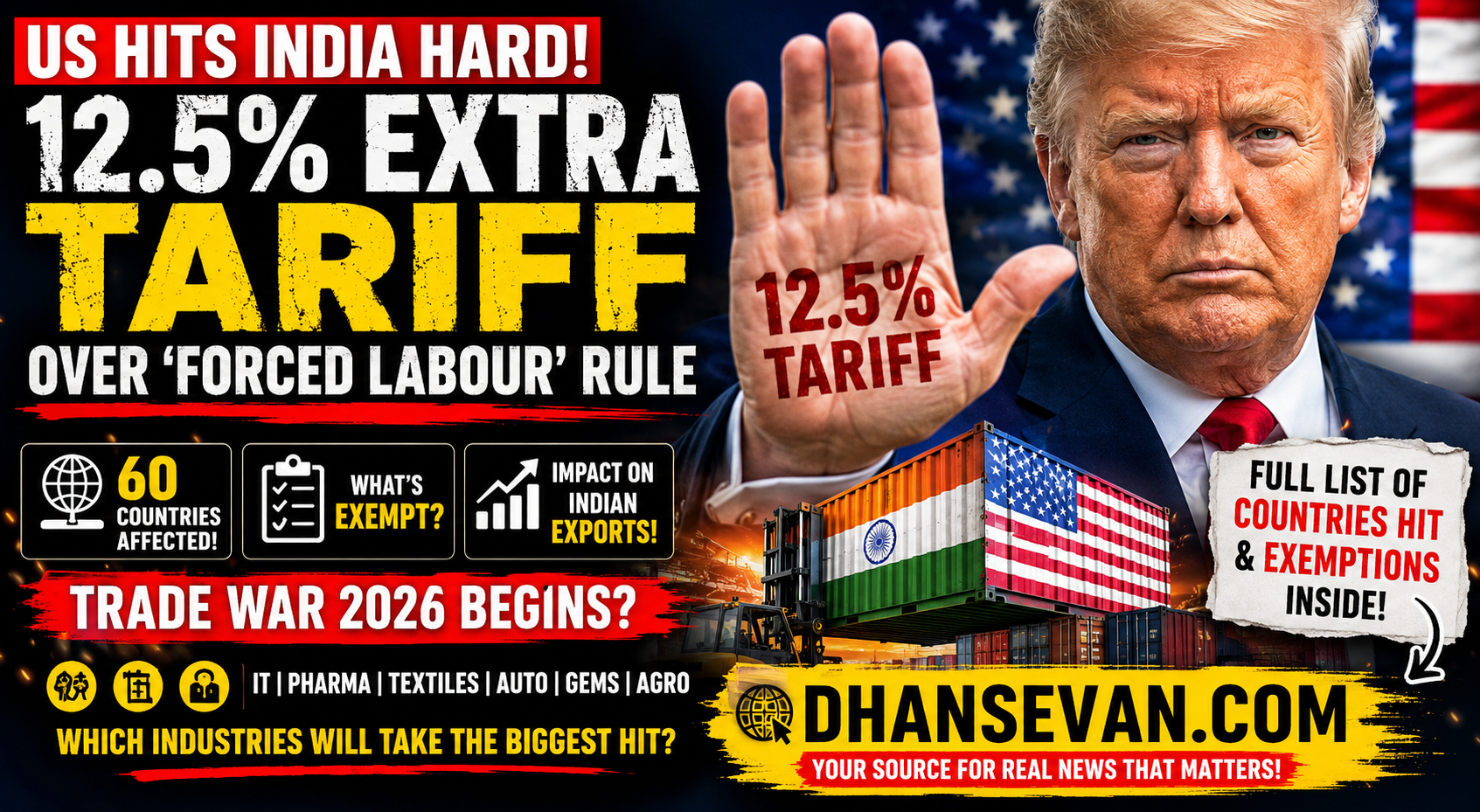
The United States has proposed new tariffs of at least 10% on imports from 60 major trading partners — with India facing a steeper 12.5% levy — accusing them of failing to enforce forced labour import bans. Here is the full breakdown of which countries are hit, what products are exempt, how Indian industries from IT to textiles will be affected, and why this tariff bombshell could reshape global trade in 2026.
Uday Jasani
Gaming Expert · Dhansevan Editorial Team
America Just Opened a New Tariff Front Against India — And 59 Other Countries
On June 3, 2026, the Office of the United States Trade Representative dropped what may become one of the most consequential trade actions of the year. The US proposed new tariffs targeting 60 economies — including India, China, Japan, South Korea, the United Kingdom, Brazil, Switzerland, and Vietnam — accusing them of failing to impose and enforce bans on the importation of goods made with forced labour.
India is among the countries facing the steeper 12.5% tariff rate. Six other economies — Canada, the European Union, Mexico, Ecuador, Indonesia, and Pakistan — were found to have prohibitions on paper but not to have enforced them effectively, earning them a slightly lower 10% rate.
The announcement is significant for multiple reasons. It is not a routine trade adjustment. It is a policy instrument that uses human rights language to justify economic protectionism. It comes amid ongoing India-US trade negotiations. It arrives while global markets are already rattled by the Iran war, oil price surges, and currency volatility. And it targets an extraordinarily wide range of countries simultaneously, making this a potential flashpoint for a multi-front trade confrontation.
For Indian businesses, exporters, stock market investors, and policymakers, the question is now urgent: what does this 12.5% tariff actually cover, who gets hit hardest, and what can India do about it?
What Exactly Did the US Announce?
The United States Trade Representative issued a notice stating that an investigation had found 54 economies "failed to impose and effectively enforce a forced labor import prohibition." These countries are proposed to face a 12.5% tariff on their exports to the United States.
A second group of six economies — Canada, Ecuador, the European Union, Indonesia, Mexico, and Pakistan — were found to have some form of forced labour import prohibition in place but were deemed not to have enforced it effectively. These countries face a 10% tariff.
The distinction matters. The US is not simply saying these countries use forced labour. It is saying they have not done enough to prevent goods made with forced labour from entering their own domestic markets or from being exported. The framing is strategic: it positions the tariff as a human rights measure rather than a purely economic one, making it harder for targeted countries to retaliate without appearing to defend forced labour practices.
Top US trade official Jamieson Greer made the rationale explicit: "The failure of our most important trading partners to address the importation of goods made with forced labor is unacceptable. This creates a dynamic where American workers are forced to compete globally on an unlevel playing field."
He added: "We will no longer tolerate this disparity."
Which Countries Face 12.5% and Which Face 10%?
The proposed tariff rates create two tiers of impact:
Countries Facing 12.5% Tariff
This higher rate applies to 54 economies that the USTR found have failed to impose any effective forced labour import prohibition. Major economies in this group include:
- **China** — by far the largest target, given the scale of US-China trade and the existing controversy over Uyghur forced labour in Xinjiang
- **India** — one of the most significant inclusions, given the ongoing bilateral trade negotiations
- **Japan** — a major US ally facing the higher rate despite close diplomatic ties
- **South Korea** — another key US partner hit with the steeper tariff
- **Vietnam** — which has become a major manufacturing hub partly by absorbing supply chains relocating from China
- **United Kingdom** — notably post-Brexit, facing the same rate as countries with far weaker labour protections
- **Brazil** — Latin America's largest economy
- **Switzerland** — despite its reputation for strong governance
Countries Facing 10% Tariff
The lower rate applies to six economies that have forced labour import prohibitions but are deemed to not enforce them effectively:
- Canada
- European Union
- Mexico
- Ecuador
- Indonesia
- Pakistan
Notably, goods from Canada and Mexico that comply with the USMCA — the North American free trade agreement — will be exempt from the new tariffs entirely. This creates a significant advantage for North American supply chains that meet USMCA standards.
What Products Are Exempt?
The proposed tariffs come with several notable exemptions that reveal the political calculations behind the policy:
- **Beef** — exempt, protecting US agricultural import dependencies
- **Coffee** — exempt, given the US is the world's largest coffee consumer
- **Certain fruits and nuts** — exempt, likely reflecting domestic supply gaps
- **USMCA-compliant goods from Canada and Mexico** — exempt, incentivising compliance with the North American trade framework
- **Certain textiles and apparel** — specific exemptions that will need to be reviewed in detail
These exemptions are strategically chosen. They protect products where the US depends heavily on imports and where domestic alternatives are insufficient. The message is clear: the tariff is designed to punish, not to inflict self-harm on American consumers.
Why India Is at 12.5% and Not 10%
India being placed in the 12.5% tier rather than the 10% tier is notable. The US assessment effectively says that India does not have an adequate forced labour import prohibition in place — not just that it has one but fails to enforce it.
This distinction has diplomatic implications. Countries in the 10% tier — like the EU, Canada, and Mexico — are being told their laws are inadequate in practice but at least exist. India, along with China, Japan, and dozens of other countries, is being told it lacks even the basic legal framework the US considers necessary.
Whether this assessment is fair is debatable. India has labour laws, constitutional protections against forced labour under Article 23, and has ratified International Labour Organisation conventions on the subject. However, enforcement gaps — particularly in sectors like brick kilns, agriculture, domestic work, and certain manufacturing supply chains — have been documented by international organisations for years.
The practical effect is that Indian exports to the US may face a 12.5% additional cost that could make them less competitive against products from countries that are either exempt or face the lower 10% rate. For industries operating on thin margins, this difference can be decisive.
How Indian Industries Will Be Affected
The impact of a 12.5% tariff on Indian exports to the US will vary significantly by sector. Here is a breakdown of the most exposed industries:
Information Technology and Software Services
India's IT services exports to the US are massive — the US is the single largest market for Indian IT companies like TCS, Infosys, Wipro, and HCL Technologies. However, most IT services are delivered as services rather than goods, and tariffs typically apply to goods imports. The direct impact on IT services may therefore be limited, though there could be indirect effects if the broader trade environment deteriorates and US companies reduce outsourcing budgets.
The stock market impact is more immediate. IT stocks on the BSE and NSE are highly sensitive to India-US trade sentiment, and even the threat of broader trade friction can trigger sell-offs. The Sensex dropped 410 points on June 3, partly reflecting global trade uncertainty.
Pharmaceuticals and Generic Drugs
India is the pharmacy of the world, supplying around 40% of generic drugs consumed in the United States. Pharmaceutical exports are one of India's most strategically important trade categories. A 12.5% tariff on pharmaceutical products would increase costs for American consumers and healthcare systems — which may create political pressure within the US to exempt this category.
However, if the tariff applies without exemption, Indian pharma companies could face margin compression. Companies like Sun Pharma, Dr Reddy's, Cipla, and Aurobindo Pharma derive significant revenue from the US market. Even a partial tariff impact could affect stock valuations and force pricing adjustments.
Textiles and Apparel
India is a major textile and apparel exporter to the US. The USTR notice mentions "certain textiles and apparel" exemptions, but the details are not yet fully clear. If the exemptions are narrow, Indian textile exporters — particularly those in Tirupur, Surat, and Ludhiana — could face serious competitiveness challenges against Vietnamese and Bangladeshi competitors who may receive different treatment.
This sector is particularly sensitive because textile manufacturing in India employs millions of workers, many of whom are women and migrant labourers. Any disruption to export orders flows directly into employment and livelihoods.
Gems and Jewellery
India's gems and jewellery exports to the US are substantial. The sector, centred in Surat for diamonds and Mumbai for finished jewellery, operates on relatively thin margins. A 12.5% tariff could make Indian processed diamonds and jewellery less competitive against products from countries with better trade terms.
Agricultural Products
Indian agricultural exports to the US — including spices, rice, seafood, and processed foods — could face the additional 12.5% duty. While these are smaller in absolute dollar terms compared to IT or pharma, they affect a large number of small and medium enterprises across rural India.
Automobile Components and Engineering Goods
India exports auto components and engineering products to the US, and these sectors are already operating in a competitive global environment. A 12.5% additional tariff could push some US buyers to source from Mexico or Canada, which enjoy USMCA exemptions.
The Supreme Court Factor: Why This Tariff Uses a Different Legal Route
One of the most important details in this announcement is the legal mechanism being used. Earlier in 2026, the US Supreme Court struck down a significant portion of President Donald Trump's tariffs, ruling that the executive branch had exceeded its authority. This decision forced US trade officials to find alternative legal pathways for imposing new duties.
The current tariff proposal uses a Section 301 investigation — a different legal instrument that has historically been used to address unfair trade practices by foreign governments. By framing the tariff as a response to forced labour failures rather than as a general reciprocal tariff, the USTR is attempting to build a more legally durable foundation that can withstand judicial review.
This legal strategy matters for India because it means the tariff could be harder to challenge in US courts and may remain in place longer than previous tariff actions that were struck down. It also means the tariff is embedded in a human rights framework, making diplomatic objections more complex.
The Timeline: What Happens Next
The tariff is not yet in effect. The USTR has outlined a process that includes several steps before implementation:
- **Written comments period** — open until July 6, 2026, allowing affected parties, businesses, and governments to submit objections and evidence
- **Public hearings** — a Section 301 panel is expected to convene beginning July 7, 2026
- **Final determination** — after reviewing comments and hearing testimony, the USTR will issue a final decision on the tariff rates and covered products
This timeline gives India approximately one month to mount a diplomatic and trade response. The Indian government, through the Ministry of Commerce and Industry and the Ministry of External Affairs, will need to decide whether to negotiate, retaliate, or seek exemptions for specific product categories.
The written comments period is also an opportunity for Indian industry associations — FICCI, CII, NASSCOM, and sector-specific bodies — to submit evidence demonstrating India's existing labour protections and enforcement efforts.
India-US Trade: The Bigger Picture
This tariff announcement does not exist in a vacuum. India and the United States have been engaged in trade negotiations that have produced mixed results. The relationship is complex: the US is India's largest trading partner, bilateral trade has grown significantly in recent years, and both countries have strategic interests in deepening economic ties — particularly as a counterweight to China.
However, trade irritants have persisted. The US has repeatedly pushed India to reduce tariffs on American agricultural products, open up its digital payments and e-commerce markets, and strengthen intellectual property protections. India, in turn, has sought greater access for Indian professionals through H-1B visa reforms and has objected to US tariff actions that it considers protectionist.
The forced labour tariff adds a new dimension to this relationship. If India is seen as unwilling or unable to address the underlying concerns, it could weaken its negotiating position on other trade issues. Conversely, if India responds with its own retaliatory measures, it risks escalating a trade dispute with its most important export market.
The most likely outcome is a combination of diplomatic engagement and targeted concessions. India may offer to strengthen its forced labour import screening mechanisms in exchange for exemptions on key product categories like pharmaceuticals and IT services. Whether the US accepts such an approach will depend on the broader political dynamics in Washington.
Market Impact: How Sensex, Nifty, and the Rupee Are Reacting
Financial markets have already begun pricing in the uncertainty. The Sensex fell 410 points on June 3, with the index closing at 73,935. The Nifty 50 also showed weakness. While the tariff announcement was not the only factor — the Iran war escalation and global oil price concerns also contributed — the trade policy uncertainty added to the negative sentiment.
The rupee faces additional pressure. If the tariff reduces Indian export revenues, it could widen the trade deficit and put downward pressure on the currency. Combined with the existing oil price shock from the Iran conflict, the rupee could face a period of sustained weakness against the dollar.
For stock market investors, the sectors most directly exposed — IT services, pharmaceuticals, textiles, and auto components — deserve close monitoring. Companies with high US revenue dependence may see analyst downgrades if the tariff proceeds as proposed.
However, it is important not to overreact. The tariff is proposed, not implemented. The comments period and public hearings create space for negotiation. Many previous tariff threats have been modified or withdrawn during the review process. Investors should track the July 6 deadline and the subsequent public hearings closely before making portfolio adjustments.
Global Context: How Other Countries Are Responding
India is not the only country processing this announcement. The tariff targets 60 economies simultaneously, creating a potential coalition of affected parties. How major economies respond will shape the global trade environment for years to come.
China, which already faces massive US tariffs from previous trade disputes, may treat this as a further escalation in an already adversarial relationship. The EU, which is placed in the lower 10% tier, may see this as an opportunity to negotiate a quick resolution while lobbying for Indian and Japanese inclusion in the lower tier as well.
Japan and South Korea — both close US allies with significant military cooperation — face a diplomatic awkwardness. Being tariffed at the same rate as China on a human rights issue is not a comfortable position for governments that consider themselves part of the democratic, rules-based order.
The UK, freshly post-Brexit and seeking to build independent trade relationships, faces the 12.5% rate despite having its own Modern Slavery Act. This may trigger domestic political debate about whether Brexit-era trade independence has delivered the benefits promised.
For India, the key question is whether it can build coalitions with other affected countries to present a unified response. A joint diplomatic effort involving India, Japan, the EU, and others could carry more weight than individual bilateral negotiations.
What India Should Do Now
The Indian government and business community have approximately one month before the written comments period closes on July 6. Here is what needs to happen:
- **Immediate diplomatic engagement** — The Ministry of External Affairs and the Indian Embassy in Washington should seek clarification from the USTR on exactly which product categories are covered and which may be exempt
- **Industry submissions** — FICCI, CII, NASSCOM, the Pharmaceutical Export Promotion Council, and textile industry bodies should prepare detailed written comments documenting India's existing labour protections and enforcement efforts
- **Legal analysis** — India's trade lawyers should examine the Section 301 legal framework to identify potential challenges or vulnerabilities in the US position
- **Contingency planning** — Export-dependent industries should model the financial impact of a 12.5% tariff and prepare alternative market strategies
- **Domestic policy review** — If the US concerns about forced labour import screening have merit, India should consider whether strengthening its own import controls could serve as a basis for seeking an exemption
Bottom Line
The US proposal to impose a 12.5% tariff on Indian exports over forced labour concerns is a serious trade action that could affect billions of dollars in bilateral commerce. It is not yet final, and the July comments period creates space for negotiation. But the framing — using human rights language to justify economic protectionism — makes this a more complex challenge than a standard tariff dispute.
For Indian exporters, the message is to prepare for impact while hoping for negotiation. For investors, the message is to monitor but not panic. For policymakers, the message is to engage urgently and substantively before the July 6 deadline.
The global trade environment in 2026 is more volatile than at any point since the original Trump tariff wars of 2018-2019. Between the Iran conflict disrupting oil markets, the CBSE and NEET crises disrupting education confidence, and now a new tariff front disrupting trade, India is navigating multiple simultaneous pressures that demand both steady leadership and adaptive strategy.
Frequently Asked Questions
What tariff rate does India face from the US?India faces a proposed 12.5% additional tariff on its exports to the United States, under a new US investigation into countries that have failed to impose and enforce forced labour import prohibitions.How many countries are affected by this US tariff?A total of 60 economies are targeted. Fifty-four face the higher 12.5% rate, while six — including Canada, the EU, and Mexico — face a 10% rate for having prohibitions that are not effectively enforced.What products are exempt from the tariff?Exemptions include beef, coffee, certain fruits and nuts, USMCA-compliant goods from Canada and Mexico, and certain textiles and apparel. The full list of exemptions will be clarified during the review process.When does the tariff take effect?The tariff is currently a proposal. The USTR has opened a written comments period until July 6, 2026, with public hearings expected to begin on July 7. The final determination will come after this review process.Which Indian industries are most at risk?Pharmaceuticals, textiles and apparel, gems and jewellery, agricultural products, and automobile components are among the most exposed sectors. IT services may be less directly affected since they are delivered as services rather than goods.Can India retaliate against this tariff?India can impose retaliatory tariffs on US imports, but this risks escalating a trade dispute with its largest trading partner. The more likely approach is diplomatic engagement and seeking exemptions for key product categories.Why is the US using forced labour as the reason for tariffs?After the US Supreme Court struck down earlier Trump-era tariffs for exceeding executive authority, the USTR is using Section 301 investigations with a forced labour framework to create a more legally durable basis for new tariffs.
About the Author
Uday Jasani
The Dhansevan editorial team consists of passionate gamers and tech enthusiasts who test and review every game before publishing. Our writers bring first-hand gaming experience and follow strict editorial standards to ensure accurate, helpful content for our readers.
Disclaimer: This article is for informational purposes only. Game features, availability, and earning potential may vary. Always download games from official sources and read their terms of service. Dhansevan does not guarantee any specific results from using the apps mentioned above.