
17-Year-Old Sarthak Sidhant Exposed CBSE's ₹Crore OSM Scam, Presented Before Parliament, and Became India's Most Savage Teenager on X
A 17-year-old student named Sarthak Sidhant spent days reviewing government procurement portals, published a devastating blog accusing CBSE of rewriting tender rules to favour one company, was called before a parliamentary standing committee, met Rahul Gandhi, and became X's newest viral hero with savage replies to trolls and media outlets. Here is the full story of how one teenager shook India's most powerful education board.
Uday Jasani
Gaming Expert · Dhansevan Editorial Team
A 17-Year-Old Student Just Took On India's Most Powerful Education Board — And Won the Internet
In a country where millions of students silently accept whatever the Central Board of Secondary Education hands them — results, answer sheets, evaluation systems, and all — one teenager decided to do something radically different. He read the fine print. Then he read the government procurement documents. Then he published everything online. And then, when the trolls came for him, he cooked them on X with the kind of savage energy that made the entire internet fall in love.
His name is Sarthak Sidhant. He is 17 years old. And in the span of a few weeks, he has gone from a relatively unknown student to one of the most talked-about young people in India — someone who presented evidence before a parliamentary standing committee, met the Leader of the Opposition, trended across every major social media platform, and became the face of a student-led backlash against a system that was supposed to serve them.
This is the full story of how Sarthak Sidhant exposed what he alleges is a systemic manipulation of CBSE's On-Screen Marking tender process, how his findings led to real political and institutional consequences, and why his savage X replies have turned him into India's newest internet icon.
What Is the CBSE OSM Controversy?
To understand why Sarthak Sidhant matters, you first need to understand the crisis that preceded him. The Central Board of Secondary Education introduced an On-Screen Marking system for evaluating Class 12 answer sheets. Instead of physical answer sheets being checked by teachers with red pens, the new system digitises the answer sheets and has them evaluated on screens through specialised software.
The idea behind OSM is not inherently flawed. Several examination boards worldwide use digital evaluation. But the way CBSE implemented it in the 2025-2026 cycle has become one of the biggest education controversies India has seen in years.
It started with the results. CBSE's Class 12 pass percentage fell noticeably, triggering anxiety among students, parents, and schools. Then individual students began reporting specific problems. Some found that the answer sheet images returned to them did not match what they remembered writing. Others reported mismatches between the pages — answers from one student allegedly appearing on another student's sheet. A few reported marks that made no mathematical sense given the answers visible on the returned sheets.
The first major individual case came from Vedant Shrivastava, a Delhi student who flagged a mismatch in his Physics answer sheet on May 23, 2026. His case attracted attention because it was specific, documented, and hard to dismiss. He showed that pages of his returned answer sheet did not correspond to his actual responses.
This was not a vague complaint about tough marking. This was a claim that the evaluation system itself was producing errors — that the technology hired to be more accurate than human checking was, in fact, creating new problems that human checking would not have produced.
Enter Sarthak Sidhant: The Blog That Changed Everything
While Vedant Shrivastava's case put a face on the problem students were experiencing, Sarthak Sidhant attacked the issue from a completely different angle. Instead of looking at individual answer sheets, he went upstream. He investigated how CBSE selected the company that built and operated the OSM system in the first place.
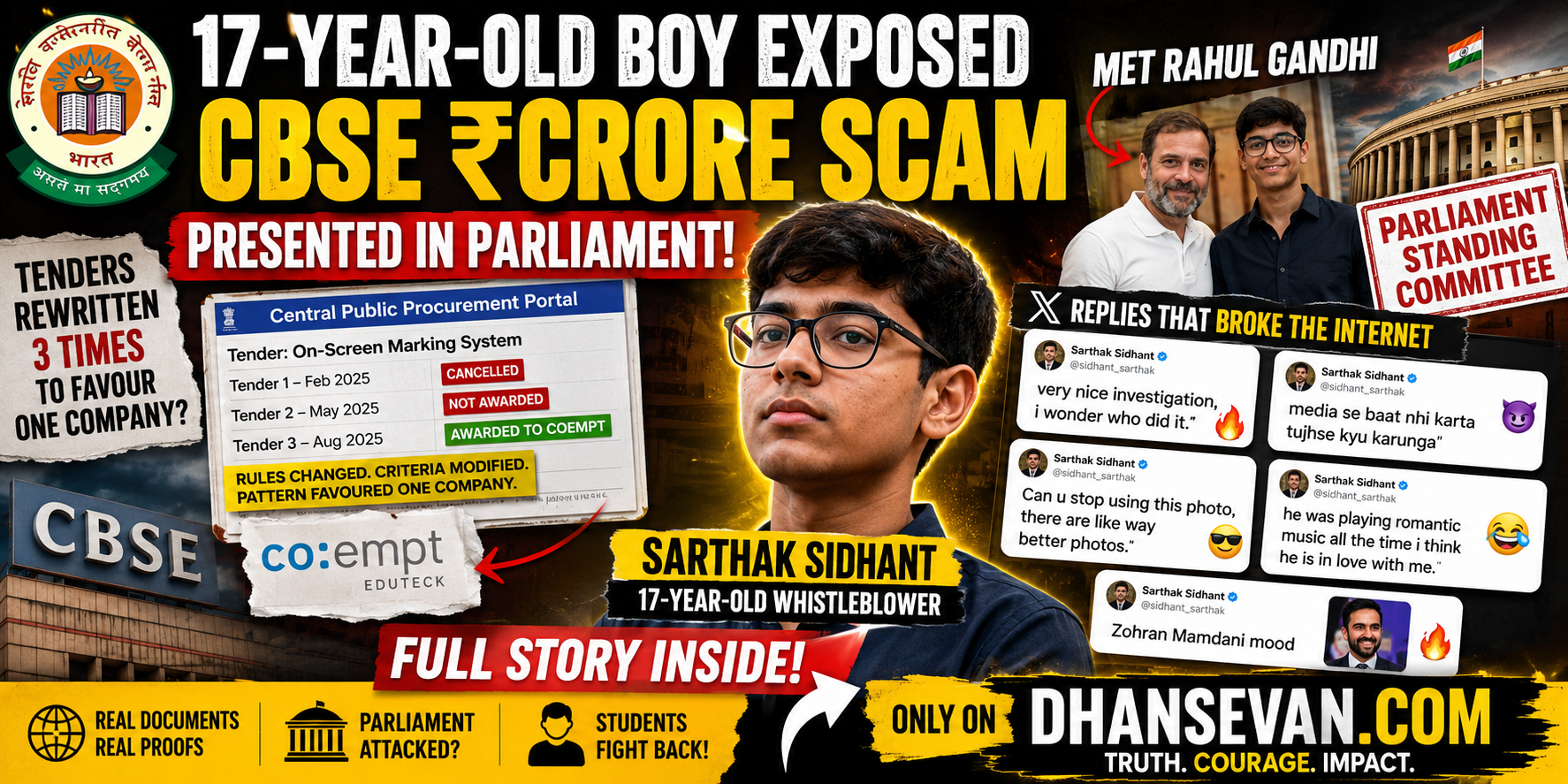
According to his own account, Sidhant spent several days reviewing tender documents available on the Central Public Procurement portal — the government website where public institutions are required to publish their procurement processes. What he found, or claims to have found, was a pattern that he published in a detailed blog post on his personal website, sarthaksidhant.com/coempt.
The blog was titled *How CBSE Rewrote Rules to Favour Coempt EduTeck*. Its opening line set the tone: *"This is a story of how a massive public institution deliberately played with students' futures by rewriting its own rulebook."*
The core allegation is this: CBSE floated three separate tenders for the OSM system. The first tender, issued in February 2025, was eventually cancelled without a successful bidder. The second, issued in May 2025, received four bids but was not awarded. The third, floated in August 2025, attracted bids from three companies — Rankguru, TCS, and a Hyderabad-based firm called Coempt EduTeck Private Limited. Coempt won after Rankguru failed to qualify at the technical stage.
What Sidhant's blog alleged was that across these three successive tender rounds, CBSE systematically modified the eligibility criteria and technical requirements in a pattern that progressively favoured Coempt. In other words, the accusation is not simply that the wrong company won. The accusation is that the rules themselves were rewritten between tenders in a way that made it easier for one specific company to win and harder for established competitors to qualify.
Both CBSE and Coempt EduTeck have denied any wrongdoing.
From Blog to Parliament: How a Student Was Called Before a Standing Committee
What happened next is almost unprecedented in Indian education politics. Sarthak Sidhant — a 17-year-old student with no political connections, no institutional backing, and no media team — was asked to appear before the Parliamentary Standing Committee on Education, Women, Children, Youth and Sports.
On Tuesday, June 3, 2026, Sidhant presented his findings before the committee. According to people familiar with his presentation, he walked the committee through the three tender rounds, explaining the changes in eligibility criteria between each round and highlighting what he described as a pattern of progressive modification that benefited the eventual winner.
This is extraordinary for several reasons. Parliamentary standing committees are among the most powerful oversight bodies in India's democratic system. They can summon government officials, demand documents, and make recommendations that carry serious political weight. For a teenager to be invited to present before such a body, based on research he conducted independently using publicly available procurement documents, reflects both the seriousness of the allegations and the failure of official institutions to address the issue before a student had to do it for them.
The parliamentary appearance also elevated the story from a social media controversy to a matter of formal democratic scrutiny. Whatever CBSE says in response will now be measured not just against public opinion but against the findings of a committee with constitutional authority.
Sarthak's Savage X Replies That Broke the Internet
If the blog and the parliamentary appearance made Sarthak Sidhant a credible whistleblower, his behaviour on X made him a viral sensation. Over the past few days, his replies to trolls, media outlets, and random commenters have become the kind of content people screenshot and share across WhatsApp groups, Instagram stories, and Reddit threads.
Here is a selection of the moments that made the internet collectively declare him the newest chad:
The Shoutout to Sanjay Maurya
When a user accused media outlets of stealing credit from students who first raised concerns about CBSE, Sidhant did not take the bait of blanket media-bashing. Instead, he specifically defended Hindustan Times reporter Sanjay Maurya, writing: *"Sanjay is doing actual exclusives. He is doing actual investigative journalism."* In an era where distrust of media is often expressed as a blanket dismissal, a 17-year-old making a specific, named defence of a journalist who was actually doing the work stood out. It showed nuance, fairness, and the ability to distinguish between outlets riding a trend and reporters genuinely digging.
The Sarcastic Media Takedown
When a news portal posted about the impact of their coverage after CBSE officials were transferred and a probe committee was formed, claiming major credit, Sidhant replied with devastating understatement: *"very nice investigation, i wonder who did it."* The reply went viral because it did not name-call or argue. It simply let the irony do the work. Thousands of retweets followed.
The Photo Complaint
When a user posted an old image of Sidhant while asking whether reports were true that he had demanded Union Education Minister Dharmendra Pradhan's resignation before the parliamentary standing committee, Sidhant's response was not about the political claim at all. He replied: *"Can u stop using this photo, there are like way better photos."* The combination of ignoring the dramatic political question and focusing on his image choice was peak Gen-Z energy. The reply was screenshotted and shared millions of times.
The Hindi Burn
When a user accused him of spreading "misleading CBSE tender propaganda by Rahul Gandhi puppet" and challenged him to join an X Spaces discussion, Sidhant fired back in Hindi: *"media se baat nhi karta tujhse kyu karunga"* — meaning "I don't speak to media, why would I speak to you." The reply was devastating because it simultaneously dismissed the challenger and elevated Sidhant's own status by implying he had bigger platforms refusing his time than a random X Space.
The Romantic Music Jab
In a follow-up to the same user, Sidhant added: *"he was playing romantic music all the time i think he is in love with me."* This was the kind of absurdist, low-effort roast that travels across platforms. It showed that Sidhant was not taking the trolls seriously enough to fight — he was treating them as entertainment. That tonal confidence from a 17-year-old dealing with national-level political pressure made the internet love him even more.
The Zohran Mamdani Mood
When asked how he was feeling with all the recent controversies, Sidhant responded with a screen recording featuring pictures of New York politician Zohran Mamdani. The choice was deliberate. Mamdani is known for his own internet-savvy, meme-friendly political presence. By using a niche global political reference instead of a standard Bollywood reaction GIF, Sidhant signalled that his cultural radar extends well beyond the usual Indian internet vocabulary.
The Rahul Gandhi Meeting and Its Political Significance
On Tuesday evening, June 3, Congress MP Rahul Gandhi met Sarthak Sidhant. Gandhi posted about the meeting on X with a Hindi wordplay: *"Sarthak, apne sidhanton pe adig raho"* — using the student's surname to say "Sarthak, stay firm on your principles (sidhant)."
This was the second teenaged whistleblower Gandhi publicly backed in three days. On May 31, he had met Vedant Shrivastava, the Delhi student who first flagged the Physics answer sheet mismatch. The pattern is clear: the Opposition is treating the CBSE-OSM controversy as a major political issue and using the student whistleblowers as both symbols and sources.
For Sidhant, the meeting with Gandhi creates both opportunity and risk. It gives his findings political amplification, which increases the pressure on CBSE and the Education Ministry. But it also gives critics ammunition to dismiss him as politically motivated — a line of attack already visible in the "Rahul Gandhi puppet" accusations he has faced on X.
Sidhant's response to this tension has so far been effective: he has not aligned himself with any party, has not made explicitly partisan statements, and has kept his focus on the procurement documents rather than on political personalities. Whether he can maintain that balance as the story grows bigger will be one of the most interesting things to watch.
The Three Teenagers Who Shook CBSE
What makes this story even more remarkable is that Sarthak Sidhant is not alone. Three teenagers have emerged as the most prominent faces of the student backlash against CBSE in 2026:
- **Vedant Shrivastava** — The Delhi student who first flagged specific answer sheet mismatches in his Physics paper on May 23, giving the controversy its first concrete, documentable case.
- **Sarthak Sidhant** — The 17-year-old who investigated the tender process itself, published the blog alleging systematic rule manipulation, and presented before a parliamentary committee.
- **Nisarga Adhikary** — A 19-year-old self-described ethical hacker who flagged alleged security vulnerabilities in the OSM portal itself, raising questions about whether the system was technically robust enough to handle millions of answer sheets securely.
Together, these three teenagers represent a generation that does not wait for journalists, politicians, or regulators to investigate. They used publicly available data, digital tools, personal websites, and social media platforms to do the work that institutions are supposed to do — and they did it faster, more visibly, and with more public impact than any official inquiry.
This is a significant moment for Indian civic engagement. When teenagers can read procurement portals, find vulnerabilities in government software, and hold press-conference-level accountability sessions on X, the balance of power in public discourse shifts. CBSE is now responding not to media pressure or political pressure but to student pressure — a dynamic that would have been almost unimaginable even five years ago.
The NEET Connection: Why the Timing Matters
The CBSE-OSM controversy is not happening in isolation. It has exploded alongside another massive education scandal: the NEET-UG 2026 paper leak. The national medical entrance exam, which determines the futures of millions of aspiring doctors, was compromised by a paper leak that led to the exam being cancelled. A re-test has been scheduled for June 21.
The combined effect of two simultaneous education scandals — one involving the integrity of school board evaluation and the other involving the security of the country's biggest medical entrance exam — has created a crisis of confidence in India's examination infrastructure. Parents, students, and educators are asking the same fundamental question: if the systems designed to evaluate and select students fairly are this compromised, what exactly can students trust?
For Sidhant and the other student whistleblowers, this broader context amplifies their impact. They are not just flagging one problem with one tender. They are embodying a generation's frustration with institutions that control their futures but seem unable to deliver basic competence and integrity.
What Has CBSE Said in Response?
CBSE has been in damage-control mode throughout this period. The board has issued multiple clarifications, denied allegations of tender manipulation, and attempted to debunk specific claims made by Opposition politicians. However, the board's response has been widely seen as insufficient — partly because the allegations are detailed and specific while the rebuttals have often been general, and partly because the simultaneous answer sheet mismatch complaints from individual students undermine CBSE's credibility on the evaluation system's reliability.
Several CBSE officials have been transferred since the controversy gained momentum. A probe committee has been formed. But these steps have been seen by critics as reactive rather than proactive — actions taken only after the story became politically untenable, not because the board identified problems on its own.
The gap between what a 17-year-old found by reading procurement portal documents and what CBSE claimed was fine with its own process is the central embarrassment of this story. Whether the board's internal review validates or refutes Sidhant's specific allegations will determine whether this remains a political controversy or becomes a full-blown institutional scandal.
Why Sarthak Sidhant Has Become a Symbol for Gen-Z India
Sarthak Sidhant's rise is not just a news story. It is a cultural moment. Here is a teenager who did not protest with placards or trending hashtags. He protested with documents. He read tenders. He compared eligibility criteria across procurement rounds. He published his findings with citations. He appeared before a parliamentary committee and walked them through the data.
And then, when the internet came for him — with both praise and attacks — he handled it with the confidence of someone who has spent their entire life on social media and understands exactly how to play the game. His one-line replies are not rehearsed PR responses. They are the natural output of a generation that grew up with meme culture, learned rhetoric through tweet threads, and developed an instinct for what goes viral.
What makes Sidhant especially compelling is the combination. Many young people are good at social media but have no substance behind the style. Many researchers do excellent work but have no idea how to communicate it. Sidhant has both: the analytical rigour to read procurement documents and the cultural fluency to body a troll in one sentence.
That combination is why the internet has crowned him. It is also why CBSE should be worried. Because if one 17-year-old can do this with publicly available data and a personal blog, the next one will do it faster, with more tools, and to an even larger audience.
What Happens Next?
Several developments are expected in the coming days and weeks. The parliamentary standing committee will likely issue observations or recommendations based on the presentations they have received, including Sidhant's. The probe committee formed by CBSE will have to produce findings that address the specific allegations about tender modification. The NEET-UG re-test on June 21 will test whether the examination infrastructure can deliver a credible result under extreme scrutiny. And the political dynamics will continue to evolve as the Opposition uses the education controversies to pressure the ruling government.
For Sarthak Sidhant personally, the question is what comes next. He has been careful so far to position himself as a student and a researcher, not as a political actor. But the forces around him — political leaders, media outlets, social media dynamics — will all try to pull him in different directions. His ability to maintain the credibility that comes from being seen as non-partisan and evidence-driven will determine whether his impact is a moment or a movement.
Either way, his story has already changed the conversation. A teenager read the documents. A teenager published the findings. A teenager walked into Parliament. And a teenager made the internet laugh while doing it. Whatever happens next, that already matters.
Frequently Asked Questions
Who is Sarthak Sidhant?Sarthak Sidhant is a 17-year-old student who investigated CBSE's On-Screen Marking tender process, published detailed findings alleging the board modified eligibility criteria across three tender rounds to favour one company called Coempt EduTeck, and presented his research before a parliamentary standing committee on June 3, 2026.What is the CBSE OSM controversy?CBSE introduced an On-Screen Marking system for evaluating Class 12 answer sheets. Students reported errors, mismatches, and mix-ups in their returned answer sheets, while Sidhant's blog alleged that the tender process for selecting the OSM vendor was manipulated. Both CBSE and the winning company have denied wrongdoing.Why did Sarthak Sidhant go viral on X?Sidhant's sharp, humorous, and savage replies to trolls, media outlets, and critics went viral on X. His one-liners — from defending a journalist, sarcastically calling out a news portal for claiming credit, to asking users to use a better photo of him — made him a Gen-Z internet hero.Did Sarthak Sidhant meet Rahul Gandhi?Yes, Congress MP Rahul Gandhi met Sarthak Sidhant on June 3, 2026, posting about it on X with a Hindi wordplay on Sidhant's name meaning principles. Gandhi had previously met Vedant Shrivastava, another student who flagged CBSE issues.What is Coempt EduTeck?Coempt EduTeck Private Limited is a Hyderabad-based company that won the CBSE contract for the On-Screen Marking system. Sidhant's blog alleges that CBSE modified tender criteria across three rounds in ways that favoured Coempt. The company has denied any irregularities.What is the connection between CBSE OSM and NEET paper leak?Both scandals exploded simultaneously in mid-2026, creating a combined crisis of confidence in India's examination infrastructure. The NEET-UG 2026 exam was cancelled due to a paper leak and rescheduled for June 21, while the OSM controversy raised questions about CBSE's evaluation integrity.Who are the three teenagers who challenged CBSE?Vedant Shrivastava flagged specific answer sheet mismatches, Sarthak Sidhant investigated the tender process, and Nisarga Adhikary — a 19-year-old ethical hacker — flagged security vulnerabilities in the OSM portal. Together they became the public faces of the student backlash.
About the Author
Uday Jasani
The Dhansevan editorial team consists of passionate gamers and tech enthusiasts who test and review every game before publishing. Our writers bring first-hand gaming experience and follow strict editorial standards to ensure accurate, helpful content for our readers.
Disclaimer: This article is for informational purposes only. Game features, availability, and earning potential may vary. Always download games from official sources and read their terms of service. Dhansevan does not guarantee any specific results from using the apps mentioned above.