
Petrol & Diesel Prices Suddenly Hiked Across India: Families Fear Bigger Inflation Shock After ₹3 Fuel Increase
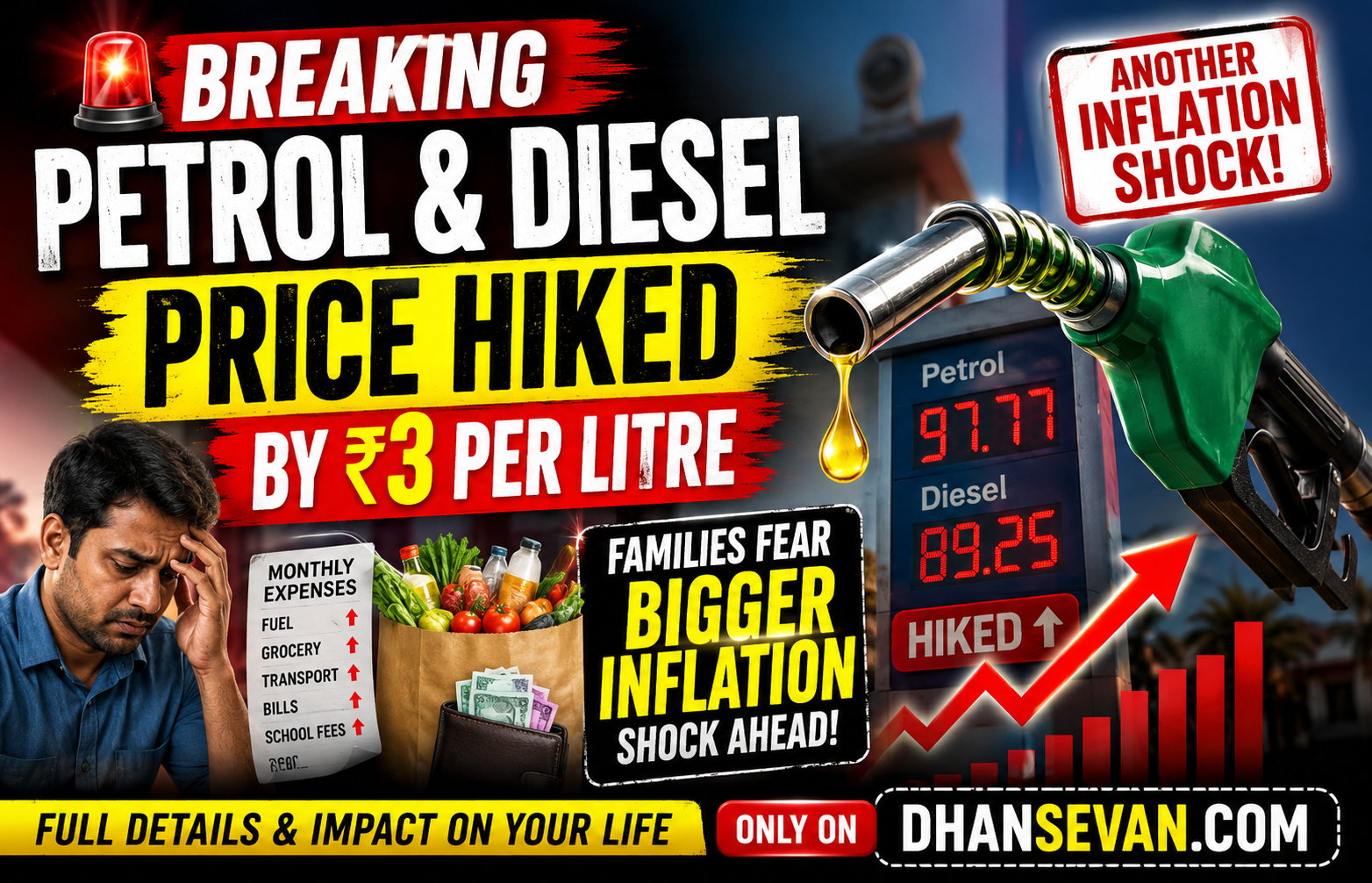
India woke up to another major economic shock as petrol and diesel prices were increased by ₹3 per litre amid rising global oil tensions. The sudden hike is expected to impact transportation, food prices, delivery costs, businesses, and household budgets across the country. Experts now fear this could be only the beginning if global crude prices continue climbing.
Uday Jasani
Gaming Expert · Dhansevan Editorial Team
India Gets Hit With Another Massive Fuel Price Shock
Millions of Indians woke up on Friday morning to an incredibly unwelcome reality: significantly higher fuel prices. Petrol and diesel became drastically more expensive across the entire country, dealing a severe blow to household budgets that were already stretched to their absolute limits.
State-owned oil marketing companies officially increased petrol and diesel prices by a steep ₹3 per litre, effectively passing a large portion of the growing global crude oil burden directly onto the shoulders of everyday consumers. The sudden move comes at a highly volatile time when international energy markets remain deeply unstable due to continuously escalating geopolitical tensions, unpredictable military conflicts in the Middle East, and persistent global supply chain disruptions.
In the national capital of Delhi, petrol prices jumped sharply from ₹94.77 to ₹97.77 per litre, while diesel prices experienced a similarly painful upward revision. In cities like Mumbai, Bangalore, and Hyderabad, where state taxes are traditionally higher, the fuel prices breached alarming new psychological barriers, causing widespread distress. For ordinary, hardworking families already struggling with sticky inflation, stagnant post-pandemic wages, and rising daily expenses, the latest fuel hike is creating intense, fresh anxiety about what the economic future holds and how they will manage to make ends meet.
Why Fuel Prices Are Rising So Fast And So Suddenly
The biggest, most undeniable reason behind this sudden and painful price increase is the ongoing, worsening instability in global oil markets.
India is structurally dependent on the rest of the world for its energy needs, importing a massive 85% to 90% of its crude oil requirements from international suppliers. This makes the Indian economy highly sensitive—and highly vulnerable—to global price shocks. Whenever global crude oil prices rise sharply due to war, supply cuts by OPEC+, or geopolitical fears, Indian fuel companies face immense financial pressure to increase domestic retail prices in order to balance their import costs and avoid catastrophic financial losses.
Experts and market analysts point out that the current geopolitical situation has become especially serious because military tensions in key oil-producing regions are directly threatening global supply chains. The Strait of Hormuz and the Red Sea, vital shipping routes connected to the international transport of oil, are under immense pressure due to conflict. Vessels are taking longer, more expensive routes to avoid danger zones, drastically increasing shipping and insurance costs, which are ultimately baked into the price of every barrel of oil.
As global crude prices continue their relentless climb, Indian oil companies are reportedly finding it mathematically impossible to absorb these mounting losses (often referred to as under-recoveries) without transferring a significant portion of that financial burden directly to the end consumers at the petrol pumps.
Middle-Class Families Are Feeling The Immediate, Painful Impact
While government officials and policymakers might argue that a ₹3 per litre increase is a necessary adjustment to global realities, economists and social commentators warn that the real, lived impact goes far beyond the numbers displayed at petrol pumps.
Fuel prices are the lifeblood of the economy; they directly and immediately affect transportation and logistics costs across every single sector. Once the cost of transportation becomes more expensive due to a diesel price hike, a domino effect begins. The prices of basic groceries, fresh vegetables, daily milk supplies, online e-commerce deliveries, heavy construction materials, and almost all daily essentials inevitably rise in tandem to cover the increased freight charges.
For middle-class and lower-income households, this cascading effect translates into significant financial pain:
- **Higher monthly commuting expenses:** People driving to work face an immediate dent in their disposable income.
- **More expensive cab and auto fares:** Ride-hailing apps and local transport unions often increase base fares to compensate for fuel hikes.
- **Costlier online food and grocery deliveries:** Delivery platforms may introduce higher delivery fees or surge pricing as their operational costs jump.
- **Increased bus and train transportation costs:** State transport corporations often hike ticket prices following major diesel price increases.
- **A definite rise in basic food prices:** Trucks bringing produce from rural farms to urban mandis will charge more, directly increasing the cost of tomatoes, onions, and wheat.
- **Higher travel expenses during vacations or family visits:** Making discretionary spending much harder to justify.
Many concerned social media users immediately began comparing the current situation to previous severe inflation spikes that historically devastated household savings and forced families to cut back on essential nutrition and healthcare to afford basic living costs.
Businesses Could Soon Pass Mounting Costs Onto Consumers
The fuel hike is not just a consumer problem; it is also expected to severely affect the profitability and operational stability of businesses across multiple crucial sectors of the Indian economy.
Industries that rely heavily on complex logistics, extensive transportation, massive delivery networks, continuous manufacturing, or fuel-intensive operations (such as running large diesel generators for power backup) will immediately face surging operational expenses. Experts widely believe that while companies might try to absorb these costs temporarily, they will inevitably have to transfer those additional expenses to customers through higher product prices to protect their shrinking profit margins.
Small and Medium Enterprises (SMEs), local independent transport operators, individual truck owners, and millions of gig economy delivery workers are among those most likely to feel the harshest, most immediate pressure from this sudden price increase. Unlike large corporations, they lack the financial buffers to absorb such shocks.
Several prominent financial analysts and banking experts say that retail inflation (CPI) and wholesale inflation (WPI) could accelerate much further if crude oil prices remain elevated globally over the next few quarters, potentially forcing the Reserve Bank of India (RBI) to keep interest rates higher for longer, which would further increase EMI burdens on home and car loans.
Public Anger And Frustration Starts Growing Online
The ₹3 price hike rapidly triggered intense, widespread reactions across various social media platforms, dominating trending topics and public forums.
Many frustrated users passionately questioned why domestic fuel prices are increasing so sharply despite constant global discussions by world leaders about economic relief, inflation control, and protecting the working class. Citizens pointed out the massive disparity between international crude price drops (when they rarely happen) and the speed at which domestic prices rise when crude goes up.
Others expressed deep, genuine concern that steadily rising fuel prices could trigger another vicious chain reaction of inflation, similar to previous devastating inflation waves seen globally after major crises. The memory of high inflation erasing hard-earned savings is still fresh in the minds of many Indian families.
A significant portion of the public also expressed fear and resignation, worrying that this ₹3 hike may not be the final increase, but rather the beginning of a series of hikes if international crude oil prices continue their upward trajectory in the face of ongoing wars.
The Tax Component: Why Doesn't The Government Cut Taxes?
A major part of the public debate surrounding fuel prices in India always centers on the heavy taxation imposed by both the Central and State governments.
Currently, a massive portion of the retail price of petrol and diesel consists of Central excise duties and State Value Added Taxes (VAT). When global crude prices rise, citizens typically demand that the government reduce these taxes to provide immediate relief to the common man.
However, governments are often highly reluctant to implement significant tax cuts. Fuel taxes are one of the most reliable, easy-to-collect, and massive sources of revenue for the exchequer. These funds are crucial for financing massive infrastructure projects, funding expansive social welfare schemes, and maintaining the fiscal deficit within acceptable limits.
Economic experts argue that while cutting taxes provides immediate popular relief, it severely damages the government's financial health, potentially leading to reduced spending on critical sectors like healthcare, education, and rural development. This creates a complex, painful policy dilemma where there are no easy answers, leaving the consumer to bear the brunt of global volatility.
Economists Warn This Could Be Just The Beginning Of A Larger Shock
Several seasoned market experts and macroeconomic forecasters believe the current ₹3 fuel hike may only be an early, glaring warning sign of much larger economic pressures lying ahead.
If geopolitical tensions in the Middle East and Eastern Europe continue affecting global oil supplies and disrupting critical shipping routes, India could soon face a multitude of converging economic challenges:
- **Further, successive fuel price increases:** Testing the absolute limits of consumer tolerance.
- **Runaway retail inflation:** Making the basic cost of living unaffordable for millions at the bottom of the pyramid.
- **Crippling transportation costs:** Slowing down domestic trade and interstate commerce.
- **Immense pressure on small businesses:** Leading to potential closures and job losses in the MSME sector.
- **Slower consumer spending:** As people spend more on fuel and food, they will stop buying appliances, clothes, and vehicles, slowing down overall GDP growth.
- **Increasing airline ticket prices:** Severely impacting the tourism and hospitality sectors.
- **Higher manufacturing expenses:** Making Indian exports less competitive in the global market.
Economists and the central bank are now closely, anxiously watching whether global crude oil markets show any signs of stabilizing in the coming weeks, or if they will continue escalating further into dangerous, uncharted territory.
Why Fuel Prices Matter Vastly More Than Most People Realize
The fundamental truth is that fuel is deeply, intricately connected to almost every single microscopic part of India’s vast economy.
When petrol and diesel prices rise, the effects do not just stop at the fuel station. They spread rapidly, like a virus, through transportation networks, massive farming operations, complex food distribution chains, bustling online commerce platforms, the critical logistics sector, and heavy manufacturing industries.
That profound interconnectedness is exactly why even a seemingly small increase in fuel prices often creates such widespread, palpable nationwide concern. Fuel is the foundation upon which the modern economy is built.
For ordinary, hardworking citizens, the real, terrifying fear is not just paying an extra ₹150 every time they fill up their two-wheeler at the petrol pump — it is the creeping, inevitable realization that everything else they consume and rely upon to survive may slowly, steadily become much more expensive too.
What Happens Next Will Depend Entirely On Global Oil Markets
At this precarious moment, the economic fate of millions of Indian households depends almost entirely on the unpredictable movements of international crude oil prices and whether global supply chains can stabilize amid raging wars.
If diplomatic efforts succeed, conflict de-escalates, and oil prices cool down internationally, India may narrowly avoid additional, devastating large fuel hikes, providing some breathing room for the RBI to manage inflation. However, if geopolitical tensions continue worsening and oil-producing nations restrict supply further, experts believe consumers must aggressively prepare their finances for significantly more economic pressure in the coming months.
For now, millions of Indians are nervously watching the numbers at the fuel dispensers, carefully adjusting their monthly household budgets, and bracing themselves as another massive wave of inflation fears begins spreading rapidly across the entire country.
About the Author
Uday Jasani
The Dhansevan editorial team consists of passionate gamers and tech enthusiasts who test and review every game before publishing. Our writers bring first-hand gaming experience and follow strict editorial standards to ensure accurate, helpful content for our readers.
Disclaimer: This article is for informational purposes only. Game features, availability, and earning potential may vary. Always download games from official sources and read their terms of service. Dhansevan does not guarantee any specific results from using the apps mentioned above.