
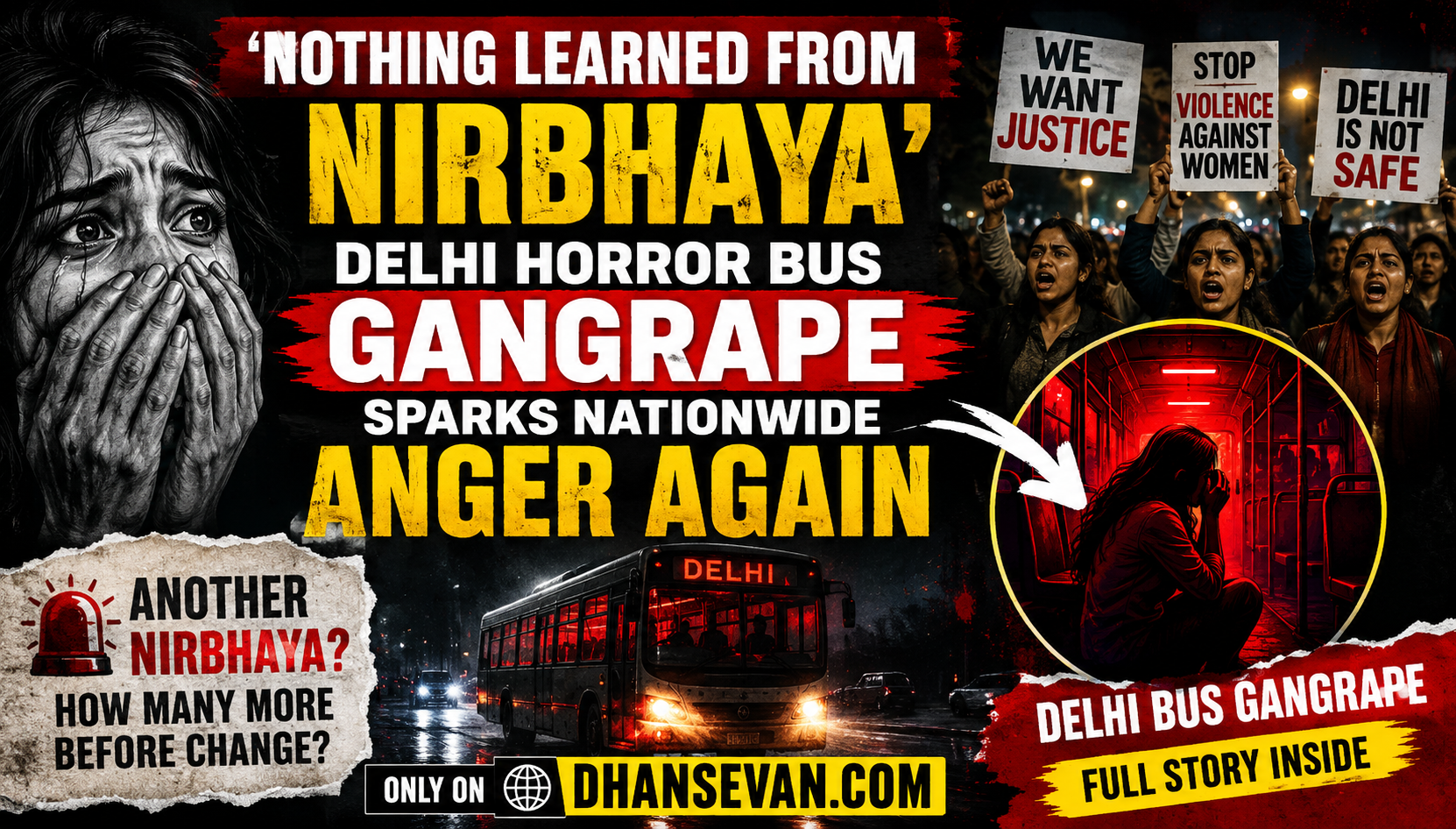
‘Nothing Learned From Nirbhaya’: Delhi Horror Bus Gangrape Sparks Nationwide Anger Again
A shocking gangrape case inside a private bus in Delhi has reignited painful memories of the 2012 Nirbhaya case, triggering outrage across the country. A 30-year-old woman was allegedly dragged into a moving bus and assaulted by the driver and conductor, raising fresh questions about women’s safety, public transport security, and whether India truly learned anything from past tragedies.
Uday Jasani
Gaming Expert · Dhansevan Editorial Team
Another Horrifying, Unthinkable Incident Shocks Delhi’s Conscience
India is once again helplessly witnessing a massive wave of nationwide anger, deep sorrow, and profound heartbreak after a deeply disturbing, savage gangrape case occurred inside a moving private bus in Delhi. The horrifying brutality of the crime instantly triggered traumatic, unavoidable comparisons to the infamous 2012 Nirbhaya tragedy, proving that the city's dark underbelly remains as dangerous as ever.
A 30-year-old married woman, simply trying to return home to her family after a long, exhausting shift, was allegedly violently dragged into a private sleeper bus in northwest Delhi. She was then brutally and repeatedly sexually assaulted by the vehicle's driver and conductor while the massive bus continued moving ominously through the city's busy streets late at night, entirely undetected by law enforcement.
The horrifying, chilling details of the case have completely shocked citizens across India, shattering any illusion of progress, and violently reignited painful, agonizing conversations about the absolute lack of women’s safety in the national capital, despite years of hollow political promises.
How The Barbaric Incident Allegedly Happened
According to preliminary police reports and the deeply traumatized survivor's harrowing testimony, the hardworking woman was desperately trying to return home after finishing a grueling shift at a local factory on the fateful night of May 11.
When she reached the desolate vicinity of the B-Block bus stand in Saraswati Vihar, hoping to find transport, she reportedly approached a man standing casually near a parked private tourist bus simply to ask for the current time, as her phone battery had died.
Investigators allege that in a split second of terrifying violence, the man suddenly and forcefully pulled her inside the dark confines of the bus. Almost immediately after, the heavy doors shut, and the vehicle began moving rapidly toward Nangloi, effectively becoming a mobile torture chamber while the driver and conductor allegedly assaulted her repeatedly over an extended period.
Police sources investigating the timeline say the bus was even brazenly parked near the Nangloi Metro Station during part of the horrific incident, hiding in plain sight, before continuing its movement again.
The vehicle, a symbol of systemic failure, has now been seized by authorities for extensive forensic examination to gather critical DNA evidence.
Why The Case Is Painfully Being Compared To Nirbhaya
The sheer brutality, the terrifying modus operandi, and the specific location of the crime immediately, unavoidably reminded millions of Indians of the horrific 2012 Nirbhaya gangrape case. That specific tragedy shook the entire conscience of the country, brought millions to the streets in unprecedented protests, and led to demands for radically stronger protections for women.
Social media platforms instantly quickly filled with raw, emotional reactions, with many traumatized people asking how such barbaric crimes are still happening more than a decade after what was supposed to be India’s most defining, transformative moment on women’s safety.
Several angry citizens expressed deep, bitter frustration that despite years of loud political promises, supposedly stricter laws (like the Nirbhaya Act), massive investments in CCTV surveillance systems, and endless public outrage, women continue facing extreme, life-threatening danger while simply attempting to travel alone at night in the capital city.
Swift Police Action And Crucial Arrests
Delhi Police stated that a desperate PCR call was received late at night from the survivor, who had managed to escape, reporting the horrific sexual assault by the two men.
Based on her detailed, courageous complaint, the Rani Bagh Police Station immediately registered a comprehensive FIR under multiple severe sections related to rape, gangrape, criminal intimidation, and common criminal intention under the newly enacted Bharatiya Nyaya Sanhita (BNS).
Authorities confirmed that following a massive manhunt utilizing electronic surveillance, one prime accused was arrested shortly after the FIR was officially filed, while the second accused was successfully apprehended by special teams within hours as he attempted to flee the state.
Both individuals were heavily guarded, later produced before a local magistrate court, and immediately sent to strict judicial custody pending further interrogation.
Dedicated police forensic teams are now meticulously examining hundreds of hours of CCTV footage along the route, analyzing complex technical evidence, collecting vital forensic material from the crime scene inside the bus, and mapping the exact route taken by the vehicle during the prolonged assault.
Serious Questions Raised Over Non-Existent Bus Safety Mechanisms
Beyond the perpetrators, investigators are also reportedly heavily scrutinizing the systemic failures, checking whether mandatory safety mechanisms inside the private bus were intentionally disabled or completely absent, violating transport laws.
Transport officials and police are trying to aggressively determine:
- **Whether the bus had functioning automatic doors:** Which are meant to prevent people from being dragged inside.
- **If mandatory emergency panic buttons were functional:** And why they were not accessible to the victim.
- **Why the commercial vehicle remained operational and roaming so late at night:** Without proper permits or passenger logs.
- **Whether GPS route monitoring systems failed:** Or if the bus was illegally operating "off the grid."
- **If severe transport regulations regarding background checks for staff were blatantly violated:** By the bus owner.
The horrific case has once again brutally exposed deeply entrenched concerns regarding the thousands of private buses operating in Delhi with virtually zero oversight, corrupt practices, and entirely inadequate passenger safety protections, making them roaming hazards.
Furious Political Reactions Intensify The Blame Game
The horrific incident predictably and quickly triggered strong, loud political reactions and fierce blame games across Delhi’s highly polarized political landscape.
Former Delhi Chief Minister Arvind Kejriwal stated publicly and angrily that society has “learned absolutely nothing from Nirbhaya,” calling the brutal crime a massive, unforgivable stain on the nation's collective conscience and governance.
Other opposition political leaders also fiercely condemned the incident, directly questioning the Union Home Ministry (which controls Delhi Police) on how such a horrific, prolonged crime could allegedly continue for an extended period inside a massive, moving bus on major city roads without any police patrol intervention or suspicion.
The tragic case is rapidly becoming a major, highly contentious political and public safety issue in the capital, with various parties demanding accountability from their rivals rather than focusing on systemic, bipartisan solutions.
Paralyzing Fear Among Women Grows Exponentially Again
For millions of working women across Delhi and other major Indian metropolitan cities, the chilling case has violently reopened deep, paralyzing fears about the inherent dangers of nighttime travel and the complete unreliability of public transportation safety.
Prominent women’s rights activists firmly state that the psychological impact of such horrific incidents extends far beyond the immediate victim; it creates a culture of terror because it fundamentally alters how safe all women feel in their everyday, ordinary lives.
Many angry citizens online correctly pointed out that despite massive technology advancements, the rapid expansion of CCTV networks, and the introduction of stricter criminal laws theoretically meant to act as deterrents, women still frequently, almost routinely, face highly unsafe, predatory conditions in public spaces.
Why This Specific Case Is Creating So Much Intense National Anger
The massive emotional reaction across India is not solely because of the unspeakable brutality of the crime, but heavily because of what this specific tragedy represents: a colossal, systemic failure of society.
More than a decade after the Nirbhaya case supposedly transformed national conversations, legal frameworks, and societal attitudes around women’s safety, many hopeful Indians genuinely believed the country had finally moved toward establishing stronger, effective protection systems.
But horrifying, repetitive incidents like this continue raising deeply painful, unanswered questions:
- Are women truly, practically safe in any form of public transport?
- Have stricter laws and the threat of the death penalty actually changed ground reality or deterred monsters?
- Is reactive law enforcement enough to prevent repeat tragedies, or do we need proactive societal reform?
- Why do such barbaric crimes continue to occur with such alarming frequency despite massive national outrage and media focus?
Those agonizing questions are now heavily dominating social media feeds, heated political discussions, and public debate in every household once again.
India Once Again Faces A Difficult, Heartbreaking Conversation
The terrifying Delhi bus gangrape case has once again forced the entire country into a deeply difficult, uncomfortable national conversation about women’s fundamental right to safety, systemic administrative accountability, and colossal societal failure.
While rapid police investigations thankfully continue and the perpetrators have already been swiftly arrested, public anger and deep sorrow remain extremely high and volatile.
For millions of traumatized Indians, the most incredibly painful part is not just acknowledging the crime itself — but grappling with the devastating, soul-crushing feeling that after so many years of protests, tears, and promises, the country may still be hopelessly trapped, repeating the exact same nightmare all over again.
About the Author
Uday Jasani
The Dhansevan editorial team consists of passionate gamers and tech enthusiasts who test and review every game before publishing. Our writers bring first-hand gaming experience and follow strict editorial standards to ensure accurate, helpful content for our readers.
Disclaimer: This article is for informational purposes only. Game features, availability, and earning potential may vary. Always download games from official sources and read their terms of service. Dhansevan does not guarantee any specific results from using the apps mentioned above.