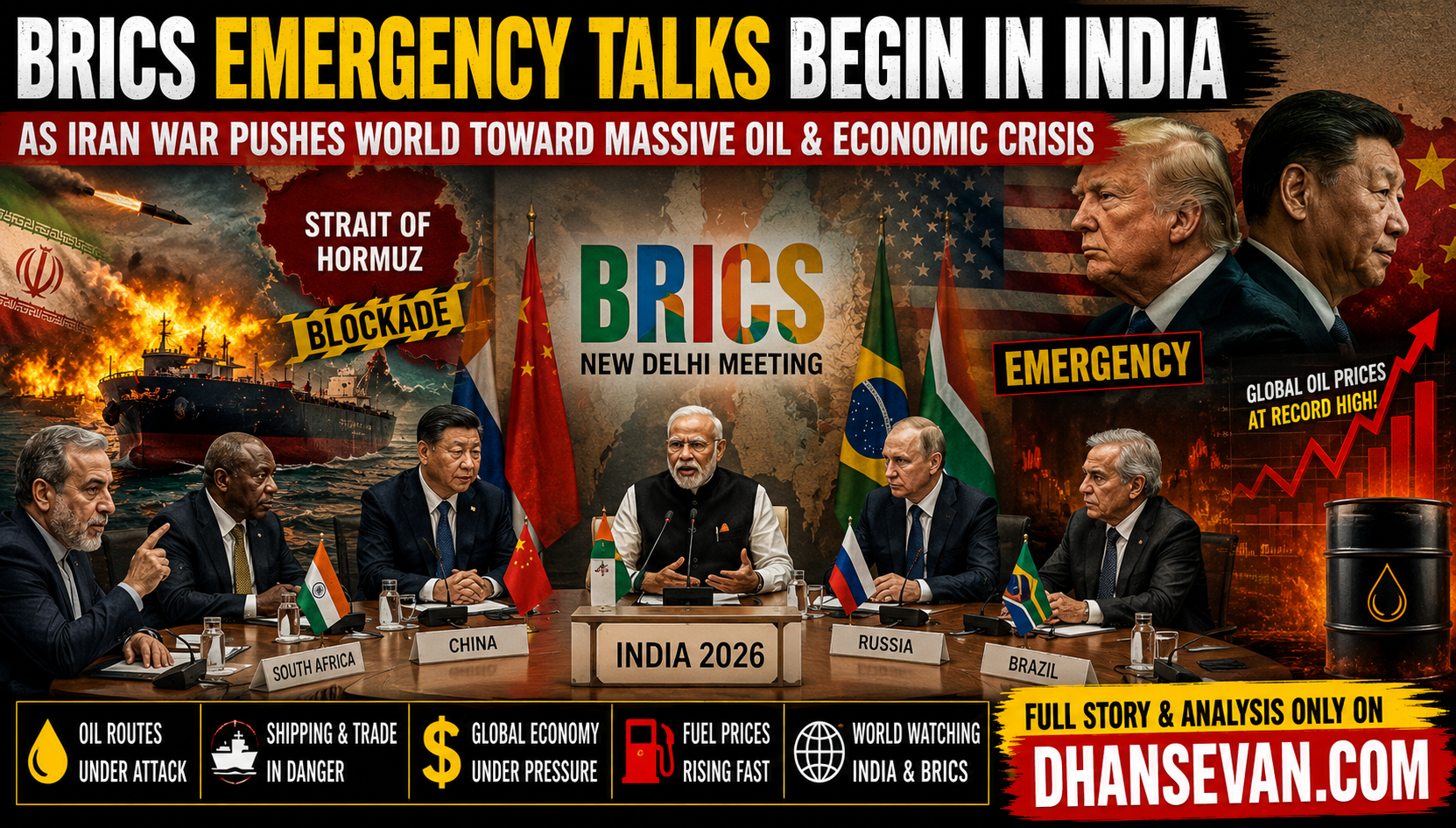
BRICS Emergency Talks Begin In India As Iran War Pushes World Toward Massive Oil & Economic Crisis
Global attention has shifted to New Delhi as BRICS foreign ministers gather during one of the most dangerous geopolitical moments in recent years. With the Iran war disrupting global oil routes, the Strait of Hormuz under blockade, Trump meeting Xi Jinping in China, and fuel prices rising worldwide, the BRICS summit preparations could shape the future of global energy, diplomacy, and economic stability.
Uday Jasani
Gaming Expert · Dhansevan Editorial Team
New Delhi Becomes The High-Stakes Center Of Global Diplomacy
At a critical juncture when the entire world is facing rapidly surging fuel prices, massive shipping disruptions, and terrifying fears of a much wider, uncontrollable Middle East conflict, global leaders have urgently turned their anxious attention toward India's capital.
The highly anticipated BRICS foreign ministers meeting officially commenced in New Delhi today. The summit is taking place against the backdrop of immense tension, as the geopolitical fallout inextricably linked to the Iran war continues violently shaking global energy markets and paralyzing international diplomacy.
The timing of this specific meeting is especially, profoundly significant because it is happening simultaneously with US President Donald Trump’s highly publicized, high-stakes diplomatic visit to China. In Beijing, Trump is meeting directly with Chinese President Xi Jinping to intensely discuss the rapidly worsening Iran crisis and coordinate a response to the devastating global oil disruptions.
Many seasoned geopolitical analysts firmly believe these crucial parallel meetings happening in Asia could fundamentally influence the future architecture of global trade, determine the trajectory of fuel prices, and reshape international alliances for months, if not years, ahead.
Why The BRICS Meeting Matters So Immensely Right Now
The BRICS alliance, originally an economic concept, has evolved significantly. It represents some of the world’s largest, most dynamic emerging economies and increasingly, confidently positions itself as a vital, necessary counterbalance to traditional Western global influence and the G7.
The powerful group originally included the foundational members Brazil, Russia, India, China, and South Africa. Recently, it boldly expanded its geopolitical footprint to formally include crucial, strategically important countries such as Iran, Egypt, Ethiopia, the UAE, and Indonesia, creating a massive bloc representing the "Global South."
But this year’s specific, emergency meeting carries far greater, existential urgency. The ongoing Iran war has created one of the absolute largest, most damaging energy disruptions seen in modern economic history, directly involving a new BRICS member.
With the vital Strait of Hormuz partially blocked by military force and critical oil shipping heavily, dangerously restricted, countries around the entire world are facing severe, paralyzing fears of hyper-inflation, soaring fuel costs, and a massive, synchronised economic slowdown.
India Sends A Major, Unambiguous Message On Global Shipping
During his forceful opening remarks in New Delhi, India’s highly experienced External Affairs Minister, Subrahmanyam Jaishankar, emphatically highlighted the absolute, non-negotiable need for “safe, secure, and unimpeded maritime flows” through international waters.
That carefully calibrated statement was widely, universally seen by diplomatic observers as a direct, pointed reference to the ongoing Strait of Hormuz crisis, where severe shipping disruptions orchestrated by Iran have already deeply affected global oil supply chains and caused immense economic pain.
The Strait of Hormuz is undeniably one of the world’s most important, irreplaceable energy routes, historically handling nearly one-fifth of total global oil and liquefied natural gas (LNG) movement before the current military conflict intensified.
Since Iran aggressively restricted large portions of maritime movement in the area as a wartime tactic, fuel prices and energy market volatility have increased sharply and dangerously worldwide, threatening to derail post-pandemic economic recoveries everywhere.
Iran Desperately Wants BRICS Nations To Support Tehran
In a highly watched move, Iranian Foreign Minister Abbas Araghchi also arrived in New Delhi for the crucial meeting. He reportedly utilized closed-door sessions to strongly urge fellow BRICS nations to formally condemn the United States and Israel over their aggressive military actions and crippling sanctions against Tehran.
Iran is actively, desperately attempting to leverage its new BRICS membership to gain vital diplomatic support and political cover, while simultaneously trying to strengthen economic ties with emerging countries that are deeply affected by the global energy crisis.
However, achieving unified, unanimous support inside the diverse BRICS coalition may prove extremely, practically difficult for Tehran.
Several powerful member nations within the bloc hold very different, highly complex political and economic relationships with Iran, Israel, the United States, and powerful Gulf countries like Saudi Arabia.
India Is Walking An Incredibly Delicate Diplomatic Tightrope
Foreign policy experts widely agree that India currently faces one of its most delicate, high-risk diplomatic balancing acts in recent decades, requiring immense geopolitical finesse.
On one side of the equation, India maintains deep, strategic, and highly lucrative relationships with the United States, Israel, and crucial Gulf countries like the UAE (also a BRICS member). On the other side, Iran remains historically and geographically important for regional stability in Central Asia, vital energy security, and major connectivity projects like the Chabahar port.
Furthermore, India is heavily, structurally dependent on imported oil moving directly through the vulnerable Strait of Hormuz, making the ongoing crisis directly, painfully connected to India’s domestic economy, inflation rates, and everyday fuel prices.
That extreme vulnerability is exactly why Indian diplomacy, specifically its nuanced rhetoric and behind-the-scenes maneuvering at this BRICS meeting, is being watched extremely closely by global observers and financial markets alike.
Parallel Trump-Xi Talks Add Massive Global Pressure
At the exact same time as the BRICS foreign ministers are meeting in India, Donald Trump and Xi Jinping are holding absolutely major, potentially world-altering discussions in Beijing.
The United States administration reportedly wants China to aggressively use its unparalleled economic leverage to pressure Iran into immediately reducing maritime restrictions in Hormuz and moving toward genuine compromise in the stalled nuclear and regional security negotiations.
China plays a critical, perhaps the most vital, role in this crisis because it remains one of Iran’s largest, most dependable economic partners and stands as one of the few major buyers willing to purchase sanctioned Iranian oil.
Geopolitical analysts strongly believe Trump may even be willing to offer significant concessions on other contentious bilateral issues—such as tariffs or technology disputes—to strongly encourage Beijing’s active cooperation regarding Iran and stabilizing the Strait of Hormuz.
The Entire World Economy Is Feeling The Severe Impact
The ongoing, escalating crisis is absolutely no longer limited to abstract geopolitics debated in UN halls.
The devastating consequences are now spreading rapidly like a contagion across global economies through multiple, painful channels:
- **Surging petrol and diesel prices:** Directly impacting consumers worldwide.
- **Higher, sticky inflation:** Forcing central banks to maintain high interest rates.
- **Massive shipping disruptions:** Causing huge delays in manufacturing.
- **Intense supply chain pressure:** Leading to shortages of consumer goods.
- **Exorbitant airline fuel (ATF) costs:** Threatening the aviation industry.
- **Increased overall transportation costs:** Acting as a universal tax on trade.
- **Currency instability:** Plunging emerging market currencies to record lows.
- **Severe stock market volatility:** Wiping out trillions in global wealth.
Massive, energy-hungry countries like India and China are especially vulnerable because they rely heavily on imported Gulf oil to fuel their massive growth engines.
Even wealthy nations less directly dependent on Hormuz oil are already feeling immense pressure through interconnected global fuel pricing mechanisms and massive trade disruptions.
BRICS Itself Is Facing Deep Internal Divisions
Despite its rapidly growing global influence and recent expansion, BRICS is emphatically not fully united on how to handle the Iran crisis.
Recent preparatory meetings reportedly failed to produce strong consensus statements because key member countries fundamentally disagreed over how strongly to criticize Western military actions, unilateral sanctions, and regional aggression by various actors.
Simmering geopolitical tensions between new members, such as Iran and the UAE, have also severely complicated internal discussions and hindered the bloc's ability to speak with one unified voice.
At the same time, India’s rapidly growing closeness with the United States and Israel—often part of the 'Quad' dynamic—has created additional diplomatic sensitivity and suspicion inside the bloc, particularly with China and Russia.
Many experienced analysts now believe BRICS faces a major, defining test of its unity and relevance during one of the world’s most unstable, dangerous geopolitical periods.
The Energy Crisis Could Completely Dominate The Upcoming BRICS Summit
The foreign ministers meeting currently taking place in New Delhi is officially meant mainly as preparation for the much larger, highly anticipated BRICS heads-of-state summit scheduled to be held later this year in India.
But energy experts and diplomats believe the devastating Iran war and massive global energy disruptions may completely, unavoidably dominate the entire agenda moving forward, overshadowing all other initiatives.
If the Strait of Hormuz crisis predictably worsens further, member countries may soon face catastrophic scenarios:
- Severe, crippling national fuel shortages.
- Deep, prolonged economic recession.
- Massive global inflation spikes destroying purchasing power.
- Months-long shipping delays halting global trade.
- Intense industrial pressure leading to mass layoffs.
- Rising, uncontrollable public unrest over skyrocketing living costs.
That terrifying possibility is exactly why global financial markets, panicking governments, and massive energy companies are closely, obsessively watching every single diplomatic development coming out of New Delhi and Beijing this week.
The World Is Entering A Highly Uncertain, Dangerous Phase
What makes this specific moment genuinely historic is the sheer scale of incredibly complex, interconnected crises happening simultaneously across the globe.
A regional, historical conflict involving Iran is now actively, directly influencing global diplomacy, international energy security, the flow of world trade, the price of oil, shifting political alliances, and the foundational economic stability of entire continents.
The BRICS meeting in India may not immediately solve the complex crisis overnight, but it could play a major, foundational role in determining exactly how the world's emerging global powers coordinate and respond to one of the most dangerous, consequential geopolitical confrontations in recent memory.
For now, the anxious world is watching closely, holding its breath, as New Delhi becomes one of the most important, critical diplomatic centers on the planet.
About the Author
Uday Jasani
The Dhansevan editorial team consists of passionate gamers and tech enthusiasts who test and review every game before publishing. Our writers bring first-hand gaming experience and follow strict editorial standards to ensure accurate, helpful content for our readers.
Disclaimer: This article is for informational purposes only. Game features, availability, and earning potential may vary. Always download games from official sources and read their terms of service. Dhansevan does not guarantee any specific results from using the apps mentioned above.