BRICS Summit Ends In Chaos: Iran War Divides Members As No Joint Statement Is Issued
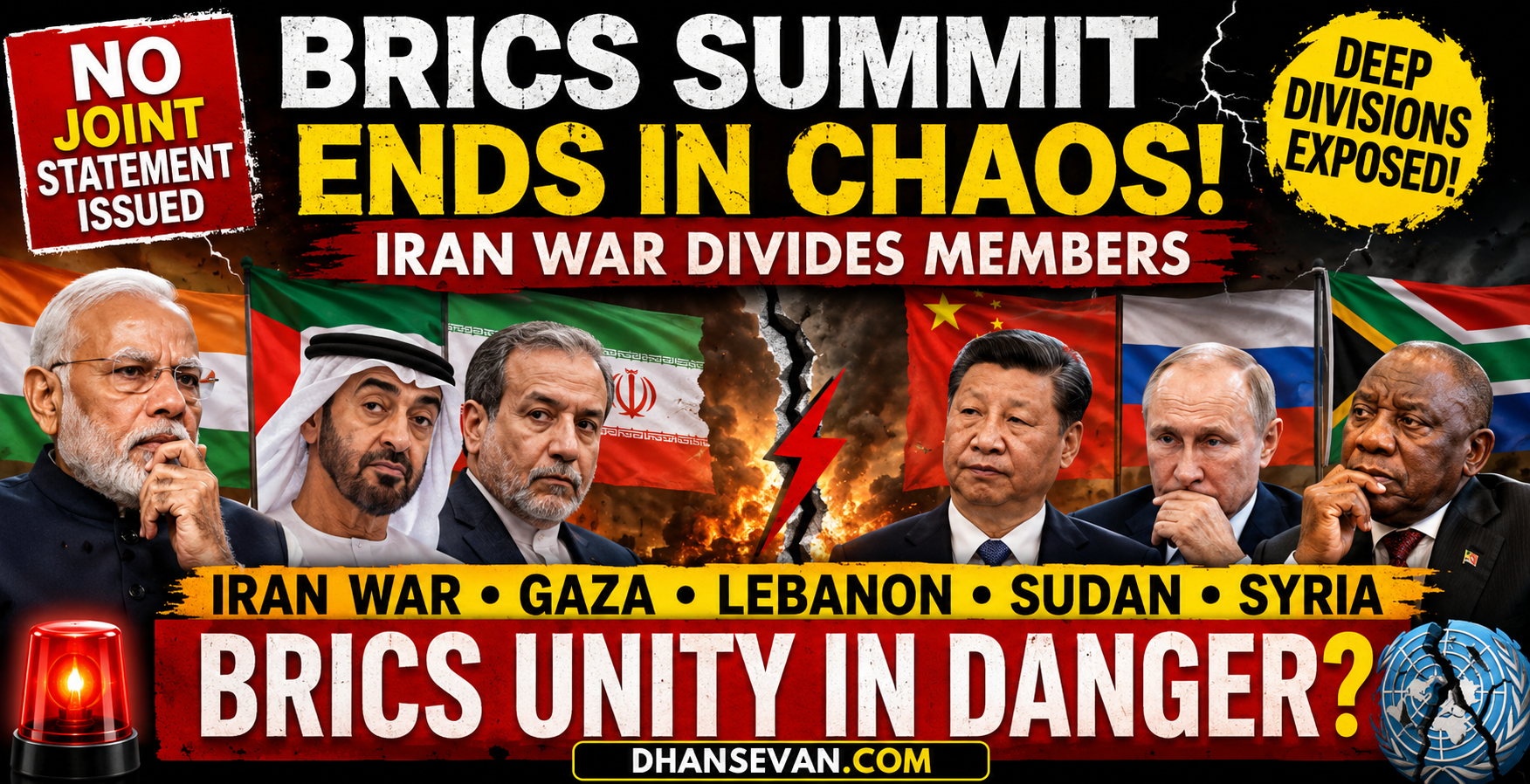
The BRICS foreign ministers’ meeting in New Delhi ended without a joint statement after deep divisions emerged over the Iran war, exposing growing cracks inside the powerful bloc. Iran pushed members to condemn the United States and Israel, while Gulf tensions, Gaza disagreements, and regional conflicts prevented consensus among BRICS nations.
Uday Jasani
Gaming Expert · Dhansevan Editorial Team
BRICS Meeting Ends Without Joint Statement In Major Diplomatic Shock
The BRICS alliance suffered a major diplomatic setback after foreign ministers failed to issue a joint statement at the end of their high-profile summit in New Delhi, exposing serious internal divisions over the ongoing Iran war and growing geopolitical tensions.
The two-day meeting, hosted by India, was expected to showcase unity among some of the world’s most powerful developing economies. Instead, it highlighted deep disagreements inside the rapidly expanding bloc.
BRICS currently includes Brazil, Russia, India, China, South Africa, Ethiopia, Egypt, Iran, Indonesia, and the United Arab Emirates, making it one of the most influential geopolitical alliances challenging Western-led global systems.
However, the worsening Iran conflict appears to have created sharp fractures between members, especially Gulf nations and Iran itself.
Iran Pushed BRICS To Condemn The US & Israel
One of the biggest flashpoints during the summit emerged after Iranian Foreign Minister Abbas Araghchi urged BRICS countries to formally condemn what he described as “violations of international law” by the United States and Israel.
Iran wanted stronger language targeting Western military actions and regional involvement in the ongoing conflict.
But consensus quickly collapsed as divisions emerged between members over how aggressively the bloc should position itself regarding the war.
India later admitted publicly that “differing views” among member countries prevented a unified declaration from being issued.
The failure to produce a joint statement is being viewed globally as a significant diplomatic embarrassment for BRICS during one of the most dangerous geopolitical crises in recent years.
Iran-UAE Tensions Exploded During The Meeting
One of the most dramatic moments of the summit involved escalating tensions between Iran and the United Arab Emirates.
Without directly naming the UAE initially, Iranian Foreign Minister Araghchi suggested that one BRICS member had blocked portions of India’s proposed statement related to the Middle East war.
The remarks quickly triggered a strong reaction from the UAE delegation.
UAE Minister of State Khalifa bin Shaheen Al Marar accused Iran of attempting to justify attacks against Gulf nations.
According to UAE officials, Iran allegedly launched thousands of missile, drone, and cruise missile attacks targeting Emirati territory since the conflict escalated earlier this year.
The sharp exchange exposed how deeply regional rivalries are now affecting BRICS unity.
Why The Iran War Is Becoming A Huge Problem For BRICS
The Iran conflict has placed BRICS members in an extremely uncomfortable position because the alliance includes countries with very different geopolitical interests and regional relationships.
Some members maintain close economic or military ties with Iran, while others have strategic partnerships with Gulf nations or Western powers.
This creates major challenges whenever the bloc attempts to adopt unified positions on international conflicts.
The situation has become especially sensitive because:
- Iran is now an official BRICS member.
- The UAE is also part of BRICS.
- Saudi Arabia remains closely connected to discussions around the bloc.
- China and India rely heavily on Middle Eastern energy supplies.
- Russia supports stronger anti-Western geopolitical coordination.
Those competing interests are now making it increasingly difficult for BRICS to project a single united diplomatic voice.
India Tried To Focus On A ‘Multipolar World’ Vision
Despite the disagreements over Iran, India attempted to steer discussions toward broader BRICS priorities involving global governance reforms and a “multipolar world order.”
The summit discussions reportedly focused heavily on:
- Reforming the United Nations Security Council.
- Increasing Global South representation.
- Reducing Western dominance in global institutions.
- Strengthening economic cooperation among developing nations.
- Expanding BRICS geopolitical influence.
These goals have long been central to BRICS diplomacy, especially as emerging economies seek greater influence in global decision-making structures.
However, the Iran war overshadowed much of the summit’s intended agenda.
Gaza & Lebanon Discussions Also Triggered Disagreements
The foreign ministers also discussed the ongoing war in Gaza and tensions in Lebanon.
According to discussions during the summit, members broadly agreed that Gaza should remain an inseparable part of any future Palestinian state.
There were also calls for unifying Gaza and the occupied West Bank under Palestinian governance.
However, reports suggested that at least one unnamed country expressed reservations regarding sections related to Gaza.
The ministers additionally called for respect toward the Lebanon ceasefire agreement, though critics argued that hostilities in the region continue despite diplomatic language about de-escalation.
Sudan & Syria Crises Were Also On The Agenda
Beyond the Middle East conflict, BRICS ministers also discussed humanitarian and security crises in Sudan and Syria.
Regarding Sudan, ministers called for an immediate ceasefire and warned that prolonged civil war conditions could create fertile ground for extremism and terrorism.
Sudan remains trapped in one of the world’s worst humanitarian disasters, with millions displaced and large regions facing severe instability.
The bloc also discussed Syria’s fragile political transition following the collapse of Bashar al-Assad’s government in late 2024.
Officials stressed the need for a peaceful and inclusive transition while warning about the dangers posed by foreign fighters operating inside Syria.
Why The Failed Joint Statement Matters Globally
The inability of BRICS ministers to release a unified statement is politically significant because the alliance has increasingly positioned itself as an alternative global power center challenging Western influence.
For years, BRICS leaders have promoted the bloc as proof that emerging economies can cooperate independently of Western-led institutions.
But the latest summit showed that internal geopolitical rivalries may become one of BRICS’ biggest long-term weaknesses.
Analysts say the failure to agree on a statement sends several major signals:
- Regional rivalries inside BRICS are intensifying.
- The Iran war is destabilizing global alliances.
- Expanding BRICS membership also increases internal divisions.
- Foreign policy consensus is becoming harder to achieve.
- Geopolitical fractures are reshaping global diplomacy.
That is why diplomats and political analysts worldwide are closely watching how BRICS handles future crises.
The Iran Conflict Is Reshaping Global Politics Rapidly
The deeper significance of the summit’s collapse lies in how quickly the Iran conflict is now reshaping international alliances and diplomatic relationships.
What initially began as a regional military escalation has now evolved into a crisis affecting:
- Global oil markets.
- International shipping routes.
- Economic stability.
- Energy security.
- Diplomatic alliances.
- Global financial systems.
The divisions visible at the BRICS summit show how difficult it is becoming for even major powers to maintain unified positions during rapidly escalating geopolitical crises.
What Happens Next Could Define BRICS’ Future
The failed New Delhi summit may become a defining moment for BRICS as the alliance continues expanding its global ambitions.
Supporters still believe the bloc represents the future of a more balanced global order where emerging economies have stronger voices.
However, critics argue that BRICS’ internal contradictions are becoming increasingly difficult to manage as membership expands.
For now, one thing is clear: the Iran war has exposed serious fractures inside one of the world’s most influential geopolitical alliances, and the consequences could shape international diplomacy for years to come.
About the Author
Uday Jasani
The Dhansevan editorial team consists of passionate gamers and tech enthusiasts who test and review every game before publishing. Our writers bring first-hand gaming experience and follow strict editorial standards to ensure accurate, helpful content for our readers.
Disclaimer: This article is for informational purposes only. Game features, availability, and earning potential may vary. Always download games from official sources and read their terms of service. Dhansevan does not guarantee any specific results from using the apps mentioned above.