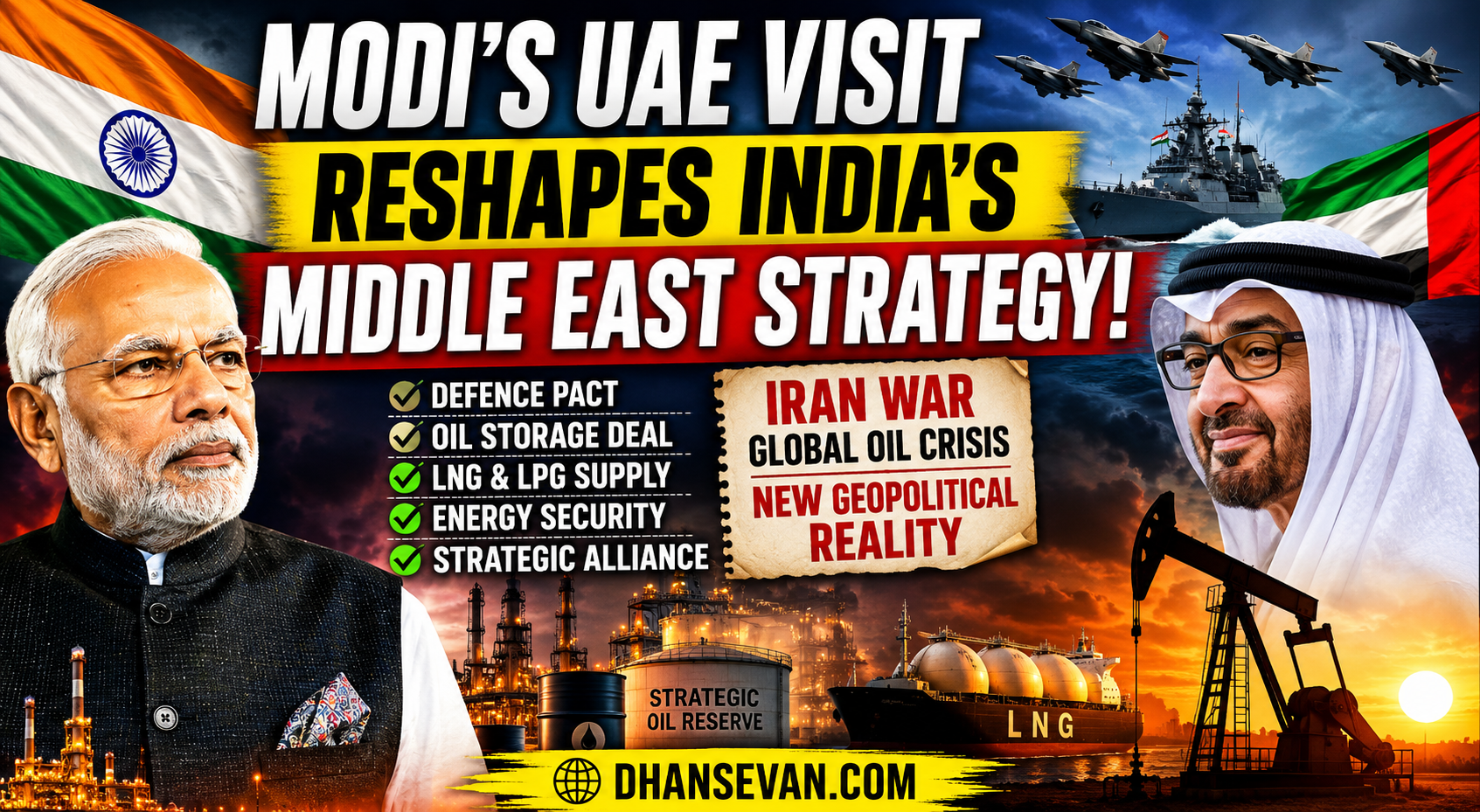
Modi’s UAE Visit Reshapes India’s Middle East Strategy Amid Iran War & Global Energy Crisis
India and the United Arab Emirates have dramatically expanded defence and energy ties during Prime Minister Narendra Modi’s high-stakes UAE visit as the Iran war disrupts global oil markets and reshapes Middle East alliances. The strategic agreements include defence cooperation, oil storage expansion, LNG supply deals, and deeper security coordination amid rising regional instability.
Uday Jasani
Gaming Expert · Dhansevan Editorial Team
India & UAE Deepen Strategic Ties During Modi’s Crucial Visit
Prime Minister Narendra Modi’s latest visit to the United Arab Emirates has emerged as one of India’s most strategically significant diplomatic moves in recent years, coming at a time when the Iran war continues destabilizing global energy markets and reshaping geopolitical alliances across the Middle East.
During the high-level visit, India and the UAE agreed on a major framework for strategic defence cooperation while also signing important agreements involving oil reserves, liquefied petroleum gas supplies, energy security, and advanced technology collaboration.
The agreements reflect how rapidly India is attempting to secure its long-term energy and strategic interests amid one of the most unstable periods in modern Middle Eastern geopolitics.
The visit also highlighted the growing importance of the India-UAE relationship as both countries navigate a rapidly changing regional power balance involving Iran, Saudi Arabia, Pakistan, China, and the United States.
Why Modi’s UAE Visit Is Happening At A Critical Global Moment
The timing of the visit is extremely important.
The Middle East is currently facing severe instability following the Iran war, which has already disrupted global shipping routes, shaken oil markets, and created major economic uncertainty worldwide.
The closure and instability around the Strait of Hormuz — one of the world’s most important oil shipping routes — has triggered fears of prolonged fuel shortages and rising energy prices across multiple economies.
India is especially vulnerable because the country imports most of its crude oil requirements from overseas, with a significant share coming from the Gulf region.
That makes energy security one of India’s biggest strategic priorities right now.
Officials indicated that Modi’s discussions focused heavily on ensuring long-term energy stability, strengthening strategic reserves, and protecting India from future global oil shocks.
India & UAE Finalized Major Defence Cooperation Plans
One of the biggest outcomes of the visit was the agreement to deepen defence and security cooperation between India and the UAE.
According to official statements, the two countries agreed to strengthen collaboration across several critical areas:
- Defence industrial cooperation.
- Advanced technology partnerships.
- Military training and joint exercises.
- Maritime security coordination.
- Cyber defence cooperation.
- Secure communication systems.
- Strategic information exchange.
The agreements show how the India-UAE relationship is now evolving far beyond traditional trade partnerships into a much broader strategic alliance.
Security analysts believe growing instability across the Middle East has accelerated the need for stronger regional defence coordination.
Energy Security Became The Core Focus Of The Visit
Energy remained the most critical topic throughout Modi’s discussions in Abu Dhabi.
India and the UAE signed agreements involving strategic petroleum reserves and expanded energy supply cooperation as both countries attempt to prepare for prolonged volatility in global oil markets.
One of the biggest announcements involved Abu Dhabi National Oil Company (ADNOC) potentially increasing crude oil storage inside India by up to 30 million barrels.
The discussions also explored storing Indian crude reserves in Fujairah, one of the UAE’s most important energy hubs.
These agreements are highly significant because strategic oil reserves act as emergency buffers during global supply disruptions.
As geopolitical instability continues, countries worldwide are aggressively trying to secure energy supplies before conditions worsen further.
Why The UAE’s OPEC Exit Matters For India
Another major factor behind the growing India-UAE partnership is the UAE’s recent decision to leave OPEC.
The move could allow the UAE to increase oil production more aggressively in the future without being bound by OPEC production restrictions.
For large importers like India, that could become extremely important during periods of global energy shortages.
Indian officials reportedly discussed long-term energy supply arrangements aimed at protecting India from unpredictable oil market shocks linked to geopolitical conflicts.
Experts believe New Delhi is now prioritizing stable bilateral energy relationships with major Gulf producers more than ever before.
LPG & LNG Deals Strengthen India’s Energy Supply Chain
Beyond crude oil, the two countries also expanded cooperation involving liquefied petroleum gas (LPG) and liquefied natural gas (LNG).
ADNOC announced plans to explore expanded LPG supply opportunities with Indian Oil Corporation.
The agreements build upon earlier deals signed between India and the UAE, including a massive multi-billion-dollar LNG agreement finalized earlier this year.
As energy demand continues rising rapidly in India, securing stable long-term gas supplies has become a national priority.
Natural gas is increasingly viewed as essential for India’s industrial growth, electricity generation, and long-term economic expansion.
Middle East Alliances Are Shifting Rapidly
The visit also reflects how quickly alliances across the Middle East and South Asia are evolving due to the Iran conflict.
One major concern for India has been the strengthening relationship between Saudi Arabia and Pakistan.
Pakistan has emerged as a key diplomatic player in regional negotiations linked to the Iran war and has also increased defence cooperation with Gulf nations.
Saudi Arabia recently announced additional financial support for Pakistan during a period of growing regional uncertainty.
Analysts believe India’s stronger strategic engagement with the UAE partly reflects New Delhi’s desire to maintain balance and influence within the Gulf region amid these shifting alliances.
Why The Iran War Is Changing Global Energy Politics
The deeper significance of Modi’s UAE visit lies in how dramatically the Iran conflict is reshaping global energy and geopolitical strategies.
The war has already:
- Disrupted shipping routes.
- Increased global oil prices.
- Triggered inflation concerns worldwide.
- Created instability in financial markets.
- Forced countries to rethink energy security.
- Accelerated strategic defence partnerships.
Countries that rely heavily on imported energy — including India, China, Japan, and many European economies — are now scrambling to secure long-term supply arrangements before global conditions deteriorate further.
India-UAE Economic Relations Are Expanding Rapidly
The visit also highlighted the rapidly growing economic relationship between India and the UAE.
Officials announced billions of dollars in UAE investments linked to India, including major banking and infrastructure deals.
The UAE has become one of India’s most important economic and strategic partners, with cooperation now extending across:
- Energy.
- Defence.
- Technology.
- Banking.
- Infrastructure.
- Cybersecurity.
- Trade and logistics.
Analysts say the relationship is evolving into one of the most important strategic partnerships for both countries.
What Modi’s Visit Signals About India’s Future Strategy
Modi’s UAE visit sends a clear message about India’s future geopolitical priorities.
As global instability rises, India appears increasingly focused on:
- Securing reliable energy partnerships.
- Expanding strategic oil reserves.
- Strengthening Gulf alliances.
- Protecting trade routes.
- Improving regional defence cooperation.
- Reducing vulnerability to global crises.
The agreements signed during the visit may therefore become extremely important for India’s long-term economic and national security planning.
The Middle East Crisis Is Reshaping Global Alliances
The larger reality emerging from Modi’s UAE visit is that the Iran conflict is no longer simply a regional war.
It is now actively reshaping global diplomacy, energy markets, military partnerships, and economic strategies across multiple continents.
Countries are rapidly adjusting alliances and building new strategic relationships as fears grow about prolonged instability in the Gulf region.
For India, securing strong ties with the UAE could become one of the most important geopolitical decisions of this decade as the world enters an increasingly uncertain energy and security environment.
About the Author
Uday Jasani
The Dhansevan editorial team consists of passionate gamers and tech enthusiasts who test and review every game before publishing. Our writers bring first-hand gaming experience and follow strict editorial standards to ensure accurate, helpful content for our readers.
Disclaimer: This article is for informational purposes only. Game features, availability, and earning potential may vary. Always download games from official sources and read their terms of service. Dhansevan does not guarantee any specific results from using the apps mentioned above.