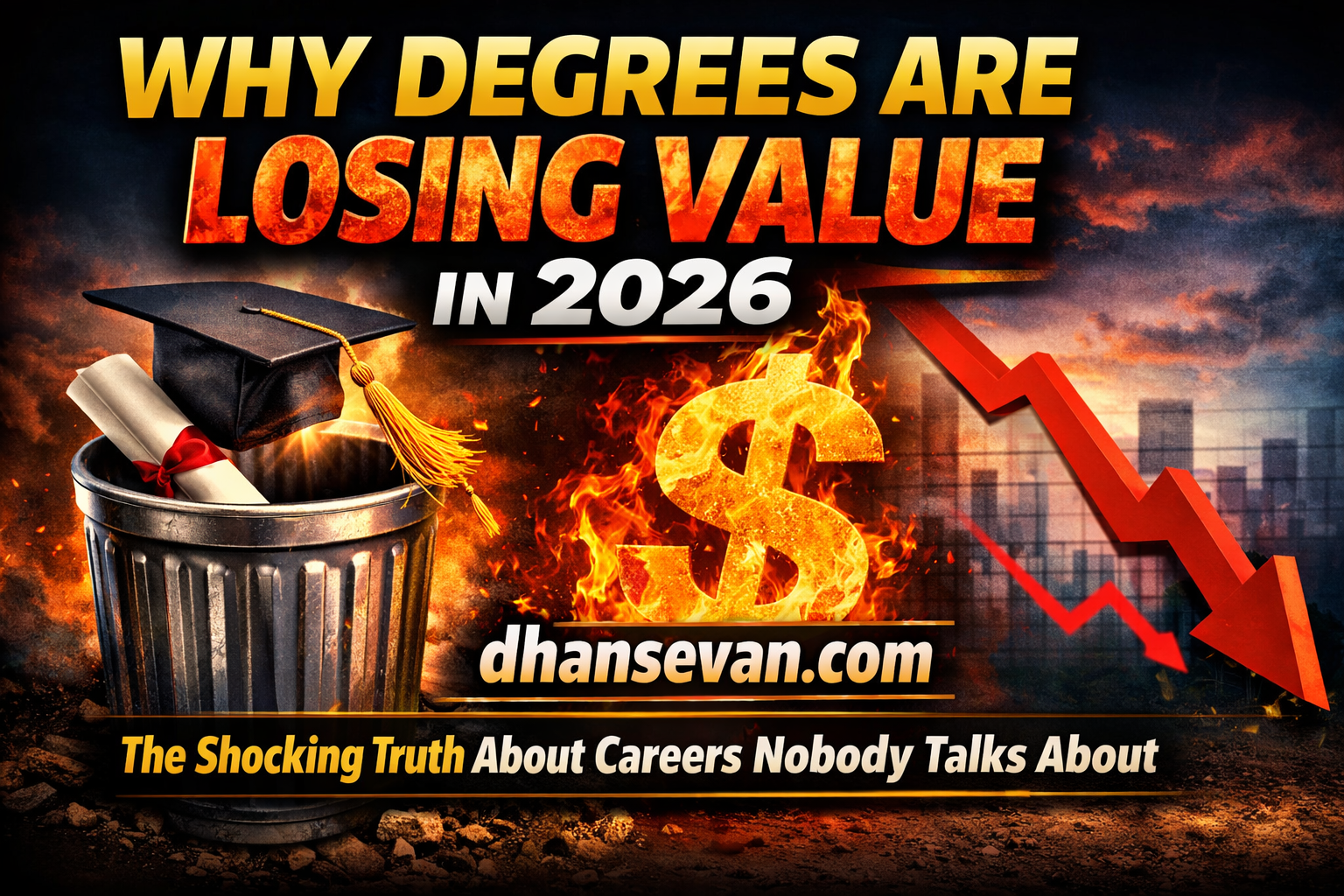
Stop Ignoring Why Degrees Are Losing Value in — The Shocking Truth About Careers Nobody Talks About—This Hidden Secret Could Change Your Life in 2026
Degrees were once the key to success, but in 2026, their value is changing fast. Discover why degrees are losing importance and what actually matters for building a successful career.
Dhansevan Team
Gaming Expert · Dhansevan Editorial Team
For decades, Indian families have invested heavily in education with one belief: a good degree guarantees a good life. This belief drove millions to pursue engineering, medicine, MBA, and other professional degrees as the primary path to financial security and social status. But in 2026, the relationship between degrees and career success has fundamentally shifted, and the evidence is impossible to ignore.
This article explores why degrees are losing their traditional value in the Indian job market, what employers actually look for in 2026, and how you can build a career strategy that combines education with the skills and experiences that actually matter.
---
The Numbers Tell the Story
The data on Indian graduate employability paints a concerning picture. According to the India Skills Report 2025, only 48.7% of Indian graduates are considered employable — meaning more than half of degree holders lack the skills employers need. The situation is particularly stark in engineering, where India produces over 1.5 million engineering graduates annually, but industry surveys consistently show that only 15-25% are job-ready without additional training.
Meanwhile, the unemployment rate among educated youth (graduates and above) stands at 13.4% — significantly higher than the overall unemployment rate. This paradox of educated unemployment is a clear signal that degrees alone are no longer sufficient for career success.
---
Why Degrees Have Lost Their Edge
1. Supply and Demand Imbalance When only 5% of Indians had college degrees (as in the 1980s), a degree was a genuine differentiator. In 2026, India has over 1,000 universities and 42,000 colleges producing millions of graduates annually. When everyone has a degree, it stops being a competitive advantage and becomes a baseline expectation — necessary but not sufficient.
2. The Curriculum-Industry Gap Most Indian university curricula are updated infrequently, often lagging 5-10 years behind industry practices. Students learn outdated technologies, theoretical frameworks, and academic approaches that do not reflect how work is actually done in modern organizations. A computer science graduate might learn C and Java in depth but have never worked with cloud computing, AI tools, or agile development methodologies that employers use daily.
3. The Rise of the Skill Economy Companies like Google, Apple, IBM, and Zoho have publicly stated that they no longer require college degrees for many positions. Instead, they evaluate candidates on demonstrable skills, project portfolios, and problem-solving ability. In India, startups and tech companies increasingly follow this approach, valuing what you can do over what certificates you hold.
4. Alternative Learning Paths Have Matured In 2026, platforms like Coursera, Udemy, YouTube, and various bootcamps offer structured learning paths in high-demand skills like data science, digital marketing, UX design, and cloud computing. These programs often cost a fraction of a college degree and can be completed in months rather than years. Many include industry-recognized certifications that employers value alongside or even above traditional degrees.
---
What Actually Drives Career Success in 2026
Based on hiring trends, employer surveys, and career outcome data, here are the factors that matter most:
Demonstrable Skills Over Credentials Employers want to see what you can do, not just what you studied. A graphic designer with a strong portfolio gets hired over an MFA graduate with no portfolio. A self-taught programmer with GitHub projects and open-source contributions gets preference over a CS graduate who has only completed classroom assignments.
Real-World Experience Internships, freelance work, personal projects, and even part-time jobs provide practical experience that no classroom can replicate. A student who managed social media for a local business during college has more relevant marketing experience than one who only studied marketing theory.
Continuous Learning Ability The half-life of professional skills is shrinking rapidly. Skills that are cutting-edge today may become obsolete in 3-5 years. Employers value candidates who demonstrate the ability and willingness to learn continuously — through online courses, certifications, reading, and experimentation.
Communication and Soft Skills Technical skills get you the interview, but communication skills get you the job and subsequent promotions. The ability to present ideas clearly, write professional emails, collaborate with teams, and handle client interactions is consistently rated as the top skill gap by Indian employers.
Digital Literacy and AI Awareness In 2026, basic proficiency with digital tools, data analysis, and AI applications is expected across all industries — not just tech. A finance professional who can use AI tools for analysis, or a marketer who understands data-driven decision making, has a significant advantage over peers who rely solely on traditional methods.
---
The Smart Strategy: Degree + Skills + Experience
The solution is not to abandon formal education entirely — degrees still provide foundational knowledge, networking opportunities, and credentialing that matters for certain career paths. Instead, the winning strategy combines education with deliberate skill building and real-world experience.
**During your degree program:** 1. Learn at least one high-demand digital skill — coding, data analysis, digital marketing, video editing, or graphic design 2. Complete at least 2-3 internships or freelance projects before graduation 3. Build a portfolio or online presence showcasing your work 4. Develop communication skills through presentations, writing, and professional networking 5. Start earning through platforms like Dhansevan, freelancing sites, or content creation to build financial independence and practical business understanding
**After graduation:** 1. Invest in continuous learning through online courses and certifications in your field 2. Focus on building a track record of results in your first job rather than just completing tasks 3. Develop expertise in an emerging area within your industry where competition is lower 4. Build your professional network actively through LinkedIn, industry events, and online communities
---
Industries Where Degrees Still Matter vs. Where Skills Dominate
| Degrees Still Essential | Skills Dominate | |------------------------|-----------------| | Medicine and Healthcare | Software Development | | Law | Digital Marketing | | Civil Engineering | Content Creation | | Academic Research | Graphic and UX Design | | Government Services | Data Science | | Chartered Accountancy | E-commerce and Sales |
---
Conclusion
Degrees are not worthless in 2026, but they are no longer enough on their own. The Indian job market has evolved from credential-based hiring to capability-based hiring, and this shift will only accelerate in the coming years. The graduates who thrive will be those who treat their degree as a foundation — not a finish line — and invest equally in skills, experience, and continuous learning. Whether you are currently a student or an early-career professional, the time to start building beyond your degree is now.
About the Author
Dhansevan Team
The Dhansevan editorial team consists of passionate gamers and tech enthusiasts who test and review every game before publishing. Our writers bring first-hand gaming experience and follow strict editorial standards to ensure accurate, helpful content for our readers.
Disclaimer: This article is for informational purposes only. Game features, availability, and earning potential may vary. Always download games from official sources and read their terms of service. Dhansevan does not guarantee any specific results from using the apps mentioned above.