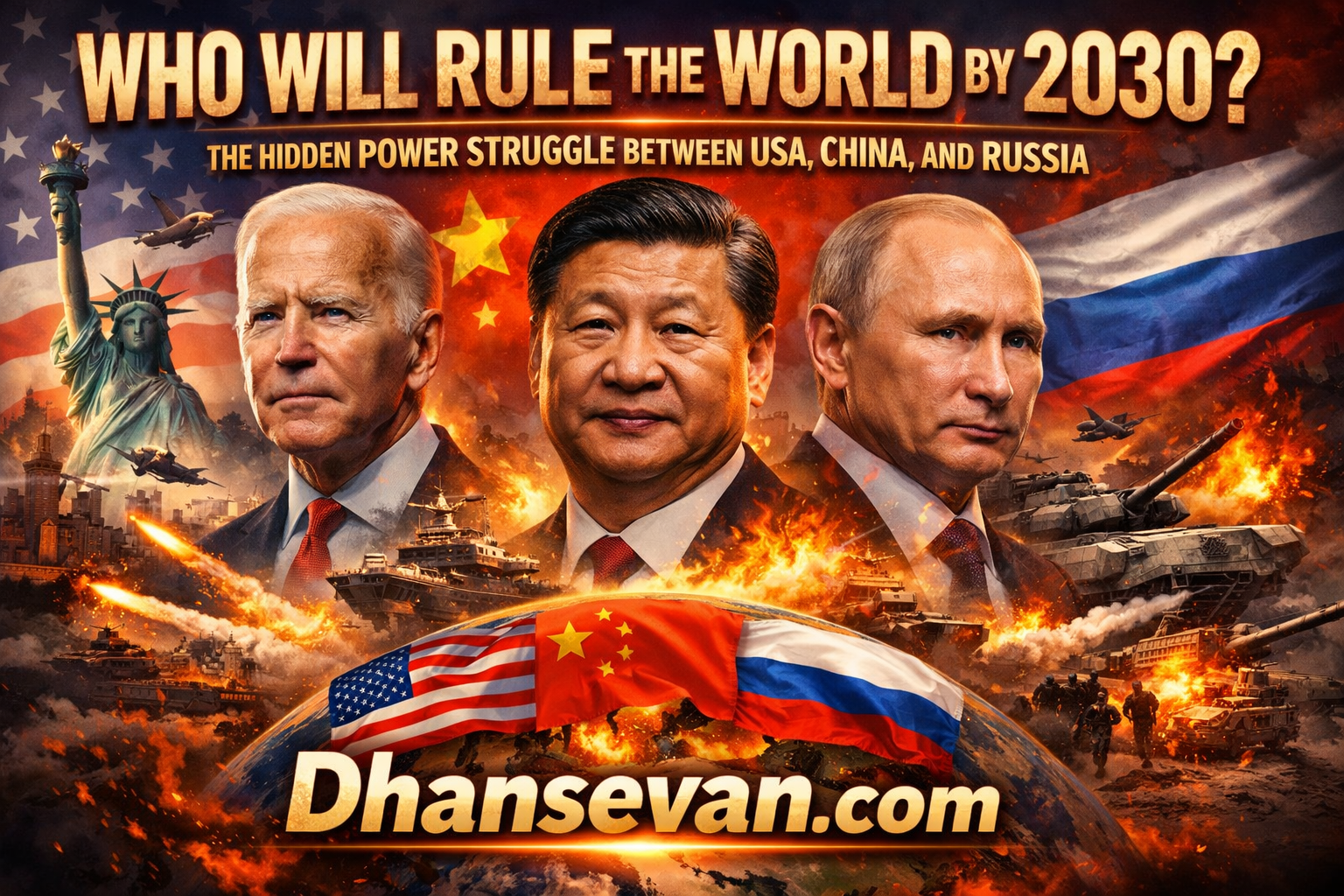
Stop Ignoring Who Will Rule the World by 2030? The Hidden Power Struggle Between USA, China, and Russia—This Hidden Secret Could Change Your Life in 2026
The world is heading toward a major power shift. Discover the hidden battle between global superpowers and who might dominate by 2030.
Dhansevan Team
Gaming Expert · Dhansevan Editorial Team
The global power structure is undergoing its most significant transformation since the end of the Cold War. In 2026, the competition between the United States, China, Russia, and emerging powers like India is reshaping international relations, trade, technology, and security in ways that will define the world order for decades to come. This analysis examines the strengths, strategies, and vulnerabilities of the major global powers and projects how the balance of power may evolve by 2030.
---
The United States: Defending Hegemony
Strengths in 2026 The United States remains the world's dominant power across multiple dimensions. Militarily, the US defense budget exceeds $900 billion annually — more than the next ten countries combined. The US maintains over 750 military bases across 80 countries, providing unmatched global power projection capability.
Economically, despite challenges, the US economy remains the world's largest by nominal GDP at approximately $28 trillion. The US dollar serves as the world's primary reserve currency, giving the US unique financial leverage through sanctions and monetary policy influence.
Technologically, the United States leads in artificial intelligence, semiconductor design, biotechnology, space technology, and software platforms. Silicon Valley's innovation ecosystem, combined with world-class research universities, maintains American technological superiority in most frontier fields.
Vulnerabilities Political polarization and domestic divisions limit the coherence and consistency of US foreign policy. National debt exceeding $35 trillion creates long-term fiscal sustainability concerns. The declining trust in US institutions among both domestic and international audiences reduces American soft power influence.
Strategy for 2030 The US strategy focuses on maintaining technological superiority through export controls and domestic manufacturing incentives. Strengthening alliance networks through NATO, AUKUS, and Quad partnerships. Competing with China for influence in the Indo-Pacific, Africa, and Latin America. Managing the balance between great power competition and cooperation on shared challenges like climate change.
---
China: The Ascending Challenger
Strengths in 2026 China's rise as a global power has been the defining geopolitical story of the 21st century. The country has the world's second-largest economy (and largest by purchasing power parity), a rapidly modernizing military with focus on naval power and missile technology, and the Belt and Road Initiative spanning over 140 countries and creating infrastructure and economic dependencies.
China's manufacturing dominance — producing roughly 30% of global manufactured goods — gives it enormous economic leverage. Its leadership in 5G deployment, electric vehicle production, renewable energy manufacturing, and certain AI applications demonstrates growing technological competitiveness.
Vulnerabilities China faces significant structural challenges including a rapidly aging population with declining birth rates that threaten long-term economic growth. A property market crisis that has affected domestic consumption and financial stability. Growing international distrust and the formation of coalitions aimed at constraining Chinese influence. Dependence on imported energy and food that creates strategic vulnerabilities.
Strategy for 2030 China aims to achieve technological self-sufficiency in semiconductors, AI, and advanced manufacturing. Expanding military capability particularly in the South China Sea and Taiwan Strait. Building alternative financial and trade systems that reduce dependency on US-dominated infrastructure. Strengthening partnerships with Russia, Iran, and developing nations through BRICS and bilateral agreements.
---
Russia: The Disruptive Power
Strengths and Weaknesses Russia's position as a global power in 2026 is defined by contradictions. It possesses the world's largest nuclear arsenal and significant conventional military capabilities. Its energy resources (oil, gas, minerals) provide economic leverage and strategic importance. Its permanent UN Security Council seat ensures a voice in global governance.
However, Russia's economy is relatively small (comparable to Italy or Brazil), its population is declining, and international sanctions have constrained its economic growth and technological access. Russia's strategy has increasingly relied on disruption — using military intervention, cyber operations, and information warfare to influence outcomes beyond what its economic weight would suggest.
---
India: The Rising Power
India's Unique Position India occupies a distinctive position in the global power landscape of 2026. As the world's most populous country, the fastest-growing major economy, and a nuclear-armed state with the world's fourth-largest military budget, India is increasingly recognized as an indispensable power in global affairs.
India's strategic advantage lies in its policy of strategic autonomy — maintaining productive relationships with both the US and Russia while navigating competition with China. This balanced approach allows India to benefit from Western technology transfer and investment while maintaining Russian defense cooperation and pursuing independent foreign policy objectives.
India's Path to Greater Influence India's growing global influence is built on several foundations. Economic growth exceeding 6.5% annually is expanding India's share of the global economy. A young, growing, tech-savvy workforce provides demographic advantage when other major powers face aging populations. Digital infrastructure (UPI, Aadhaar, Digital India) that is world-leading in scale and adoption. Space technology and defense manufacturing capabilities that are gaining international recognition. Soft power through democracy, cultural exports, and diaspora influence across every continent.
By 2030, India is projected to be the world's third-largest economy, potentially giving it economic weight commensurate with its population and geopolitical ambitions.
---
Projected Power Balance by 2030
Most Likely Scenario: Competitive Multipolarity The most probable world order by 2030 is one where no single power dominates unchallenged. The US maintains military and technological leadership but with reduced margin. China continues economic growth but at slower rates, facing domestic structural challenges. Russia remains a significant but not dominant player, relying on military and energy leverage. India emerges as a major independent power with growing global influence. Regional powers (EU, Japan, Saudi Arabia, Brazil) play increasingly significant roles.
This multipolar world creates both risks (multiple points of potential conflict) and opportunities (more balanced decision-making in international affairs, greater voice for developing nations).
---
What This Means for Ordinary People
Global power dynamics affect daily life through energy prices influenced by geopolitical tensions and production decisions. Job markets shaped by international trade policies and technology competition. Investment returns affected by global economic stability and currency movements. Technology access influenced by export controls and technology competition. Security environment determined by the management of great power relationships.
Understanding these dynamics helps individuals make better decisions about careers (which skills will be valuable in a shifting global economy), investments (geographic and sector diversification), and personal development (language learning, cultural awareness, digital skills).
---
Conclusion
The question of who will rule the world by 2030 does not have a single answer — the emerging reality is a multipolar world where multiple powers compete and cooperate simultaneously. For Indians, this multipolar world presents enormous opportunity as India's economic weight, demographic advantage, and strategic positioning make it an increasingly influential player in global affairs. Understanding global power dynamics is essential for making informed decisions about careers, investments, and the future in an interconnected world.
About the Author
Dhansevan Team
The Dhansevan editorial team consists of passionate gamers and tech enthusiasts who test and review every game before publishing. Our writers bring first-hand gaming experience and follow strict editorial standards to ensure accurate, helpful content for our readers.
Disclaimer: This article is for informational purposes only. Game features, availability, and earning potential may vary. Always download games from official sources and read their terms of service. Dhansevan does not guarantee any specific results from using the apps mentioned above.