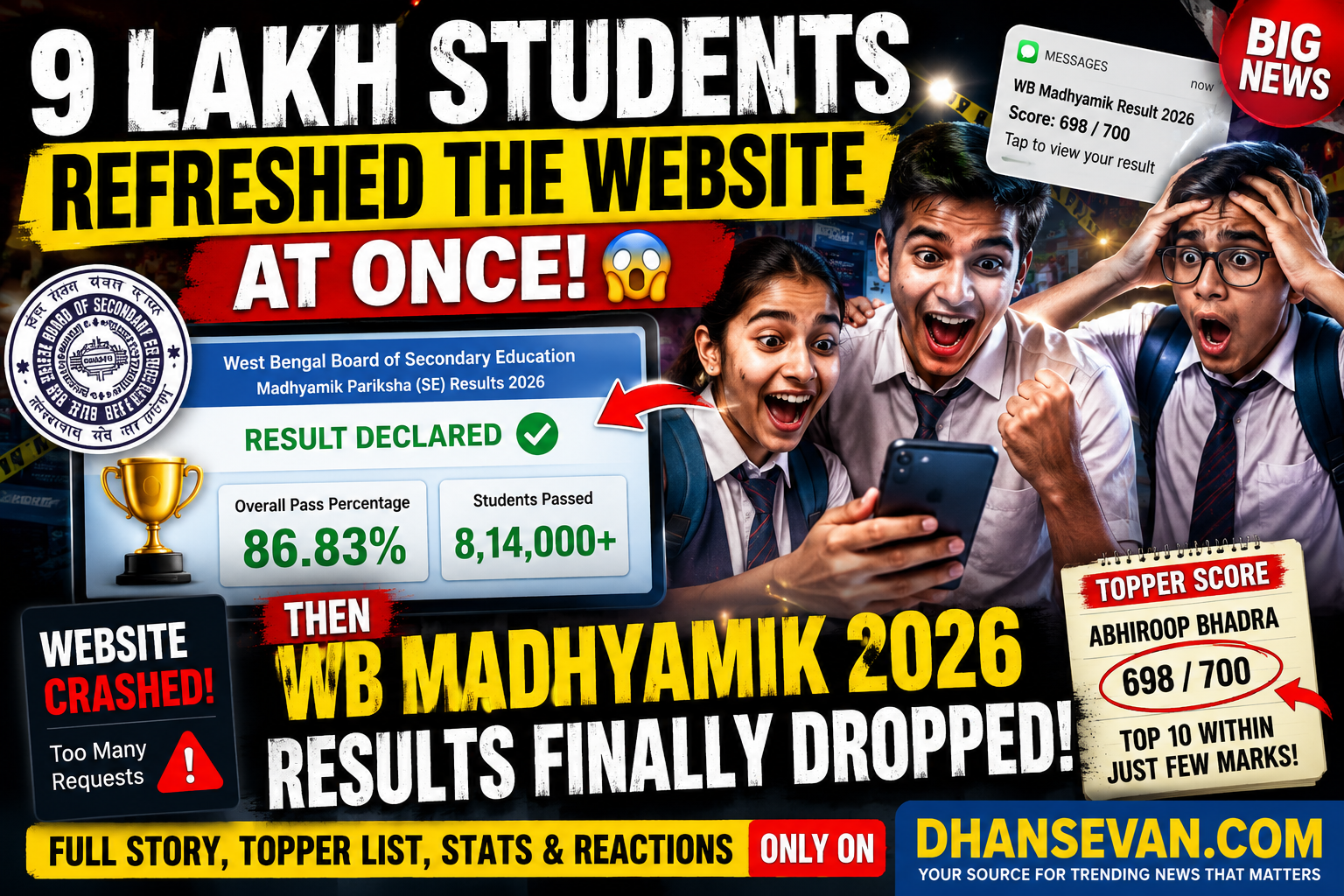
9 Lakh Students Refreshed The Website At Once — Then WB Madhyamik 2026 Results Finally Dropped
Panic, crashing websites, emotional reactions, and razor-thin topper margins — West Bengal’s Madhyamik 2026 results created massive drama online as over 9 lakh students rushed to check their scores at the same time.
Uday Jasani
Gaming Expert · Dhansevan Editorial Team
West Bengal Students Just Experienced One of the Most Stressful Mornings of 2026
For lakhs of students across West Bengal, May 8 started with panic, refresh buttons, crashing websites, and nonstop anxiety.
And then finally — the Madhyamik 2026 results dropped.
Within minutes, official websites slowed down as more than 9 lakh students and parents rushed online together to check scores.
Social media instantly exploded with celebration posts, emotional reactions, memes, and nervous students asking the same question:
**“Result aaya kya?”**
Over 8 Lakh Students Passed
The West Bengal Board of Secondary Education officially announced the Madhyamik 2026 results with an impressive overall pass percentage of 86.83%.
Out of nearly 9.7 lakh students who appeared for the exams, more than 8.14 lakh students successfully cleared the examination.
For thousands of families, it became a day filled with relief, tears, celebrations, and emotional phone calls.
The Topper Scored Almost Perfect Marks
This year’s topper, Abhiroop Bhadra from Uttar Dinajpur, stunned everyone by scoring 698 marks.
But what truly shocked students was how insanely competitive the topper list became.
The difference between Rank 1 and Rank 10 was just a few marks.
Students online called it “one of the toughest topper races ever.”
Websites Crashed As Students Rushed Together
Moments after the result links became active, many students faced loading errors and slow websites.
Thousands rushed to alternate methods including SMS services and DigiLocker after official portals struggled to handle massive traffic.
Memes flooded Instagram and X as students joked about pressing refresh hundreds of times.
For many, the website opening successfully felt more difficult than the exam itself.
Science Stream Pressure Already Begins
Even before celebrations ended, many students immediately began worrying about Class 11 admissions.
Students aiming for Science streams and competitive exams like JEE and NEET are now preparing for the next academic battle.
Schools across West Bengal are expected to begin admission processes very soon.
And yes — cutoff discussions have already started online.
Some Students Are Still Worried
While lakhs celebrated success, not everyone had a happy day.
Students who received lower marks or failed in one or two subjects are now exploring compartment exams and re-evaluation options.
Teachers and counselors are urging students not to panic, reminding them that one exam does not define their future.
Still, the emotional pressure around board exam results remains extremely intense.
District Performance Sparked Big Discussions
Kolkata and several major districts recorded excellent pass percentages again this year.
However, some regions showed lower performance levels, sparking conversations around education quality differences across districts.
Education experts are now closely analyzing the numbers.
Social Media Turned Into Full Result Festival
As soon as results were declared, Instagram stories, WhatsApp statuses, YouTube live streams, and Facebook posts exploded everywhere.
Students posted screenshots of marksheets, emotional family reactions, celebration videos, and funny memes about result stress.
For hours, Madhyamik remained one of the biggest trending topics online.
Final Thoughts
The WB Madhyamik 2026 results were more than just marks.
They became an emotional event involving pressure, dreams, competition, celebration, disappointment, and massive online chaos.
For some students, this day marked the beginning of confidence.
For others, it became motivation to come back stronger.
But one thing is certain:
West Bengal’s students just lived through one of the internet’s most intense result days of the year.
Why This Guide Was Expanded
This article has been expanded so it does not remain a shallow trend summary. Readers usually arrive with a real question in mind: what happened, why it matters, what is confirmed, what is speculation, and what could change next.
For that reason, this guide adds practical context around 9 Lakh Students Refreshed The Website At Once — Then WB Madhyamik Results Finally Dropped: the background, the moving parts, the risks of reacting too quickly, and the points readers should verify before forming a strong opinion.
Context Behind the Headline
9 Lakh Students Refreshed The Website At Once — Then WB Madhyamik Results Finally Dropped should be read with context. Political, education, global, and breaking-news topics often move quickly, but the first wave of attention is not always the most accurate one. A headline may explain what happened, while the deeper value comes from understanding why people are reacting and what evidence supports the claim.
When a topic is developing, avoid treating early claims as final facts. Look for official statements, exact dates, primary sources, and whether later updates have corrected the first version of the story.
How Readers Can Judge the Situation
- Separate confirmed facts from speculation.
- Check whether the information is current or already outdated.
- Notice who benefits from a particular interpretation.
- Compare multiple credible sources before forming a strong opinion.
- Be careful with viral screenshots, edited clips, and emotional captions.
Real-Life Example
Imagine a reader sees 9 Lakh Students Refreshed The Website At Once — Then WB Madhyamik Results Finally Dropped trending on social media. A shallow article would only repeat the emotional headline. A useful article helps the reader slow down: who made the claim, what official record supports it, what timeline matters, and what possible outcomes are still uncertain.
That difference matters because viral topics can influence voting opinions, student decisions, market expectations, public trust, and personal choices. Better context protects readers from reacting only to noise.
Step-by-Step Action Plan
- Read the headline, then identify the exact claim being made.
- Check whether the article names official sources, documents, court orders, result portals, or direct statements.
- Compare the claim with at least one other credible source.
- Wait for updates if the situation is still developing.
- Save or share only information that includes context, not just emotion.
Common Mistakes to Avoid
- Do not rely on a single viral claim without checking details.
- Do not treat early reports as final outcomes.
- Do not ignore dates, source names, legal process, or official confirmation.
- Do not confuse popularity with accuracy.
- Do not share screenshots or clips without verifying where they came from.
Editorial Note
Dhansevan aims to make blog pages useful for Indian readers by adding context, cautions, examples, and decision points. When a topic involves politics, education, finance, health, news, or global events, readers should verify important details from official or primary sources before acting.
Why This Guide Was Expanded
This topic deserves more than a quick summary because readers usually arrive with a real decision in mind. They may want to install an app, understand a trend, compare options, avoid a mistake, or decide whether a claim is worth trusting.
For that reason, this page adds practical context around 9 Lakh Students Refreshed The Website At Once — Then WB Madhyamik Results Finally Dropped: what it means, what to verify, where the risks are, and how to use the information without falling for hype.
Context Behind the Headline
9 Lakh Students Refreshed The Website At Once — Then WB Madhyamik Results Finally Dropped should be read with context. News and trending topics often move quickly, but the first wave of attention is not always the most accurate one. A headline may explain what happened, while the deeper value comes from understanding why people are reacting and what could change next.
When a topic is developing, avoid treating early claims as final facts. Look for official statements, dates, primary sources, and whether later updates have corrected the first version of the story.
How Readers Can Judge the Situation
- Separate confirmed facts from speculation.
- Check whether the information is current or already outdated.
- Notice who benefits from a particular interpretation.
- Compare multiple credible sources before forming a strong opinion.
- Be careful with viral screenshots, edited clips, and emotional captions.
Practical Takeaway
The deeper meaning of 9 Lakh Students Refreshed The Website At Once — Then WB Madhyamik Results Finally Dropped is not only the event itself. It is also how the event affects public attention, decisions, markets, entertainment, safety, or daily life. Good analysis should help readers slow down, understand the moving parts, and avoid reacting only to noise.
Common Mistakes to Avoid
- Do not rely on a single viral claim without checking details.
- Do not treat estimated results as guaranteed outcomes.
- Do not ignore official terms, app permissions, payment rules, or update dates.
- Do not copy another person's strategy without adjusting it to your own situation.
- Do not confuse popularity with quality.
Editorial Note
Dhansevan aims to make blog pages more useful for Indian readers by adding context, cautions, examples, and decision points. When a topic involves money, gaming, APK downloads, finance, health, news, or AI tools, readers should verify important details from official or primary sources before acting.
Why This Guide Was Expanded
This article has been expanded so it does not remain a shallow trend summary. Readers usually arrive with a real decision in mind: they may want to understand a topic, compare options, avoid a mistake, install an app, or decide whether a claim is worth trusting.
For that reason, this guide adds practical context around Android Game Lag Fix: What Actually Worked in a 24-Hour Real Device Test (): what it means, what to verify, where the risks are, and how to use the information in a realistic way.
Deeper Context
Android Game Lag Fix: What Actually Worked in a 24-Hour Real Device Test () is useful only when it moves beyond a surface-level trend. The real value is in understanding what the topic changes for ordinary readers, what assumptions need to be checked, and what action makes sense after reading.
Many online articles stop at curiosity. A stronger guide should explain the background, the practical impact, the risks, and the next step. That is the difference between thin content and content that actually helps.
Reader Checklist
- What problem does this topic solve?
- Who is affected most?
- What evidence supports the claim?
- What are the limits or risks?
- What should a reader do next?
Final Takeaway
Use this guide as a starting point for better judgment. The best content does not push you into a rushed decision; it gives you enough clarity to choose carefully.
Common Mistakes to Avoid
- Do not rely on a single viral claim without checking details.
- Do not treat estimated results as guaranteed outcomes.
- Do not ignore official terms, app permissions, payment rules, or update dates.
- Do not copy another person's strategy without adjusting it to your own situation.
- Do not confuse popularity with quality.
Editorial Note
Dhansevan aims to make blog pages useful for Indian readers by adding context, cautions, examples, and decision points. When a topic involves money, gaming, APK downloads, finance, health, news, or AI tools, readers should verify important details from official or primary sources before acting.
Real-Life Example
Imagine a reader who discovers Android Game Lag Fix: What Actually Worked in a 24-Hour Real Device Test () through a search result or a social media post. A shallow article would only repeat the main claim and push the reader toward a quick reaction. A useful article does something different: it slows the decision down and shows what the reader should compare before taking action.
For example, if the topic is an app, the reader should check the official source, permissions, reviews, payment terms, and whether the app fits their device. If the topic is a trend or news story, the reader should compare dates, sources, and confirmed facts. If the topic is about earning, the reader should calculate time, cost, risk, and realistic return before believing any headline.
Step-by-Step Action Plan
- Read the main claim carefully and write down what it is actually promising.
- Check whether the article gives evidence, examples, risks, and limitations.
- Compare the topic with at least one alternative before deciding.
- Start with the lowest-risk action first, especially when money, data, or account access is involved.
- Review the result after a few days instead of assuming the first impression is final.
This approach turns Android Game Lag Fix: What Actually Worked in a 24-Hour Real Device Test () from a simple trending topic into a practical decision guide. That is the difference between thin content and content that genuinely helps the reader.
About the Author
Uday Jasani
The Dhansevan editorial team consists of passionate gamers and tech enthusiasts who test and review every game before publishing. Our writers bring first-hand gaming experience and follow strict editorial standards to ensure accurate, helpful content for our readers.
Disclaimer: This article is for informational purposes only. Game features, availability, and earning potential may vary. Always download games from official sources and read their terms of service. Dhansevan does not guarantee any specific results from using the apps mentioned above.