
Google Employees Are Terrified of Google Employees Are Terrified of This New AI Tool (And It's Completely Free)
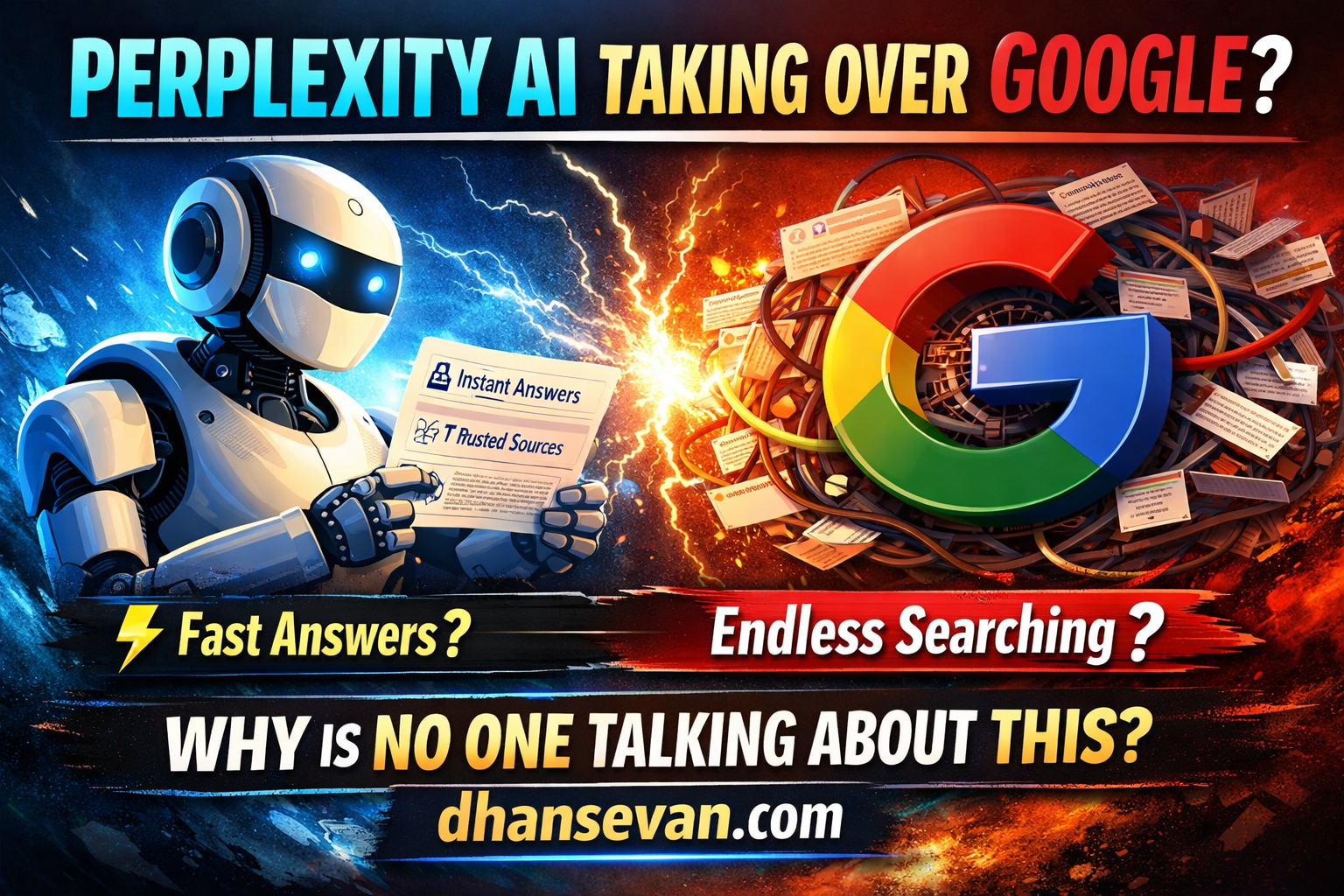
Perplexity AI is gaining serious attention, but many users still don’t understand why. Here’s a deep, honest breakdown of what makes it different from Google and why it’s growing fast.
Dhansevan Team
Gaming Expert · Dhansevan Editorial Team
The way people search for information online is undergoing its biggest transformation since Google replaced Yahoo as the dominant search engine over two decades ago. In 2026, AI-powered search tools like Perplexity AI are attracting millions of users who are frustrated with Google's increasingly ad-heavy, SEO-manipulated search results. But is Perplexity truly better than Google, or is it solving different problems? This article provides an honest comparison.
---
What Is Perplexity AI and How Is It Different?
Perplexity AI is an AI-powered answer engine that provides direct, sourced answers to questions instead of a list of links. When you ask a question on Perplexity, it searches the internet in real-time, synthesizes information from multiple sources, and presents a coherent answer with citations — all within seconds.
This is fundamentally different from Google's traditional model where you type a query, receive a list of 10 blue links, click on several of them, read through ads and SEO-optimized content, and piece together the answer yourself. Perplexity eliminates this friction by doing the reading and synthesis for you.
---
Why Users Are Switching From Google to Perplexity
1. Direct Answers vs. Link Lists The most common complaint about Google in 2026 is that finding actual answers requires clicking through multiple pages, each loaded with ads, cookie banners, and SEO-padded content. Perplexity provides the answer directly, saving significant time for research-oriented queries.
2. Fewer Ads and Commercial Bias Google's revenue model depends on advertising, which means search results increasingly prioritize paid placements and commercially-motivated content. Perplexity's ad-free experience (as of 2026) provides results based on relevance rather than advertising spend.
3. Source Transparency Every claim in a Perplexity answer includes a numbered citation linking to the original source. This allows users to verify information quickly and dive deeper when needed. Google's AI Overview feature offers similar functionality but is less consistent in sourcing.
4. Better for Complex Research Queries For multi-step questions like "What are the pros and cons of investing in index funds versus direct stocks for a 25-year-old Indian with Rs 10,000 per month to invest?" — Perplexity provides a comprehensive, structured answer. Google would require visiting 3-5 different websites and mentally combining the information.
---
Where Google Still Wins
1. Local Search and Maps Google Maps integration makes local searches (restaurants near me, directions, store hours) far superior to any AI search tool. Perplexity cannot compete with Google's local business data.
2. Image and Video Search Google Images and YouTube integration provide visual search capabilities that Perplexity currently lacks. For queries where visual content matters, Google remains dominant.
3. Real-Time Information For breaking news, live sports scores, stock prices, and weather, Google's instant information cards are faster and more reliable than AI-generated responses.
4. Shopping and Product Comparison Google Shopping, with its price comparison, reviews, and merchant listings, is more practical for purchase decisions than AI-generated product recommendations.
5. Ecosystem Integration For users deeply embedded in Google's ecosystem (Gmail, Calendar, Drive, Photos), Google Search provides contextual results that no competitor can match.
---
Head-to-Head Comparison
| Feature | Google | Perplexity AI | |---------|--------|---------------| | Answer Style | Links to websites | Direct synthesized answers | | Ads | Heavy ad presence | Ad-free (currently) | | Source Citations | Limited | Every claim cited | | Local Search | Excellent | Limited | | Image/Video Search | Excellent | Basic | | Research Queries | Requires multiple clicks | Single comprehensive answer | | Real-Time Data | Excellent | Good but not instant | | Privacy | Extensive tracking | Less tracking | | Cost | Free | Free tier + Pro ($20/month) | | Mobile App | Dominant | Growing |
---
The Bigger Picture: How Search Is Evolving
The shift from link-based search to AI-powered answer engines represents a fundamental change in how people access information. This has implications for content creators, businesses, students, and anyone who relies on the internet for information.
For students and researchers, AI search tools dramatically reduce research time by synthesizing information from multiple sources. For businesses, this means traditional SEO strategies may become less effective as AI intermediaries replace direct website visits. For content creators, the value shifts toward creating genuinely unique, expert content that AI tools cite as sources rather than shallow SEO-optimized articles.
---
Which Should You Use in 2026?
The practical answer is both, depending on your need:
- **Use Perplexity** for research questions, learning new topics, comparing options, and getting comprehensive explanations
- **Use Google** for local search, navigation, shopping, real-time information, image/video search, and ecosystem-integrated tasks
- **Use both** for important decisions — cross-reference AI answers with primary sources
---
Conclusion
Perplexity AI and Google are not direct replacements for each other — they excel at different types of queries. The smartest approach in 2026 is to use both tools strategically based on your specific information need. What is clear is that the search landscape is evolving rapidly, and users who adopt AI-powered search tools early gain a significant productivity advantage in both professional and personal contexts.
How This AI Development Actually Affects Indian Users
The conversation around Google Employees Are Terrified of Google Employees Are Terrified of This New AI Tool (And Its Completely Free) matters particularly for Indian users because AI adoption in India is following a unique trajectory compared to Western markets. With over 750 million smartphone users and rapidly improving internet infrastructure, India represents one of the largest potential markets for AI-powered tools and services. Platforms like Dhansevan are already exploring how AI can improve content curation and game recommendations for Indian audiences.
However, the practical reality of AI usage in India involves several factors that global coverage often overlooks. Language diversity is a major consideration — while most AI tools perform best in English, a significant portion of Indian users prefer Hindi, Tamil, Telugu, Bengali, or other regional languages. The quality of AI outputs in these languages is improving but still lags behind English significantly, which affects how useful these tools are for the average Indian user.
Data privacy is another critical concern. Many AI tools require users to input personal or professional information to generate useful outputs. Indian users should be especially cautious about sharing financial details, Aadhaar numbers, business strategies, or personal photographs with AI platforms. Understanding each tool's data retention and privacy policies is essential before regular use. Trusted Indian platforms like Dhansevan maintain transparent privacy policies that clearly explain how user data is handled.
Practical Evaluation Framework
Before adopting any AI tool or acting on AI-related trends, Indian users should evaluate five key dimensions. First, accuracy: does the AI output match information from reliable Indian sources like government websites, established news outlets, and verified databases? AI tools frequently generate plausible-sounding but incorrect information, especially about Indian-specific topics like tax regulations, legal requirements, and regional policies.
Second, cost-effectiveness: many AI tools offer free tiers with limited functionality and paid plans ranging from ₹500 to ₹5000 per month. For students and early-career professionals, the free tiers of ChatGPT, Gemini, and Claude often provide sufficient functionality. Upgrading to paid plans makes sense only when the tool demonstrably saves significant time or improves output quality for professional work.
Third, integration with existing workflows: the most valuable AI tools are those that fit naturally into your existing work processes rather than requiring you to learn entirely new systems. For Indian professionals, tools that integrate with popular platforms like Google Workspace, Microsoft Office, WhatsApp Business, and common Indian accounting software provide the most practical value. Even gaming platforms like Dhan7 game are beginning to use AI to personalize user experiences and improve matchmaking quality.
Fourth, reliability and uptime: AI services occasionally experience outages or performance degradation, which can disrupt workflows if you become too dependent on them. Always maintain the ability to complete critical tasks without AI assistance, especially for time-sensitive work like filing tax returns, meeting business deadlines, or completing academic submissions. For more AI-related guides and practical reviews, visit the Dhansevan blog where the editorial team regularly evaluates the latest tools and trends relevant to Indian users.
About the Author
Dhansevan Team
The Dhansevan editorial team consists of passionate gamers and tech enthusiasts who test and review every game before publishing. Our writers bring first-hand gaming experience and follow strict editorial standards to ensure accurate, helpful content for our readers.
Disclaimer: This article is for informational purposes only. Game features, availability, and earning potential may vary. Always download games from official sources and read their terms of service. Dhansevan does not guarantee any specific results from using the apps mentioned above.