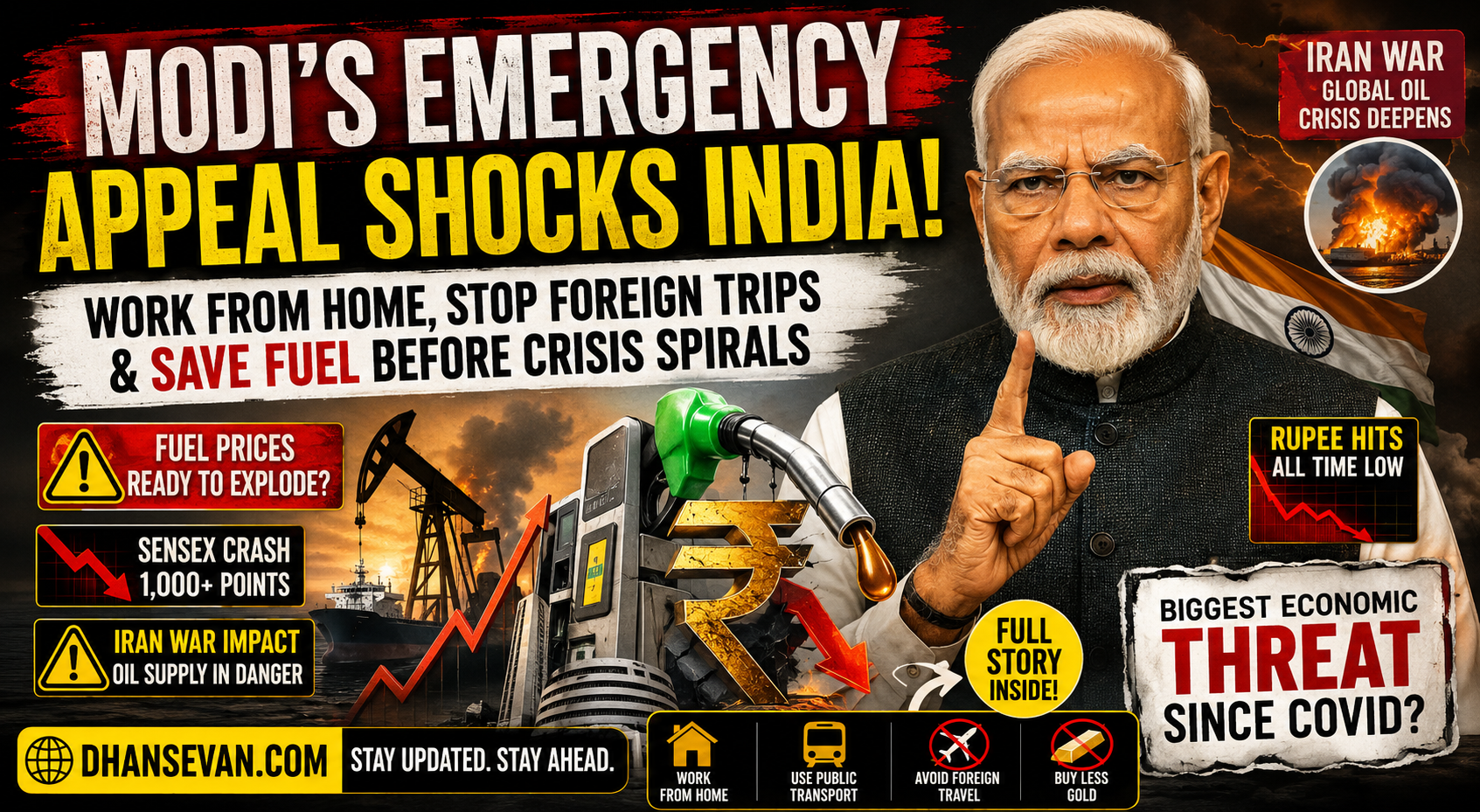
Modi’s Emergency Appeal Shocks India: Work From Home, Stop Foreign Trips & Save Fuel Before Crisis Spirals
India is staring at a massive economic storm after PM Narendra Modi urged citizens to work from home, reduce fuel use, avoid unnecessary foreign travel, and even buy less gold as the Iran war disrupts global oil supplies. With crude prices exploding, the rupee crashing, industries under pressure, and fears of inflation rising rapidly, many experts believe this could become India’s biggest economic stress test since Covid.
Uday Jasani
Gaming Expert · Dhansevan Editorial Team
India Suddenly Faces A Crisis Nobody Expected To Return
For millions of Indians, the phrase “work from home” instantly brings back memories of the harrowing Covid-19 lockdown era, a period defined by isolation, economic standstill, and profound uncertainty. But this time, the reason for the resurgence of this phrase is completely different — and possibly even more worrying for the long-term health of the global and domestic economy.
Prime Minister Narendra Modi has made an urgent and unprecedented national appeal asking Indians to fundamentally alter their daily habits. He urged citizens to reduce fuel consumption, avoid unnecessary foreign travel, use public transport more often, and even reconsider buying gold during this volatile period of global uncertainty. The appeal came as the ongoing Iran conflict continues to severely disrupt global oil supply chains and shake economies across Asia, sending shockwaves through energy markets.
What shocked many economic experts, geopolitical analysts, and ordinary citizens was not just the advice itself, but the undeniable tone of urgency and gravity behind it. Analysts across financial markets described it as one of the strongest, most direct public economic warnings issued by the Indian government in recent years. It signals that the government views the current international crisis not as a passing storm, but as a systemic shock that requires immediate, collective national action to mitigate.
Why Is India Suddenly Asking Citizens To Cut Fuel Usage?
To understand the sudden panic, one must look thousands of kilometres away from India’s shores — directly at the Strait of Hormuz.
This incredibly narrow water route, located between the Persian Gulf and the Gulf of Oman, is arguably the world’s most critical oil shipping channel. A staggering portion of global crude oil — nearly a fifth of total global consumption — passes through this chokepoint every single day. Since military tensions and direct conflict involving Iran escalated, the region has witnessed major disruptions, vessel seizures, and maritime threats, creating widespread panic in energy markets worldwide.
India is particularly, almost uniquely, vulnerable to these disruptions because the country imports nearly 85% to 90% of its massive crude oil requirements from foreign nations, with a significant chunk originating from the Middle East. That means every sudden increase in global oil prices directly and immediately impacts India’s economy, driving up transportation costs, fueling inflation, and draining household expenses.
As crude prices surged globally, India’s import bill reportedly increased by billions of dollars within mere weeks. Economists now fear that if the disruption in the Strait of Hormuz continues for a prolonged period, it could trigger a catastrophic chain reaction across multiple sectors of the Indian economy, leading to a severe balance of payments issue and depleting precious foreign exchange reserves.
Modi’s Message Sounded More Like A National Warning
During a widely televised public event in Hyderabad, Prime Minister Modi urged citizens to adopt what many commentators are now calling “economic patriotism.” He emphatically stated that patriotism today is not only about protecting national borders with military might, but also about making responsible, conscientious daily decisions that help shield the nation's economy during incredibly difficult times.
His specific suggestions to the public included:
- **Reviving work-from-home wherever possible:** To drastically reduce daily commuting and lower the national consumption of petrol and diesel.
- **Using metro trains and public transport:** Encouraging a shift away from private vehicles to more energy-efficient mass transit systems.
- **Carpooling to reduce fuel consumption:** A practical step for those who must use private transport.
- **Limiting unnecessary international travel:** To conserve foreign exchange reserves, as international travel involves spending in US dollars.
- **Reducing gold purchases to save foreign exchange:** India is one of the world's largest importers of gold. Cutting back on gold imports directly saves billions of dollars, helping to stabilize the depreciating Indian Rupee.
- **Farmers cutting fertilizer usage significantly:** Promoting natural farming methods to reduce reliance on imported chemical fertilizers, whose prices are linked to global natural gas and oil markets.
While these measures may sound simple or even rudimentary on paper, they signal something much deeper — the government is actively preparing the public for a prolonged, painful period of economic pressure. It is a preemptive attempt to manage demand because the supply side is completely outside of India's control.
Indian Markets Reacted Immediately With Severe Volatility
The financial markets did not ignore the glaring warning signs.
Within hours of the Prime Minister's comments gaining national attention and saturating news channels, the Sensex and Nifty reportedly dropped massively during early trading, wiping out lakhs of crores in investor wealth. Investors are increasingly fearful that prolonged fuel disruptions could severely slow India’s economic growth trajectory, weaken industrial production output, and push retail inflation to uncomfortable, policy-altering highs.
The Indian rupee has also been under serious, relentless pressure in recent weeks, touching historic, alarming lows against the US dollar. A weaker rupee is a double-edged sword in an energy crisis; it means that even if global crude prices stabilize, the cost of importing that oil into India becomes more expensive in rupee terms. This imported inflation further increases the financial pressure on businesses attempting to maintain profit margins and consumers trying to manage their household budgets.
Economists say this situation is especially dangerous because fuel prices act as a universal input cost. They affect almost everything in the modern economy — from the transportation of raw materials to food logistics, basic manufacturing, electricity generation, and even airline ticket prices. When energy costs spike, everything else follows.
Factories, Farmers & Common Families Are Already Feeling The Squeeze
The biggest fear right now is not only the immediate pain of expensive petrol or diesel at the pump. The real, systemic concern is the larger, unavoidable economic ripple effect.
Several manufacturing industries that depend heavily on fuel, power, and energy-intensive processes are already showing visible signs of distress. Businesses involved in glass manufacturing, plastic products, ceramics, heavy machinery, and tiles are reportedly struggling with rapidly rising production costs. Profit margins are shrinking, and the fear of widespread industrial slowdown is palpable.
If geopolitical conditions worsen and oil remains exorbitantly priced, experts warn that hundreds of thousands of jobs, particularly in the unorganized manufacturing sector and logistics, could come under severe risk.
The agricultural sector, the backbone of rural India, is also becoming highly vulnerable. The impending threat of fertilizer shortages (due to disrupted supply chains and high natural gas prices) and increasing transportation expenses for moving produce from farms to markets could directly affect agricultural output and profitability in the coming months. Lower agricultural production, combined with high transport costs, will inevitably lead to higher food prices across urban and rural India alike.
For ordinary, hardworking Indian families, this macroeconomic crisis translates into painful microeconomic realities:
- Significantly more expensive daily groceries and vegetables.
- Higher daily commuting and public transportation costs.
- Increased electricity bills as power generation costs rise.
- Costlier air travel, making family visits or business trips prohibitive.
- Rising prices for almost all daily essentials and FMCG products.
- Higher interest rates on home and auto loans as the RBI attempts to fight inflation.
Many citizens on social media platforms compared the creeping anxiety of the situation to the early, uncertain stages of the Covid-era economic slowdown, noting that while the causes are entirely geopolitical this time, the financial pain feels remarkably similar.
Opposition Leaders Attack The Government's Preparedness
Predictably, the political opposition reacted aggressively after Modi’s remarks began dominating national headlines and public discourse.
Senior opposition leaders, including Congress's Rahul Gandhi, accused the central government of deflecting blame and shifting the burden of macroeconomic management onto ordinary citizens instead of accepting systemic policy failures. According to various opposition voices, the government should have prepared much stronger energy backup plans, diversified its oil import basket earlier, and built larger strategic petroleum reserves to cushion the country from such predictable geopolitical shocks.
Several opposition politicians argued passionately that average citizens are already struggling immensely with existing inflation, stagnant wages, and rising living costs. They contend that demanding additional financial sacrifices from middle-class and lower-income families is both unfair and economically counterproductive, as it will kill consumer demand.
However, government spokespersons and supporters vehemently defended the Prime Minister's appeal, arguing that extraordinary global circumstances — specifically a war involving a major oil producer — require collective, unified cooperation from all citizens. They maintain that energy conservation is a national duty in times of global crisis.
This Is Not Just India’s Problem: A Global Contagion
While India’s vulnerability is high, the profound impact of the Iran conflict and the Strait of Hormuz blockade is being felt deeply across multiple countries, especially in the energy-hungry Asian continent.
China, despite its massive strategic reserves, has reportedly reduced certain fuel exports to ensure domestic security, while several major airlines across the region are drastically cutting flight frequencies due to soaring, unsustainable aviation turbine fuel (ATF) costs. Some regions in Australia have proactively introduced free or heavily discounted public transport to aggressively discourage private vehicle use and reduce national fuel consumption.
The Philippines declared sweeping emergency economic measures earlier this year, including direct transport subsidies for vulnerable workers and shorter, four-day work weeks for some government employees to save energy.
Sri Lanka, still recovering from its recent historic economic collapse, also introduced preemptive fuel rationing and reduced operational days for non-essential institutions in a desperate bid to conserve limited foreign exchange and energy resources.
Global energy agencies, including the IEA, now starkly warn that the current supply disruption could quickly devolve into one of the largest, most damaging oil-related crises in modern history if military tensions in the Middle East continue escalating without diplomatic intervention.
Could Fuel Prices Rise Even Higher In India Soon?
One major, anxiety-inducing question is now dominating public discussion in homes and workplaces across the nation: will petrol and diesel prices rise sharply again?
So far, the Indian government has attempted to shield consumers from the full brunt of the global spike, avoiding massive, sudden fuel price hikes despite mounting financial pressure on state-owned oil marketing companies (OMCs). But industry experts unanimously believe that if global crude oil remains expensive for a longer, sustained period, severe price revisions at the retail level will become mathematically unavoidable to prevent the collapse of these oil companies.
Some financial analysts also believe that if the international situation deteriorates further, stricter, legally binding fuel-saving directives — such as odd-even rationing for private vehicles or restrictions on fuel sales hours — could be announced in the coming weeks.
That grim possibility has already triggered widespread concern and panic-buying among small businesses, logistics operators, gig economy delivery workers, and middle-class families whose daily livelihoods depend entirely on affordable, accessible fuel.
Why This Moment Feels Bigger Than Just Fuel Prices
What makes this specific situation so unique and terrifying is how deeply interconnected the modern global crisis has become.
A localized military conflict happening thousands of miles away in the Middle East is now directly and immediately affecting:
- The daily performance of Indian stock markets and retirement funds.
- The tight monthly budgets of millions of middle-class households.
- The price of basic food staples like tomatoes, onions, and wheat.
- The operational viability of thousands of small and medium factories.
- Overall employment stability and future hiring prospects.
- The feasibility of international and domestic travel.
- Public transportation policies and urban planning.
- The underlying strength and purchasing power of the Indian Rupee.
That complex, terrifying web of interconnectedness is exactly why Prime Minister Modi’s appeal created such a massive, visceral reaction online and across all financial sectors. Many people initially thought the suggestions sounded like temporary, precautionary advice, but seasoned economists fear they reflect grim, necessary preparations for a prolonged, painful global disruption.
What Happens Next Could Shape India’s Economy For Years
At this critical juncture, everything depends entirely on how long the Middle East conflict continues, whether it expands to involve other regional powers, and whether global oil supply routes, specifically the Strait of Hormuz, can reopen fully and safely.
If diplomatic interventions succeed and military tensions ease quickly, India may be able to absorb the shock and avoid severe, long-term structural damage to its growth story. But if disruptions continue for several more months or escalate further, the country will almost certainly face much stronger inflation, significantly slower GDP growth, tight monetary conditions, and severe economic hardship for its most vulnerable populations.
For now, 1.4 billion citizens are watching carefully, adjusting their budgets, and waiting to see whether the government introduces stricter economic measures or major, unavoidable fuel price revisions in the coming weeks. The era of cheap, easily accessible energy may be taking a pause, and the adjustments required will test the resilience of the entire nation.
One thing is already painfully clear: this crisis is no longer just a distant matter of geopolitics discussed on news channels. It has forcefully entered the kitchens, the commutes, and the daily lives of ordinary Indians, and its impact will be felt for a long time to come.
About the Author
Uday Jasani
The Dhansevan editorial team consists of passionate gamers and tech enthusiasts who test and review every game before publishing. Our writers bring first-hand gaming experience and follow strict editorial standards to ensure accurate, helpful content for our readers.
Disclaimer: This article is for informational purposes only. Game features, availability, and earning potential may vary. Always download games from official sources and read their terms of service. Dhansevan does not guarantee any specific results from using the apps mentioned above.